
Fiberglass Insulation R Value: Conductivity and Thickness
Fiberglass insulation R value depends on thermal conductivity and effective installed thickness. Using a reference conductivity range of 0.035–0.042 W/(m·K), one inch (25.4 mm) of fiberglass provides approximately R-3.4 to R-4.1 in US units. A 50 mm layer provides about R-6.8 to R-8.1, while 100 mm provides approximately R-13.5 to R-16.2.
At the same conductivity and mean temperature, doubling thickness doubles the thermal resistance of a uniform insulation layer. For walls, roofs and other insulated assemblies with a specified R-value requirement, determine the necessary thickness before matching it to a suitable product form and available installation depth.
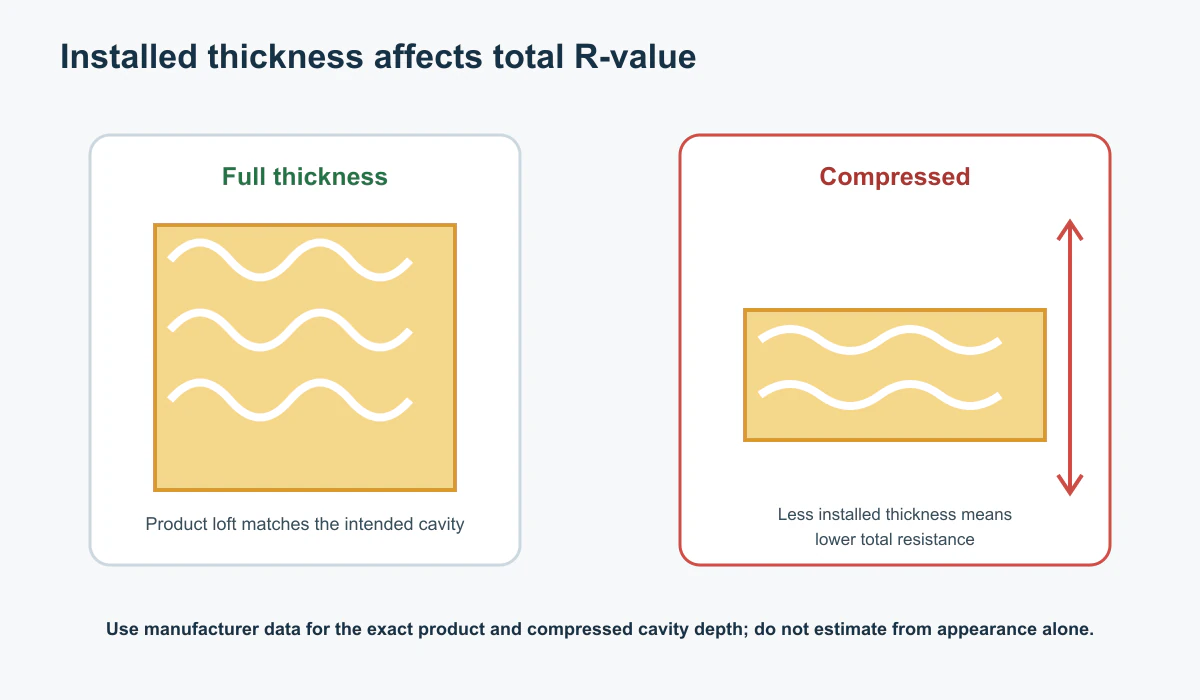
Three conditions for using these reference values:
- Use the calculationConvert thickness and thermal conductivity at the specified mean temperature into thermal resistance.
- Check the installationCompression, gaps and framing can reduce effective performance.
- Match the product formRolls, boards and pipe sections have different available sizes and installation requirements.
Fiberglass Insulation R Value by Thickness
For a uniform material layer, thickness and thermal conductivity are the direct inputs to an R-value calculation. At the same thickness, lower conductivity produces higher thermal resistance; density alone does not establish the result.
The table shows calculated fiberglass insulation R value for flat layers using a conductivity range of 0.035–0.042 W/(m·K).
| Fiberglass thickness | SI thermal resistance (m²·K/W) | US R-value |
|---|---|---|
| 25 mm (about 1 in.) | 0.60–0.71 | R-3.4 to R-4.1 |
| 50 mm (about 2 in.) | 1.19–1.43 | R-6.8 to R-8.1 |
| 100 mm (about 4 in.) | 2.38–2.86 | R-13.5 to R-16.2 |
| 150 mm (about 6 in.) | 3.57–4.29 | R-20.3 to R-24.3 |
| 200 mm (about 8 in.) | 4.76–5.71 | R-27.0 to R-32.4 |
At 100 mm, the change from 0.042 to 0.035 W/(m·K) raises the calculated R-value by approximately 20%. The mean temperature at which conductivity is specified therefore matters when comparing grades, even if their nominal thicknesses match.
For rigid formats, see Glass Wool Board. For the conductivity values used in these calculations, see Fiberglass Thermal Conductivity.
Fiberglass Insulation R Value: Thickness for R11 to R49
The following estimates convert common US R-value targets into total fiberglass thickness, again using 0.035–0.042 W/(m·K). They describe the resistance of a uniform flat material layer, not the effective R-value of a complete wall or roof assembly.
| Target R-value | Calculated total thickness |
|---|---|
| R11 fiberglass insulation | About 68–81 mm |
| R15 fiberglass insulation | About 92–111 mm |
| R21 fiberglass insulation | About 129–155 mm |
| R30 fiberglass insulation | About 185–222 mm |
| R38 fiberglass insulation | About 234–281 mm |
| R49 fiberglass insulation | About 302–362 mm |
For R11 and R15, a suitably rated roll or board may meet the target in one layer. For R21 or R30, thicker products or multiple layers may be necessary, depending on available thickness and cavity depth. The R30 fiberglass insulation estimate in the table refers to total material thickness; it does not imply that a particular single product is available in that size.
For higher targets such as R49 fiberglass insulation, check total available depth and joint layout before selecting a layered arrangement. The intended thickness must be maintained without compression, and layers should remain continuous at joints and penetrations.
For R13, R19 and R20 requirements, see R13/R19/R20 Fiberglass Insulation for roll formats and sizes. The R13 vs R19 Fiberglass Insulation comparison covers differences between those targets.
Calculating Fiberglass Insulation R Value
For a uniform, flat layer, thermal resistance is calculated as:
R = t / λ
Here, R is SI thermal resistance (m²·K/W), t is thickness in meters, and λ is thermal conductivity in W/(m·K). Multiply the SI result by approximately 5.678 to express it in US R-value units.
For example, with a 50 mm fiberglass layer and a conductivity of 0.040 W/(m·K):
SI R = 0.050 / 0.040 = 1.25 m²·K/W
US R = 1.25 × 5.678 ≈ R-7.1
The fiberglass insulation R value per inch is therefore a range rather than a universal figure: conductivity must be specified for the product and temperature condition being evaluated.
Why Mean Temperature Matters
Fiberglass conductivity varies with temperature. An illustrative fiberglass thermal reference dataset gives approximately 0.033 W/(m·K) at a mean temperature of 24°C, 0.040 W/(m·K) at 93°C, and 0.049 W/(m·K) at 149°C.
At the same 50 mm thickness, those conductivities yield approximately R-8.6, R-7.1 and R-5.8, respectively, in US units. This shows why fiberglass insulation R value can fall as the relevant conductivity increases, even though the physical thickness is unchanged.
Building envelopes, HVAC systems and industrial equipment operate at different temperatures. Use conductivity data appropriate to the application rather than applying one nominal R-value to every condition.
Pipe insulation introduces another distinction: cylindrical geometry changes heat-transfer calculations. The flat-layer values on this page are useful reference comparisons, but they do not replace a pipe-specific heat-loss calculation.
Product Forms for Fiberglass Insulation R Value Targets
The product form must suit the installation, available space, facing requirements and offered thickness range. The calculated fiberglass insulation R value is a starting point for choosing the appropriate material configuration.
Glass Wool Roll
Insulvora's standard glass wool rolls are available in 25–100 mm thicknesses for roofs, building envelopes and other large-area applications. Its R13/R19/R20 insulation series includes roll options within a 25–200 mm thickness range for different resistance requirements and installation depths.
Glass Wool Board
Glass wool boards are offered in 20–130 mm thicknesses. Their panel form suits walls, partitions, roofs and locations where a stable board is preferred. If one board does not provide the required resistance, the available space and combined layer thickness need to be assessed.
Glass Wool Pipe Insulation
Preformed glass wool pipe sections are available with 25–100 mm insulation thicknesses and 22–720 mm inside diameters. Selection must match the pipe outside diameter and operating temperature as well as the specified insulation thickness.
View Glass Wool Pipe Insulation
For more on layer arrangements and available thicknesses, see Fiberglass Insulation Thickness.
Why Installed R-Value Can Differ from Calculated R-Value
A calculated fiberglass insulation R value describes a material layer under stated conditions. It does not necessarily equal the effective thermal resistance of a complete wall or roof assembly.
Compression and inadequate depth. Compressing flexible fiberglass below its intended thickness can reduce its total thermal resistance. Check actual cavity depth rather than forcing a thicker product into a smaller space.
Gaps and joints. Open joints between boards or roll ends, corners and service penetrations can increase local heat transfer. Where several layers are used, staggered joints help avoid continuous gaps.
Thermal bridges. Metal framing, studs and other conductive components can transfer heat around the insulation. The complete assembly may therefore have a lower effective R-value than the insulation layer alone.
Facings and assembly design. Foil facings, vapor-control layers and protective coverings can serve important moisture-management or installation functions. These functions should be evaluated separately from the thermal resistance of the fiberglass itself.
Choose Fiberglass Insulation for Your R-Value Requirement
Insulvora supplies glass wool rolls, boards, faced products and preformed pipe insulation. To discuss a fiberglass insulation R value target, share your required R-value, application, available installation depth and any facing needs. Insulvora can then review suitable product forms, thickness configurations and pricing.