
Fiberglass Insulation Thickness: Choosing the Right Build-Up
Fiberglass insulation thickness should be selected from the thermal performance required, the conductivity of the chosen material, available installation depth and operating conditions. For walls, roofs and ceilings, the starting point is usually a specified R-value or U-value. For pipework, diameter, operating temperature, heat loss and allowable surface temperature also affect the decision.
Insulvora supplies fiberglass rolls and preformed pipe sections in 25–100 mm thicknesses, standard boards in 20–130 mm, high-density boards in 20–100 mm, and selected R-rated products in 25–200 mm. These are ranges for different product forms, not an interchangeable thickness schedule.
Selection at a glance
- Set the performance target:Identify the required R-value, heat-loss limit or project specification.
- Choose the build-up:Match the required thickness to an available product or suitable layer arrangement.
- Preserve installed depth:Check for compression, gaps and joints that interrupt the insulation.
Start with the Required R-Value
For a flat insulation layer, fiberglass insulation thickness can be estimated from its thermal resistance:
R is metric thermal resistance (m²·K/W), d is thickness in metres, and λ is thermal conductivity (W/(m·K)) at the relevant design condition. The following reference assumes λ = 0.040 W/(m·K); it is not a performance rating for every fiberglass product.
| Insulation thickness | Metric R-value (m²·K/W) | Approx. US R-value |
|---|---|---|
| 25 mm (about 1 in.) | 0.625 | R-3.55 |
| 50 mm (about 2 in.) | 1.250 | R-7.10 |
| 75 mm (about 3 in.) | 1.875 | R-10.65 |
| 100 mm (about 4 in.) | 2.500 | R-14.20 |
At this assumed conductivity, US R-13 corresponds to approximately 92 mm, and R-19 to approximately 134 mm. These figures are flat-layer calculation examples, not fixed thicknesses for products carrying R-13 or R-19 labels. A product's rated performance depends on its own thermal data, test conditions and installed depth; R-20 likewise does not identify one universal thickness.
Use the calculation to establish a starting thickness, then verify the selected product against the thermal target and available assembly depth. For more on thermal resistance and conductivity, see Fiberglass Insulation R-Value.
Available Thickness by Product Form
The available fiberglass insulation thickness depends on whether a project needs a flexible roll, a board or a preformed pipe section.
| Insulvora product | Available thickness | Typical application |
|---|---|---|
| Glass Wool Roll | 25–100 mm | Large roof and ceiling areas and suitable building assemblies |
| Glass Wool Board | 20–130 mm | Walls, partitions, roofs and structures requiring board insulation |
| High Density Glass Wool Board | 20–100 mm | Installations needing a firmer board and stable panel form |
| Glass Wool Pipe Insulation | 25–100 mm | Hot-water, heating and suitable industrial pipework |
| R13/R19/R20 Fiberglass Insulation | 25–200 mm | Building assemblies with specified R-value requirements |
These ranges do not imply identical densities, thermal conductivities or installation methods. A higher-density board does not automatically achieve the same resistance at a smaller thickness: conductivity at the relevant condition must be checked. To define a supply specification, also identify the required dimensions, density, and faced or unfaced configuration.
When Should You Use One Layer or Several?
A single layer is generally the simpler arrangement when an available product meets the thermal target within the construction depth. If the necessary fiberglass insulation thickness exceeds the selected product's single-layer range, consider another available product or a multilayer build-up.
For example, where a design requires 150 mm but the chosen roll is available only up to 100 mm, a second suitable layer or a different product form may be needed. The full design thickness still needs adequate space; compressing material is not a substitute for a workable layer arrangement.
For multiple layers, stagger joints, maintain the intended depth and coordinate fixings. Studs, purlins and other structural members can create thermal bridges, so an insulation-only R-value does not describe the heat flow through an entire wall or roof assembly. See Glass Wool Ceiling Insulation for a related application.
How Thickness Selection Changes by Application
Walls and partitions. Fiberglass insulation thickness is constrained by stud depth, the specified thermal resistance and the lining arrangement. If the cavity cannot accommodate the depth needed for the target performance, the insulation layout or wall assembly may need to change.
Roofs and ceilings. Rolls are useful for covering large surfaces, but the insulation design must also account for purlins, hangers, penetrations and vapour-control requirements. The product thickness must work within the roof assembly rather than being assessed in isolation.
Hot-water and industrial pipes. Fiberglass insulation thickness for pipework depends on outside diameter, service temperature, permissible heat loss and surface-temperature limits. Because heat travels through a cylindrical layer, the flat-layer R-value table above cannot replace a pipe heat-loss calculation. Conductivity also changes with temperature: for one fiberglass pipe-insulation reference grade, it is approximately 0.033 W/(m·K) at 24°C mean temperature, 0.040 at 93°C and 0.049 at 149°C. Designs also require appropriate cladding, joints and support details.
Acoustic assemblies. In partitions, ceilings and equipment enclosures, fiberglass insulation thickness is only one factor in acoustic performance. Airflow resistivity, cavity depth, facing and the complete assembly affect sound absorption and transmission. Greater depth may improve absorption over some frequency ranges, but it is not an acoustic rating by itself.
Nominal Thickness vs Installed Thickness
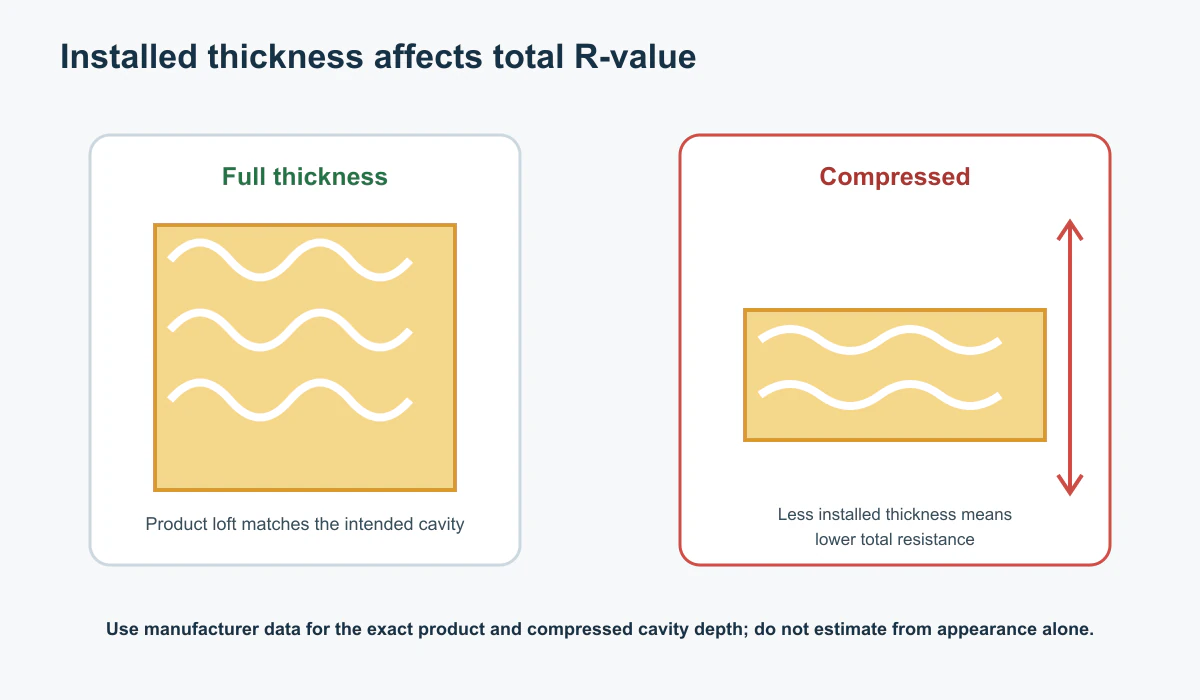
Nominal fiberglass insulation thickness is not necessarily the thickness achieved on site. If a nominal 100 mm roll or batt is compressed to 75 mm, its original full-thickness R-value should not be assumed to remain unchanged. Compression can alter conductivity as well as depth, and total thermal resistance generally decreases.
Gaps can also compromise the result. Unfilled edges, misaligned joints and openings around framing or pipe supports interrupt continuity, even where adjacent insulation retains its specified thickness.
For walls and roofs, check the insulation at framing penetrations and layer joints. For pipe sections, check longitudinal seams, circumferential joints and supports. Where vapour control or moisture protection is required, the facing and joint sealing must be suitable for the application; insulation thickness alone does not form a vapour barrier.
Request Fiberglass Insulation Specifications and Pricing
Insulvora supplies rolls, boards and preformed pipe sections in the thickness ranges shown above. Share the target R-value or pipe operating conditions, required dimensions, available installation depth and preferred product form. We can review the relevant fiberglass insulation thickness, density and faced or unfaced configuration against available specifications and discuss a quotation.