
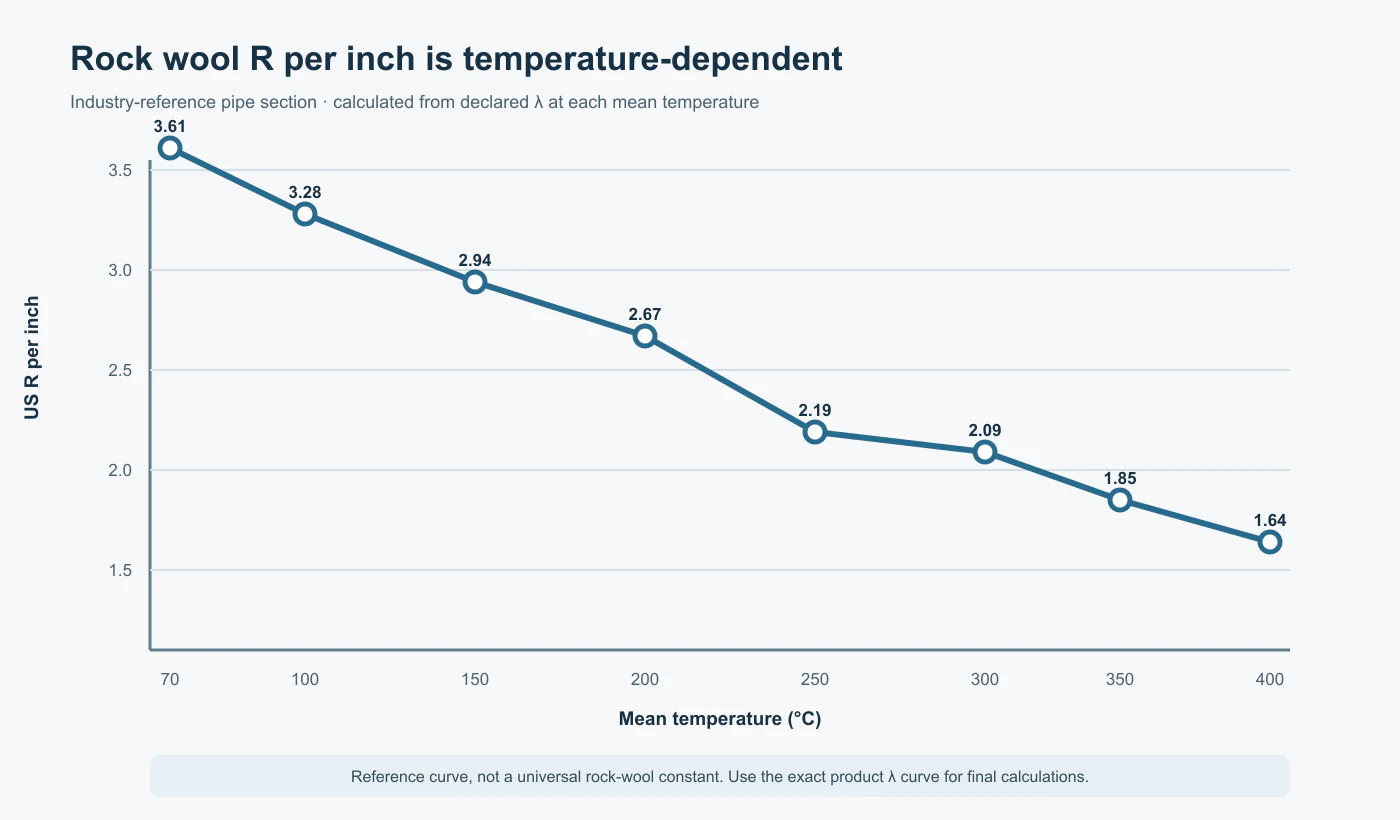
Rock Wool R Value per Inch Reference Chart
The chart shows rock wool R value per inch calculated from conductivity for a flat layer 25.4 mm thick. These are reference conversions, not one specification for every grade.
| Thermal conductivity, λ (W/m·K) | US R-value per inch |
|---|---|
| 0.035 | R-4.1 |
| 0.038 | R-3.8 |
| 0.040 | R-3.6 |
| 0.042 | R-3.4 |
| 0.045 | R-3.2 |
US R-value per inch ≈ 0.1442 ÷ λ
Here, λ is conductivity in W/(m·K) at the stated mean temperature. The formula gives US area-based resistance for a flat, 25.4 mm layer. It also applies to mineral wool R value per inch comparisons when grade-specific conductivity and conditions are used. Rock wool is one type of mineral wool, and its grades do not share one fixed R-value.
For λ = 0.040 W/(m·K), the approximate material resistance at different thicknesses is:
- 25.4 mm: R-3.6
- 50 mm: R-7.1
- 100 mm: R-14.2
With constant conductivity, doubling thickness approximately doubles the flat layer's resistance; the rock wool R value per inch stays the same. Equal-thickness grades may differ because their conductivity differs.
Estimating Thickness from a Target R-Value
The rock wool R value per inch can be used for preliminary thickness sizing. At λ = 0.040 W/(m·K), US R-10 needs approximately 70 mm and US R-15 approximately 106 mm, assuming constant conductivity in a flat layer.
Compare the calculated thickness against available product sizes. If thickness is fixed, use the grade's conductivity to calculate its resistance. For hot-service insulation with significant temperature gradients, use temperature-dependent conductivity and an appropriate heat-transfer calculation. Any mineral wool R value per inch used for sizing must reflect the relevant temperature. See the rock wool thickness guide.
How Mean Temperature Affects Rock Wool R Value per Inch
Rock wool conductivity generally increases with mean insulation temperature, so the same thickness provides less resistance. A rock wool R value per inch quoted near room temperature may not apply to hot pipes, tanks, or process equipment.
The reference example below is for an industrial rock wool pipe section of approximately 120 kg/m³ density. US R-values are calculated from the listed conductivity data.
| Mean temperature | Conductivity (W/m·K) | Calculated US R-value per inch |
|---|---|---|
| 70°C | 0.040 | R-3.61 |
| 100°C | 0.044 | R-3.28 |
| 150°C | 0.049 | R-2.94 |
| 200°C | 0.054 | R-2.67 |
| 250°C | 0.066 | R-2.19 |
| 300°C | 0.069 | R-2.09 |
| 350°C | 0.078 | R-1.85 |
| 400°C | 0.088 | R-1.64 |
These values illustrate the temperature response of one reference material grade. They are not a universal conductivity curve for all rock wool or other mineral wool products.
In this example, the rock wool R value per inch falls from R-3.61 at 70°C to R-1.64 at 400°C, with no change in thickness. Low-temperature data can therefore underestimate heat loss or required insulation thickness in hot-service design. Use the selected grade's conductivity, operating conditions, and temperature distribution. A published mineral wool R value per inch must be read alongside its mean temperature; high-temperature capability does not mean constant R-value.
Does Higher Density Mean a Higher R-Value?
Not necessarily. Density influences rigidity, compression resistance, dimensional stability, and installation, but does not determine the rock wool R value per inch alone. Fiber structure and heat transfer through solids and gas also affect conductivity. Density and R-value have no universal linear relationship.
Two 50 mm rock wool boards may have different densities without the denser one offering higher thermal resistance. Compare conductivity at the same mean temperature; this also applies to mineral wool R value per inch data for different grades.
Where roofs, walls, or equipment require greater rigidity or compression resistance, high-density rock wool board may be appropriate. Otherwise, a suitable rock wool board grade may suffice. Physical suitability depends on more than thermal resistance.
Matching R-Value Requirements to Rock Wool Products
Boards, blankets, and pipe sections meet different installation needs. A quoted mineral wool R value per inch can compare material grades, but surface geometry, fixing, and available sizes determine which form is practical.
Rock Wool Board: Walls, Roofs, and Flat Surfaces
Rock wool board provides a stable, flat insulation layer for walls, roofs, and certain industrial equipment surfaces. Insulvora's range includes 60–200 kg/m³ densities, 30–150 mm thicknesses, and a standard board size of 1200 × 600 mm.
For specified conductivity of 0.038–0.042 W/(m·K), the rock wool R value per inch is approximately R-3.4 to R-3.8 at corresponding reference conditions. Select board grade by thermal performance and required stiffness or load resistance, rather than density alone. A mineral wool R value per inch figure does not replace checking physical specifications.
Rock Wool Blanket: Curved and Large Surfaces
Rock wool blanket is suitable for ducts, tanks, large equipment, and other surfaces where flexible wrapping is useful. Insulvora offers blanket thicknesses of 25–200 mm across different density grades. For larger-diameter piping or equipment that requires additional support, wire mesh rock wool blanket can help secure the insulation.
Joint continuity, fixing, and protective cladding matter alongside the mineral wool R value per inch used in material comparisons. Material resistance alone does not describe the finished installation.
Rock Wool Pipe Sections: Industrial Piping
Rock wool pipe section provides a preformed cylindrical shape for straight pipe runs. Insulvora's range includes 22–910 mm internal diameters, 20–150 mm insulation thicknesses, and 1 m standard lengths.
Select by actual pipe outside diameter, service temperature, and required thickness. The rock wool R value per inch helps compare grades, but pipe heat loss also depends on pipe and insulation diameters. Flat-layer R-value is not a cylindrical system's linear thermal resistance; pipe-system calculations require a cylindrical heat-transfer method.