
Acoustic Panels vs Foam: Soundproofing Effectiveness, Noise Reduction and Material Selection
For offices, meeting rooms, and recording spaces with unwanted echo, polyester fiber acoustic panels are a practical option when the treatment must also provide a neat wall or ceiling finish. Acoustic foam may be more suitable for selected flexible coverage, irregular surfaces, or specified composite constructions.
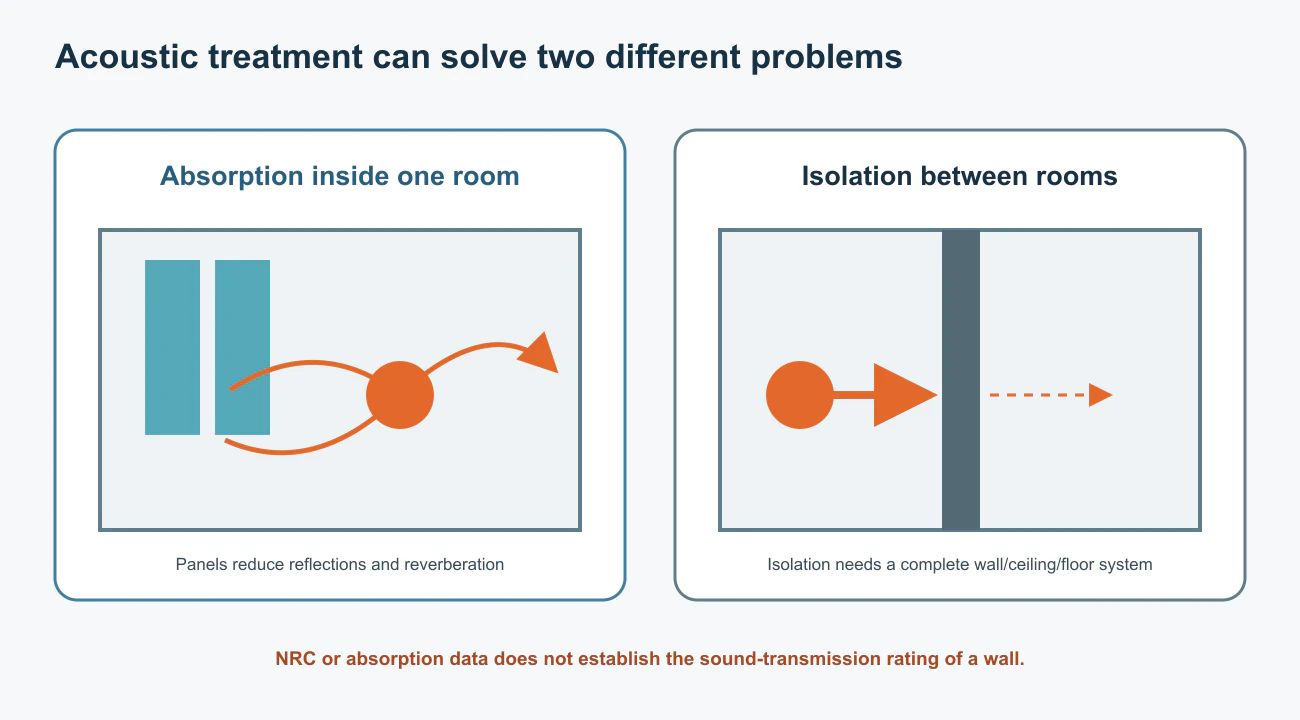
When comparing acoustic panels vs foam, first distinguish sound absorption inside a room from sound isolation between spaces. Construction, thickness, frequency, and mounting affect the result; neither surface treatment alone replaces a properly designed sound-isolation assembly.
Key selection conditions
- AbsorptionThickness, treated area, and placement influence reverberation and frequency response.
- IsolationLimiting sound transmission requires attention to mass, airtightness, and structural separation.
- Room requirementsOffices, studios, and equipment spaces may call for different finishes and acoustic assemblies.
What Is the Difference Between Polyester Acoustic Panels and Acoustic Foam?
Polyester fiber acoustic panels use a fibrous, semi-rigid construction that can absorb room sound while serving as a visible finish on walls and ceilings.
Acoustic foam covers several constructions. Conventional open-cell foam dissipates sound within interconnected pores. Rubber-based acoustic materials vary in cell structure, surface profile, and composite layers; flexibility does not, by itself, establish their absorption performance.
| Comparison | Polyester fiber acoustic panels | Acoustic foam and rubber-based acoustic materials |
|---|---|---|
| Construction | Fibrous, semi-rigid panels | Flexible foam sheets; single-layer and composite options |
| Main role | Reducing room reflections, echo, and reverberation | Room absorption or localized acoustic treatment, depending on construction |
| Format | Flat, modular panels | Flat or profiled flexible sheets |
| Insulvora thicknesses | 15 mm | 10, 20, 30, and 50 mm |
| Appearance | Regular layouts and decorative wall finishes | Functional coverage and installations needing a flexible material |
| Mounting | Wall, ceiling, or planned panel arrangements | Self-adhesive or non-adhesive versions, as appropriate |
| Typical direction | Offices, conference rooms, and commercial interiors | Selected studio areas, local wall or door treatment, and composite assemblies |
Neither type can be declared the better absorber at every frequency without comparable performance data. The appropriate choice depends on the acoustic problem and how the material will be installed.
Does Soundproof Foam Work?
Does soundproof foam work for echo? Suitable absorptive foam can reduce reflections and reverberation within a room. It does not automatically block speech or noise traveling through a wall, ceiling, or door.
A sound-isolating partition works as a system. Its performance depends on surface mass, structural connections, cavity treatment, airtightness, and flanking transmission paths—not simply on adding foam to an exposed surface. Thin surface treatments cannot replace a properly designed wall assembly when room-to-room privacy is the objective.
Fiberglass or rock wool may be used as cavity infill in a partition, while polyester fiber panels are generally used on the room side to control reflections. For structural approaches, see Acoustic Wall Insulation and Acoustic Insulation.
Acoustic Panels vs Foam: Absorption Effectiveness and Frequency
The absorption effectiveness of acoustic panels vs foam changes across frequency bands. A material may control one range effectively while doing much less in another. Compare frequency-specific results rather than assuming that one product is superior at every pitch.
| Frequency range | Acoustic consideration |
|---|---|
| Low: 125–250 Hz | Thin porous treatments are less effective at long wavelengths. HVAC hum and studio bass buildup may require greater absorber depth, an air cavity, or dedicated low-frequency treatment. |
| Mid: 500–1,000 Hz | This range matters for speech clarity and reverberation. Polyester panels or suitable foam may help, depending on construction, treated area, and mounting. |
| High: 2,000–4,000 Hz | Porous absorbers can be effective against higher-frequency reflections. Treatment on selected wall and ceiling surfaces may reduce sharp reflections from hard finishes. |
Thickness, Air Gaps, and Mounting
Greater effective depth can extend porous absorption toward lower frequencies, and an air gap behind the material can improve some lower-frequency responses. However, a 15 mm polyester panel cannot be ranked against 50 mm rubber foam by thickness alone. Fiber structure, pore characteristics, facings, and the way the material is mounted all matter. Direct bonding is not equivalent to installation with a rear air space.
Understanding NRC and Frequency-Specific Results
The Noise Reduction Coefficient (NRC) summarizes absorption at 250, 500, 1,000, and 2,000 Hz using the prescribed averaging and rounding procedure. It is useful as an initial indication, but it does not show how performance varies across individual frequency bands.
For an acoustic panels vs foam comparison, use frequency-band absorption results obtained under comparable mounting conditions. NRC is not a measurement of sound transmission through partitions, so it cannot establish a product's sound-isolation performance.
Which Material Fits Your Space?
In choosing acoustic panels vs foam, start with the room's use, the frequency problem, the available surfaces, and whether the acoustic treatment will remain visible.
Offices and Conference Rooms: Prioritize Polyester Panels
Glass, hard walls, floors, and ceilings can prolong reverberation and make speech less clear. Polyester panels can treat selected reflective surfaces while providing a regular, finished appearance. Modular arrangements and available color choices are particularly relevant in visible commercial interiors.
See Office Acoustic Panels for the application and Polyester Fiber Acoustic Panel for the product format.
Recording and Media Rooms: Select for the Frequency Problem
Both polyester panels and suitably absorptive foam can be used for early reflections and mid-to-high-frequency issues. Panels provide orderly layouts, while suitable foam may offer more flexible surface profiles. Neither thin wall treatment should be assumed to control bass buildup or standing waves; deeper, dedicated low-frequency treatment may be necessary.
Local Wall and Door Treatment: Consider Rubber-Based Configurations
Rubber-based acoustic sheets may suit localized coverage, flexible installation, or specified composite assemblies. Their absorption performance must be assessed for the chosen construction, not inferred from flexibility or surface shape.
Self-adhesive sheets require compatible, even substrates. When material is applied to doors, clearance and normal movement must be preserved. See Self Adhesive Rubber Acoustic Foam for relevant formats.
Product Sizes, Installation, and Project Cost
Once the acoustic function and installation area are defined, compare actual material dimensions, required coverage, fixing methods, and total installed cost.
Polyester Fiber Acoustic Panels
Insulvora supplies 15 mm polyester panels in 400 × 400 mm and 300 × 600 mm sizes. Square panels suit regular grids, while rectangular panels allow different layouts.
For 12 m² of net coverage, the theoretical requirement is 75 pieces of 400 × 400 mm panels or 67 pieces of 300 × 600 mm panels, rounded up to whole pieces. These figures exclude cutouts and installation waste. Substrate condition, fixing, joints, and edge details also affect the finished work. See Acoustic Wall Panel Installation.
Rubber Acoustic Foam
Available configurations include 1 × 1 m sheets, 10, 20, 30, and 50 mm thicknesses, flat or profiled surfaces, self-adhesive and non-adhesive versions, and single-, double-, or triple-layer constructions. Listed colors include black, grey, off-white, yellow, blue, orange, and green.
B1 fire-performance options are available only for selected configurations. Relevant fire and acoustic ratings depend on the specified construction; thickness and surface pattern alone do not establish absorption performance.
Compare Installed Cost, Not Just Price per Piece
For acoustic panels vs foam, compare the cost of the actual treated area rather than unit price alone. Include substrate preparation, adhesives or mechanical fixings, cutting waste, surface durability, cleaning, and possible replacement.
A visible interior may place more value on modular finish and ongoing maintenance, while localized treatment may favor the flexibility of sheet installation. The suitable option depends on the project rather than on a single price or acoustic rating.
Request Acoustic Material Specifications and Pricing
Insulvora supplies polyester fiber panels and rubber-based acoustic materials in the formats described above. For an office, meeting room, studio, or localized treatment project, share the application, required coverage, preferred format and thickness, and installation conditions when requesting product specifications and pricing.