
Fiberglass Insulation Fire Rating: Standards and Product Selection
Glass wool is used in walls, roofs, ducts, and industrial insulation where thermal performance, acoustic control, and fire behavior all matter. Depending on its formulation and test results, an unfaced product may qualify for a noncombustible or low flame-spread classification. Foil-faced and other composite products need to be evaluated in their finished form, including the facing and bonding materials.
A fiberglass insulation fire rating describes performance under a specified test. It may concern reaction to fire, surface flame spread, or smoke development. A 60-minute or 120-minute rating is different: it concerns the fire resistance of a tested wall, floor, roof, or other assembly, not the glass wool on its own. A request for fiberglass insulation fire resistance must therefore identify whether the project calls for a rated construction or a material test result.
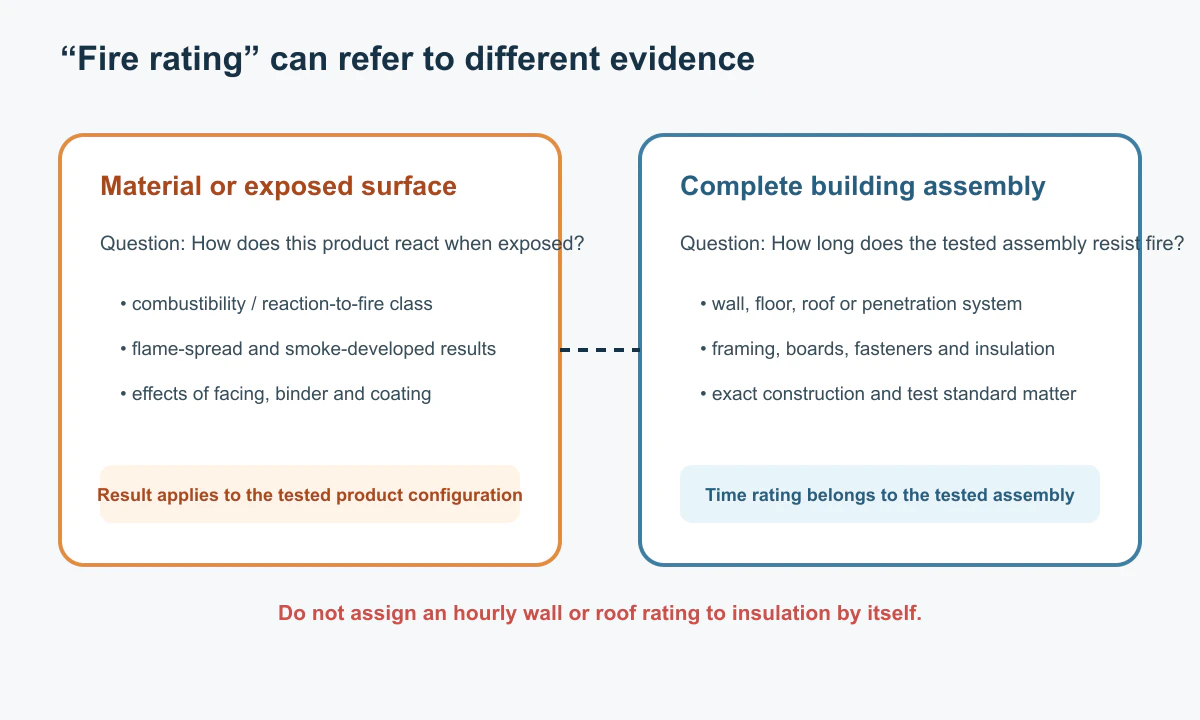
Three checks before selecting a product
- Identify the test. Match the reported class or index to its standard and tested product configuration.
- Check the facing. Unfaced and faced fiberglass may have different reported fire behavior.
- Confirm the assembly. For fiberglass insulation fire resistance, a material classification cannot establish a one- or two-hour rating for a construction.
Fiberglass Insulation Fire Rating: Common Standards and Classes
| Standard or classification | Typical rating or result | What it tells you |
|---|---|---|
| GB 8624 | Class A | Reaction-to-fire classification for building materials and products; Class A denotes the noncombustible category. |
| EN 13501-1 | A1, A2-s1,d0, and other Euroclasses | Reaction-to-fire classification; the s and d suffixes describe smoke production and flaming droplets or particles. |
| ASTM E84 | Class A: Flame Spread Index 0–25; Smoke Developed Index 450 or less | Surface-burning characteristics used in classification under applicable building codes. |
| ASTM E136 | Noncombustibility test outcome | Evaluates eligible materials in a vertical furnace at 750°C; it does not by itself rate a complete faced insulation system. |
| ASTM E119 | Fire-resistance test results, such as 60 or 120 minutes | Tests the performance of complete building assemblies under specified fire exposure. |
| EN 13501-2 | Fire-resistance classifications based on relevant test data | Classifies building elements and systems using results from applicable fire-resistance tests. |
The same letter grade can describe different properties under different standards. Under ASTM E84, a Class A fiberglass insulation fire rating concerns surface flame spread and smoke development, not proof of noncombustibility. It should not be treated as equivalent to GB 8624 Class A merely because both use the letter A.
Under EN 13501-1, A1 and A2-s1,d0 are distinct classifications. The latter includes specified performance for smoke production and flaming droplets. When reviewing a fiberglass insulation fire rating, read the complete class alongside the test standard and the construction of the product tested.
Fire Behavior of Glass Wool vs. Fire Resistance of an Assembly
Glass wool consists primarily of inorganic glass fibers, which do not act as a combustible fuel source in the way many organic foam materials do. The finished product may also contain binders and other organic components. A fiberglass insulation fire rating must therefore relate to the actual product supplied, rather than to the fibers alone.
Reaction-to-fire and surface-burning tests assess properties such as noncombustibility, flame spread, and smoke behavior under stated conditions. Fiberglass insulation fire resistance, when used to describe a rated building element, concerns how the complete assembly performs during fire exposure for a specified period. Depending on the rating system and construction, integrity, insulation, and loadbearing capacity may be relevant.
For example, a 60-minute partition rating is based on the tested wall construction, including plasterboard, framing, glass wool infill, fixings, and joint details. A Class A glass wool product does not, by itself, make a wall a 60-minute assembly. Likewise, specifying a thicker layer of insulation cannot establish a 120-minute rating without supporting assembly test evidence. This distinction is essential when a project specification refers to fiberglass insulation fire resistance rather than a material classification.
Unfaced and Foil-Faced Glass Wool: Why Ratings Can Differ
Unfaced glass wool boards and rolls consist principally of glass fibers and a binder system. For specifications prioritizing noncombustibility or low surface flame spread, the fiberglass insulation fire rating of an appropriately classified unfaced product offers a practical starting point.
Foil-faced glass wool adds a composite surface for applications that may require vapor control, surface protection, or a particular installation arrangement. Although aluminum foil itself is metallic, a finished facing can include reinforcement, adhesive, and other layers. These elements can affect the reported fire behavior. A fiberglass insulation fire rating for an unfaced product must not automatically be applied to a foil-faced version, even when the fiber density and thickness are the same.
Kraft-faced insulation may produce different results again because paper facing behaves differently from foil. Where a facing remains exposed, check the classification of the complete faced product and the conditions under which it may be installed. The fiberglass insulation fire rating should always be associated with the tested configuration.
For guidance on facing choice, vapor control, and installation, see Faced vs. Unfaced Fiberglass Insulation.
Choosing Glass Wool for Fire-Related Project Requirements
Product selection begins with the application: a wall cavity, an extensive roof or ceiling area, and external ductwork do not necessarily need the same glass wool form or facing.
Walls, Partitions, and Facade Insulation
For walls, partitions, and suitable facade applications, the required fiberglass insulation fire rating needs to be considered with board stability, thermal performance, sound absorption, and available cavity space.
Insulvora Fire Resistant Glass Wool Board is offered in densities of 48–100 kg/m³, thicknesses of 20–100 mm, lengths of 600–2400 mm, and widths of 600–1200 mm. The range includes a GB 8624 Class A reaction-to-fire classification; confirm its applicability to the selected product configuration.
Choose board thickness for the thermal requirement and cavity dimensions, not as a scale of fire-resistance time. Where a wall specification calls for fiberglass insulation fire resistance, assess the board as part of the rated construction. Dedicated curtain-wall perimeter firestopping remains a separate system requirement and cannot be replaced by ordinary insulation board.
Roofs, Ceilings, and Large Insulation Areas
Flexible glass wool rolls provide continuous coverage over large areas and may be used in suitable roof, ceiling, and acoustic insulation arrangements.
Insulvora Glass Wool Roll is available in densities of 10–72 kg/m³ and thicknesses of 25–100 mm. Match the fiberglass insulation fire rating of the specified unfaced roll to the project's reaction-to-fire requirement. If the roof requires vapor control or a facing layer, evaluate that finished construction as well. Any roof requirement for fiberglass insulation fire resistance must be supported by the relevant tested roof assembly, rather than the roll's material classification.
Ductwork and Faced Insulation Systems
External duct insulation may need thermal control, moisture management, surface protection, and limits on flame spread or smoke development.
Insulvora Foil Faced Glass Wool Roll is available with single-sided, double-sided, and reinforced foil facing options for suitable ductwork and building-insulation applications. Where flame-spread or smoke limits apply, use the fiberglass insulation fire rating of the finished faced product, not a classification reported only for its glass wool core.
If a specification also calls for fiberglass insulation fire resistance in a duct system, confirm the applicable fire-rated duct construction. Ordinary foil-faced thermal insulation alone does not create a fire-resistant duct assembly.
Thermal and service-temperature considerations. Density, thickness, thermal conductivity, product form, and facing still affect the insulation's suitability for the installation. Higher density does not automatically result in a higher fire classification. For high-temperature equipment, a fiberglass insulation fire rating must not be read as a continuous service-temperature limit: binders, facings, and adhesives may have more restrictive operating temperatures than the glass fibers themselves.
Glass Wool Products for Fire-Sensitive Applications
Insulvora supplies fire-resistant glass wool boards, rolls, and foil-faced insulation for building, roofing, and mechanical projects. To discuss the fiberglass insulation fire rating required for your order, share the test standard and classification, product form, facing preference, and dimensions. If fiberglass insulation fire resistance is also specified, identify the relevant wall, roof, or duct assembly requirement so suitable options and pricing can be discussed.