
Faced vs Unfaced Fiberglass Insulation: Differences and Selection
The main difference in faced vs unfaced fiberglass insulation is the factory-applied surface layer. A facing may provide vapor control, surface protection, reinforcement, or a specified finish. It does not automatically improve the thermal resistance of the fiberglass core.
Choose faced fiberglass when the wall, roof, or duct assembly requires a specific facing function. Choose unfaced fiberglass when that function is provided by another component or is not required.
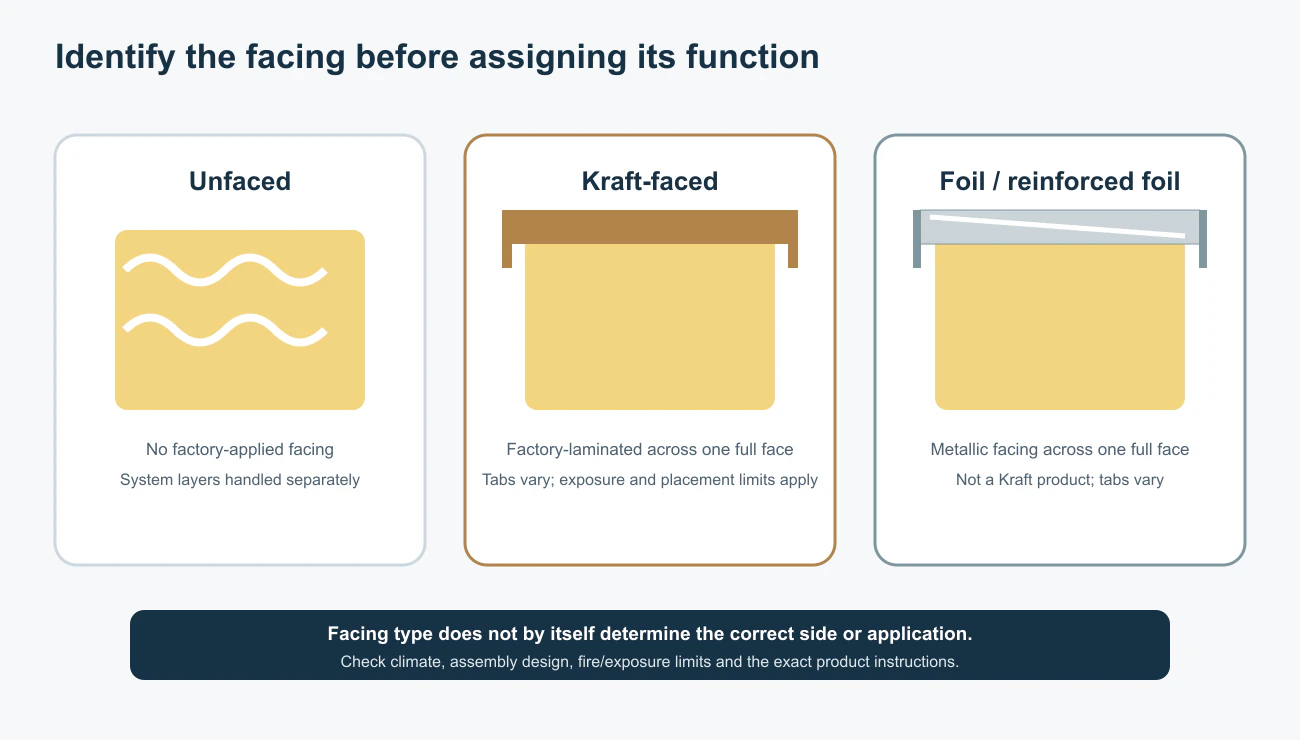
Key Differences Between Faced and Unfaced Fiberglass
| Consideration | Faced fiberglass | Unfaced fiberglass |
|---|---|---|
| Construction | Fiberglass with foil, Kraft paper, or another factory-applied facing | Fiberglass without a factory-applied surface facing |
| Thermal insulation | Primarily determined by core properties and thickness | Primarily determined by core properties and thickness |
| Vapor control | Certain facings can form part of a vapor-retarder or vapor-barrier system | Vapor control, if needed, is provided elsewhere in the assembly |
| Surface function | May provide protection, reinforcement, a reflective surface, or a specified finish | Suitable for concealed cavities or assemblies with separate covering layers |
| Installation | Facing orientation, attachment, and joint treatment must be considered | Can be fitted, wrapped, or retained by separate assembly components |
| Selection basis | A particular facing function is required | No factory facing is needed, or that function is already provided |
In faced vs unfaced fiberglass insulation selection, a factory facing should not be treated as a replacement for every other control or protective layer. Equally, choosing unfaced material does not automatically mean an additional vapor-control membrane is necessary. The assembly design determines which layers are required.
Faced vs Unfaced Fiberglass Insulation by Application
Exterior Walls and Light-Gauge Steel-Framed Walls
In walls incorporating gypsum board, air-control components, exterior water-resistive protection, and other specified layers, unfaced fiberglass can provide thermal and acoustic insulation within the cavity. Faced fiberglass may be appropriate when the design assigns a vapor-retarding function to the insulation facing.
Facing selection and placement depend on climate, indoor humidity, sheathing, and the vapor permeability of adjacent materials. In heating-dominated cold climates, some wall designs place a vapor retarder toward the interior to limit moisture movement into colder wall layers. In hot, humid climates with extensive air-conditioning, vapor drive can move inward, and a highly vapor-resistant interior layer may restrict drying.
There is no universal rule requiring faced insulation in exterior walls or unfaced insulation in interior partitions. For faced vs unfaced fiberglass insulation in walls, the assembly's moisture-control and drying strategy is decisive.
Metal Roofs and Industrial Buildings
Foil-faced fiberglass rolls are commonly used in metal roofs and large building-envelope assemblies where a continuous surface, vapor control, or protection is specified. Some systems use reinforced foil facing directed toward the interior or another designated side; attachment points, joints, and penetrations must follow the system design.
Where independent air-control, vapor-control, and covering layers already provide those functions, unfaced fiberglass can serve as the insulation layer. The faced vs unfaced fiberglass insulation decision is therefore about the role of the insulation within the roof construction, rather than the appearance of its surface.
A reflective foil surface should not be confused with the fiberglass core's thermal resistance. For low-emissivity foil to reduce radiant heat transfer, it needs an appropriate adjacent air space. Foil installed directly against another solid layer does not automatically deliver a substantial increase in the insulation's R-value.
External Insulation for HVAC Ducts
Cooled-air ducts require insulation that reduces heat gain and a system that limits ambient moisture reaching surfaces cold enough for condensation. When the insulation facing is intended to function as the vapor-control layer, foil-faced fiberglass rolls are a common choice. The fiberglass core provides thermal resistance; a low-permeance facing contributes vapor control when installed as a continuous, sealed layer.
For faced vs unfaced fiberglass insulation on ducts, roll joints, overlaps, hangers, and penetrations need attention because breaks in continuity can undermine condensation control. Unfaced fiberglass may also be used where a separate, continuous vapor-control and protective system is specified.
Outdoor ductwork additionally requires appropriate weather and mechanical protection. Ordinary foil facing alone is not a complete outdoor waterproof jacket.
Interior Partitions and Acoustic Cavities
In interior partitions, ceiling cavities, and other concealed acoustic assemblies, fiberglass thickness, fit, and interaction with the full wall or ceiling system are generally more important than a decorative facing. Unfaced fiberglass is often suitable behind gypsum board, metal panels, or other finished surfaces without an unnecessary factory-applied layer.
If the acoustic design requires a particular surface, its effect on sound absorption must also be considered. A continuous, relatively impermeable facing can alter how sound reaches the fibers. Consequently, faced vs unfaced fiberglass insulation should not be regarded as acoustically interchangeable simply because the underlying fibers are similar.
Facing Types Are Not Interchangeable
In faced vs unfaced fiberglass insulation comparisons, the actual facing construction matters: vapor permeance, strength, temperature limits, and fire-related behavior vary between products.
Kraft paper facing is used in certain wall and roof assemblies. Appropriately treated Kraft facing may serve as a vapor retarder, but it is not equivalent to a low-permeance foil barrier. Conventional Kraft-faced products may also face restrictions on exposed use under applicable fire and assembly requirements.
Plain aluminum foil facing can provide low vapor permeance and low-emissivity surface properties. Its effectiveness in a vapor-control system depends on the full composite, the treatment of joints, and installation continuity.
Reinforced foil-composite facing incorporates foil with fiberglass scrim, Kraft paper, or other reinforcing layers. FRK is one foil-reinforced composite construction, not a separate base material equivalent to foil or Kraft. Reinforcement may improve handling and durability, while actual vapor permeance, tear resistance, temperature limits, and fire performance remain specific to the finished construction.
Fire performance must be assessed for the faced product, not inferred from the fiberglass core alone. Facing films, reinforcements, and adhesives can influence reaction-to-fire behavior and temperature suitability. Where projects specify fire classifications, surface-burning performance, or exposed installation, the finished material and applicable assembly requirements must be considered.
For faced vs unfaced fiberglass insulation, the word “faced” is not a complete specification. Identify the facing composition and required function. For a narrower comparison, see Kraft Faced vs Unfaced Insulation.
Vapor Control and Installation Continuity
A facing, vapor retarder, air barrier, and waterproofing layer serve different purposes and should not be assumed to be interchangeable. Moisture can move through an assembly by both vapor diffusion and air leakage. A low-permeance facing can restrict vapor diffusion; it contributes to air control only when its joints, edges, and penetrations are detailed and sealed for that purpose.
Walls and roofs also need a workable drying strategy. Highly vapor-resistant materials on both sides can limit drying if moisture enters. Multiple membranes are not necessarily unsuitable, but their location and function must be coordinated with the complete assembly.
Installation details vary with facing construction. Reinforced foil used as a continuous vapor-control layer requires appropriate lap treatment, tapes, and sealing around penetrations. Kraft-faced batts are fastened according to their intended installation method and wall design. These approaches are not interchangeable.
For faced vs unfaced fiberglass insulation, the key installation check is whether each required control layer remains effective after the insulation is installed—not simply whether a facing is present.
Insulvora Fiberglass Products and Facing Options
Insulvora offers two relevant roll configurations for projects comparing faced vs unfaced fiberglass insulation:
Unfaced Fiberglass Insulation Roll. Available densities are 10–72 kg/m³, with thicknesses of 25–100 mm. These flexible roll formats are intended for suitable roof, ceiling, wall-cavity, and other large-area assemblies where a factory-applied facing is not required or the necessary control layers are provided separately.
Foil Faced Fiberglass Insulation Roll. Available densities are 10–48 kg/m³, with thicknesses of 25–100 mm and single-sided or double-sided facing options. Facing constructions include plain foil, FRK reinforcement, and fiberglass-scrim reinforcement for assemblies requiring the corresponding surface or vapor-control function.
These are alternative configurations for different assembly requirements, not simply basic and premium grades. For related building-envelope applications and available material formats, see Roof Insulation Materials.
Choose the Right Fiberglass Facing for Your Project
For project-specific faced vs unfaced fiberglass insulation selection, share the installation position, required facing function, thickness, and dimensions. Insulvora can then discuss suitable unfaced or foil-faced roll configurations and pricing.