
Kraft Faced vs Unfaced Insulation: Which Should You Choose?
Kraft faced vs unfaced insulation is primarily a question of vapor control, not which fiberglass core insulates better. Kraft facing adds a factory-applied vapor-retarding layer; unfaced fiberglass has no such facing. Where the fiberglass core, thickness, and product grade are equivalent, the two can provide comparable thermal resistance.
Kraft faced fiberglass insulation is commonly considered for enclosed walls and ceilings that require a vapor retarder at the specified location. Unfaced fiberglass is often preferable where vapor control is provided by another layer, is not required, or where an additional layer of insulation is being installed. The right choice depends on the climate and complete wall, ceiling, or roof assembly.
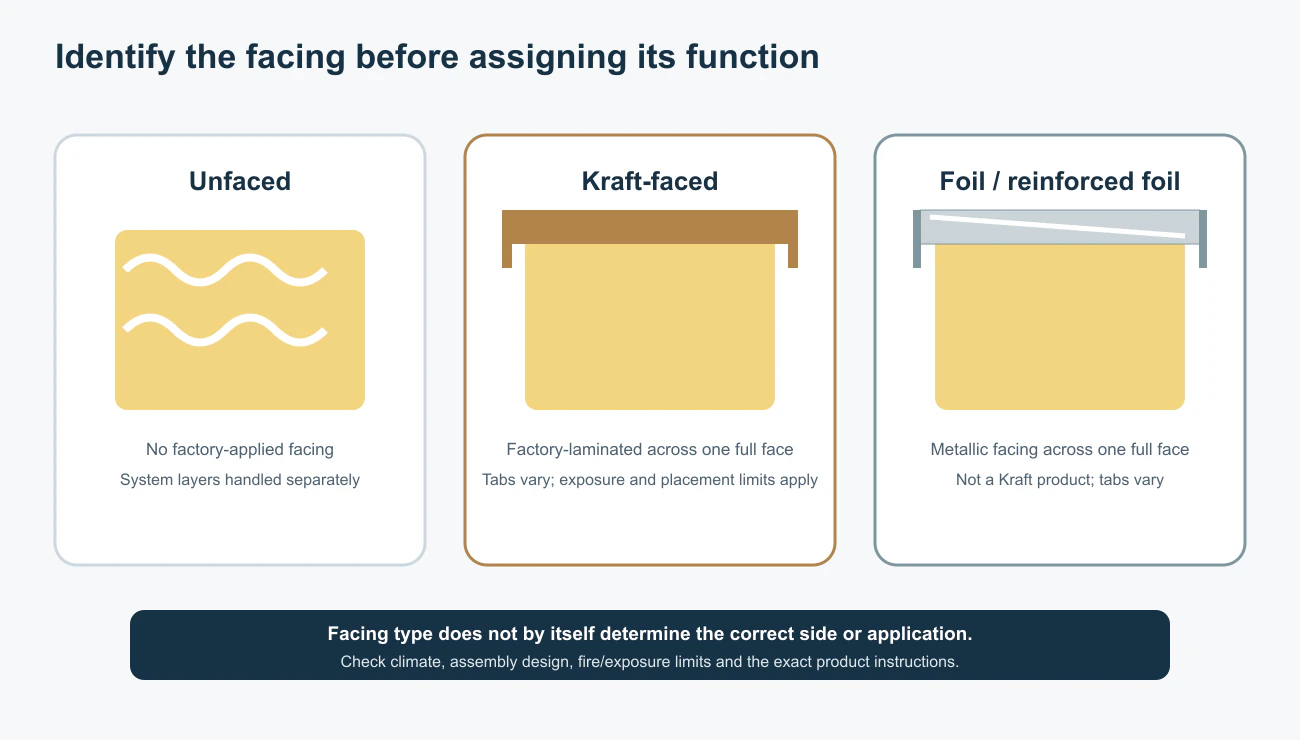
Key checks for kraft faced vs unfaced insulation
- Climate and assembly: Locate vapor control according to the design's moisture strategy.
- Facing exposure: Ordinary kraft paper is not a universal exposed finish; applicable fire requirements still govern.
- Continuity: Check facing laps, tears, penetrations, and connections with adjoining materials, while providing the air sealing the assembly requires.
Kraft Faced vs Unfaced Insulation: Key Differences
| Selection point | Kraft faced fiberglass insulation | Unfaced fiberglass |
|---|---|---|
| Construction | Fiberglass with treated kraft-paper facing | Fiberglass without a factory-applied facing |
| Vapor control | The facing can slow water-vapor diffusion as part of the assembly | Any required vapor control must come from another assembly layer |
| Thermal resistance | Primarily determined by the fiberglass core, thickness, and product grade | Comparable R-value with an equivalent core, thickness, and grade |
| Typical uses | Enclosed exterior walls and ceilings requiring the specified vapor retarder | Interior partitions, assemblies with separate vapor control, and additional attic insulation |
| Installation | Some products include stapling flanges for wood framing | Can be fitted into cavities or secured with suitable supports or fasteners |
| Fire and exposure | Ordinary kraft facing is combustible and generally needs an approved covering | Product and finished-assembly fire requirements still apply |
For kraft faced vs unfaced insulation, comparable R-values do not imply identical vapor-control or fire-exposure properties.
What Vapor Control Does Kraft Facing Provide?
Kraft faced fiberglass insulation generally uses paper treated with asphalt or another suitable coating to reduce water-vapor diffusion compared with untreated kraft paper. In North American practice, vapor retarders are commonly grouped by their tested permeance:
| Vapor-retarder class | Vapor permeance | Typical examples |
|---|---|---|
| Class I | 0.1 perm or less | Polyethylene sheet; nonperforated aluminum foil |
| Class II | More than 0.1 to 1.0 perm | Typical treated kraft faced fiberglass insulation |
| Class III | More than 1.0 to 10 perms | Certain latex-painted finishes |
Lower permeance means greater resistance to vapor diffusion. Some facings used with kraft faced fiberglass insulation become more vapor-permeable at higher relative humidity, potentially allowing some drying under suitable conditions. Actual behavior depends on the selected facing and its test conditions; the kraft layer does not increase the fiberglass R-value.
Kraft faced fiberglass insulation and aluminum-foil-faced products are not interchangeable simply because both have facings. Nonperforated foil is usually less permeable, whereas kraft facing properties depend on its treatment and surrounding humidity.
A vapor retarder is also not the same as an air barrier. Kraft faced fiberglass insulation does not, by itself, stop air leakage through a wall. Joints, edges, penetrations, and adjoining materials still require air sealing appropriate to the complete assembly.
When Should You Choose Kraft-Faced or Unfaced Insulation?
Choosing kraft faced vs unfaced insulation depends on climate, the intended location of vapor control, and the other layers already present. These five situations illustrate how the decision changes.
1. Exterior Walls in Cold Climates
In predominantly heating climates, indoor water vapor can migrate toward colder parts of an exterior wall during winter. Where a wood-framed wall requires an interior Class II vapor retarder, kraft faced fiberglass insulation is a familiar option. Its facing is commonly positioned toward the room, behind drywall or another approved finish.
Exterior continuous insulation or a separate vapor-control layer can change that requirement. The complete wall must have an appropriate moisture-control and drying strategy rather than relying on facing orientation alone.
2. Walls with an Existing Vapor-Control Layer
If a membrane or another component already supplies the required vapor control, unfaced fiberglass is often the simpler choice. In such walls, the kraft faced vs unfaced insulation decision concerns whether adding a second vapor-retarding layer would serve any useful purpose.
Low-permeance layers on both sides can limit the drying of moisture that enters the cavity and may increase moisture accumulation in sensitive materials. The permeability and location of existing layers should therefore be reviewed before adding a facing.
3. Adding Insulation to an Existing Attic
When comparing kraft faced vs unfaced insulation for an attic retrofit, unfaced fiberglass is generally preferred for installation on top of an existing layer. New batts or blankets can be installed across the direction of the existing layer to cover some framing and improve coverage.
A second kraft facing between insulation layers is usually unnecessary and may introduce an unwanted vapor-retarding layer. For a first-time attic installation, the need for kraft faced fiberglass insulation instead depends on the ceiling assembly and local climate.
4. Interior Partitions and Acoustic Filling
For interior partitions, the kraft faced vs unfaced insulation choice is usually driven by acoustic filling rather than envelope vapor control. Fiberglass in cavities between conditioned rooms helps absorb sound, and unfaced rolls, batts, or boards are generally suitable options.
Cavity dimensions, insulation thickness, installation fit, and the acoustic and fire requirements of the completed wall are more relevant than adding a paper facing.
5. Hot, Humid Climates and Air-Conditioned Buildings
In cooling-dominated conditions, water vapor can move from warm, humid outdoor air toward cooler layers inside the building. A low-permeance interior facing in the wrong location may restrict drying or contribute to condensation risk in some assemblies.
Details used for cold-climate walls should not automatically be applied to air-conditioned buildings in hot, humid regions. Here, kraft faced vs unfaced insulation must be evaluated against the entire moisture-control strategy. Unfaced fiberglass can provide the thermal layer where another facing is not required.
Installation, Facing Orientation and Fire Safety
When installing kraft faced vs unfaced insulation, follow the designated facing location in the wall or roof design. The familiar interior-facing arrangement for a cold-climate enclosed wall is not a universal rule for every climate, ceiling, or roof system.
Some kraft faced fiberglass insulation products have stapling flanges for securing them to framing. The fiberglass should fit the cavity without gaps, folds, or unnecessary compression. Facing joints, openings, and penetrations must be detailed according to the selected assembly's installation requirements; the wall's required air sealing remains a separate consideration.
Ordinary kraft-paper facing is combustible and generally should not be left exposed in occupied spaces. An approved covering, commonly drywall, is normally required. Unfaced fiberglass has no combustible kraft-paper layer, but its own fire performance and the finished assembly's requirements still need to be checked.
The paper used in kraft faced fiberglass insulation differs from plain aluminum foil and reinforced foil-scrim-kraft (FSK/FRK) facings. Reinforced laminates commonly contain foil, a reinforcing layer, and kraft paper. Their vapor permeance, installation requirements, and exposure or fire ratings should not be assumed to match those of ordinary kraft facing.
Related Fiberglass Products from Insulvora
For projects comparing kraft faced vs unfaced insulation, Insulvora supplies unfaced and foil-faced fiberglass rolls for compatible wall, ceiling, and roof applications. These products are not automatic substitutes for specified kraft faced fiberglass insulation: the required vapor-retarder class, facing position, fire requirements, and installation details must still be checked.
Flexible fiberglass rolls are available for suitable roof, ceiling, and cavity applications. The range includes 25–100 mm thicknesses, with different densities and roll dimensions. Unfaced material can be considered for additional attic insulation and assemblies with separate vapor control. Selection should also account for cavity fit, roll dimensions, and the specified fixing method.
For assemblies that specifically require aluminum-foil facing, surface protection, or a defined vapor-control function, Insulvora offers single-sided, double-sided, and reinforced foil configurations. Facing properties depend on the exact construction. Foil-faced rolls should only be considered as alternatives to kraft facing where the assembly's performance and installation conditions permit.
Related products and technical guidance:
Choose Fiberglass Insulation for Your Wall or Roof Project
Insulvora supplies unfaced and foil-faced fiberglass rolls for compatible wall and roof assemblies. Share the assembly type, required thickness, facing configuration, and dimensions to discuss suitable product forms and pricing.