
What Is NBR Foam? Structure, Performance and Insulation Uses
What is NBR foam? It is a flexible cellular insulation material based on nitrile butadiene rubber (NBR). In commercial insulation, NBR is commonly blended with PVC to produce a closed-cell elastomeric foam. The foam limits heat transfer and vapor movement while conforming to pipes and equipment.
Available as tubes, sheets and rolls, it is used for air-conditioning and refrigeration lines, chilled-water piping, ducts and equipment. Performance depends on formulation, conductivity, thickness, service temperature and installation.
Composition: NBR, NBR/PVC and Closed Cells
What is NBR foam made of? NBR is a synthetic rubber formed from acrylonitrile and butadiene. Foaming creates cells that change its density, thermal behavior and compression characteristics compared with solid rubber.
Commercial NBR/PVC insulation combines nitrile rubber with polyvinyl chloride. Formulation and foaming affect flexibility and performance. The terms have distinct meanings: NBR names the rubber component, NBR/PVC identifies a common commercial blend, and closed-cell describes the structure of the foam.
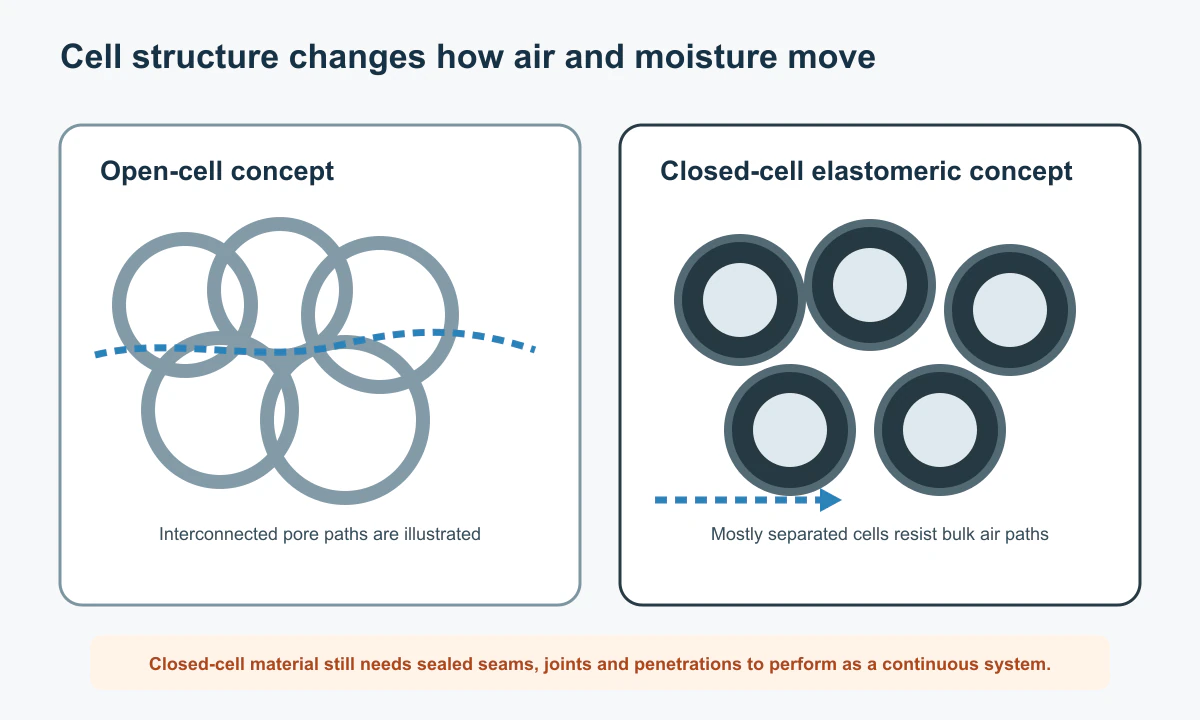
So what is NBR foam in relation to closed-cell elastomeric insulation? In predominantly closed-cell foam, most cells are separate rather than connected by open passages. This helps restrict gas movement and slow water vapor transmission through the material. Actual vapor control also requires suitable product properties and sealed joints. See Closed Cell Elastomeric Insulation.
Thermal and Vapor Performance in Pipe and Equipment Insulation
What is NBR foam expected to do in an insulation system? It reduces heat transfer and vapor movement while providing flexible coverage.
Thermal Conductivity and Insulation Thickness
Small cells slow heat transfer. At the same temperature and thickness, lower thermal conductivity means less heat transfer. Greater thickness also reduces heat transfer under equivalent conditions.
On chilled-water, refrigeration and air-conditioning lines, insulation helps limit heat gain; on suitable hot-water pipes, it reduces heat loss. Pipe diameter, operating and ambient temperatures, and insulation thickness affect selection. Check the product’s rated temperature range.
Water Vapor and Condensation Control
Condensation can form when a surface is below the surrounding air's dew point. Cold-service insulation must limit heat gain to help keep its outer surface above the dew point while slowing vapor movement toward the colder pipe.
The predominantly closed cells in NBR/PVC foam help restrict vapor transmission. Suitable thickness and sealed joints are essential; gaps can undermine condensation control, particularly on air-conditioning, chilled-water and refrigeration lines.
Common Applications
What is NBR foam used for in HVAC and mechanical systems? Applications differ in their insulation requirements and practical product forms.
| Application | Main insulation requirement | Typical product form |
|---|---|---|
| Air-conditioning copper and refrigeration lines | Limit heat gain and control condensation | NBR/PVC foam tubes |
| Chilled-water and cold-water piping | Reduce heat transfer and vapor ingress | Preformed or slit tubes |
| Hot-water and PPR piping | Limit heat loss and fit around pipework | Flexible foam tubes |
| HVAC ducts | Reduce heat transfer and maintain continuous surface coverage | Foam sheets and rolls |
| Equipment housings and larger surfaces | Fit varied shapes with continuous insulation | Flexible sheets and rolls |
For pipe runs, preformed tubes are generally practical when their inside diameter is matched to the pipe's outside diameter. Slit tubes can be fitted around installed lines without disconnecting the pipe. Flexible foam follows bends and equipment shapes, but elbows, valves, supports and joints still need continuous coverage.
What is NBR foam suitable for outdoors or at higher temperatures? Suitability depends on product configuration and protection. Sun exposure, service temperature and unusual chemical environments may require additional measures.
Product Forms and Insulvora Options
What is NBR foam available as from Insulvora? Insulvora supplies closed-cell NBR/PVC tubes, sheets and rolls. The following specifications apply to the named slit-tube series, not every NBR/PVC product.
Slit NBR/PVC Rubber Foam Pipe
Insulvora's Slit Rubber Foam Pipe is a preformed, longitudinally slit tube made from closed-cell NBR/PVC elastomeric foam.
| Property | Product specification |
|---|---|
| Material | Closed-cell NBR/PVC elastomeric foam |
| Density | 65–85 kg/m³ |
| Thermal conductivity | ≤0.034 W/(m·K) at 0°C |
| Service temperature | −40°C to +105°C |
| Fire performance designation | B1 |
| Available thicknesses | 15, 20, 25, 30, 40 and 50 mm |
| Product form | Preformed, longitudinally slit tube |
Conductivity is stated at 0°C. Thickness depends on operating conditions, and available tube inside diameters vary by thickness.
NBR/PVC Foam Sheets and Rolls
For ducts and equipment surfaces, Insulvora supplies sheets and rolls that can be cut, joined or bonded for continuous coverage. The B1 Rubber Foam Insulation Board is available in thicknesses including 10, 20, 30 and 50 mm, with different surface finishes and adhesive-backed configurations. Aluminum-foil-faced and self-adhesive options suit HVAC and equipment applications requiring those finishes or installation methods.
NBR/PVC Foam Insulation for Your Project
Insulvora supplies NBR/PVC insulation tubes, sheets, and rolls for pipes, ducts, and equipment. Share the operating temperature, dimensions, required thickness, and application to discuss suitable product configurations and pricing.