
Closed Cell Elastomeric Insulation: Structure, Condensation Control and Selection
Closed cell elastomeric insulation consists of a network of sealed, largely independent foam cells that restrict heat transfer and resist water vapor movement. On chilled-water pipes, refrigeration lines, air ducts and equipment, it helps limit heat gain and reduce the risk of moisture reaching cold surfaces beneath the insulation.
For cold-service systems, the properties of the foam are only part of the design. Conductivity and thickness affect surface temperature, while vapor resistance and continuity at joints, fittings and supports influence moisture control. The selected grade and the finished installation must be considered together.
Key selection conditions
- Thermal and vapor roleCheck conductivity at its stated test temperature, insulation thickness and water-vapor properties for the selected grade.
- Condensation designSelect thickness with the surrounding dew point in mind, and seal joints to limit moisture entry.
- Choose the formUse tubes for pipework and sheets or rolls for ducts, vessels and equipment surfaces.
How Closed Cells Affect Thermal and Vapor Performance
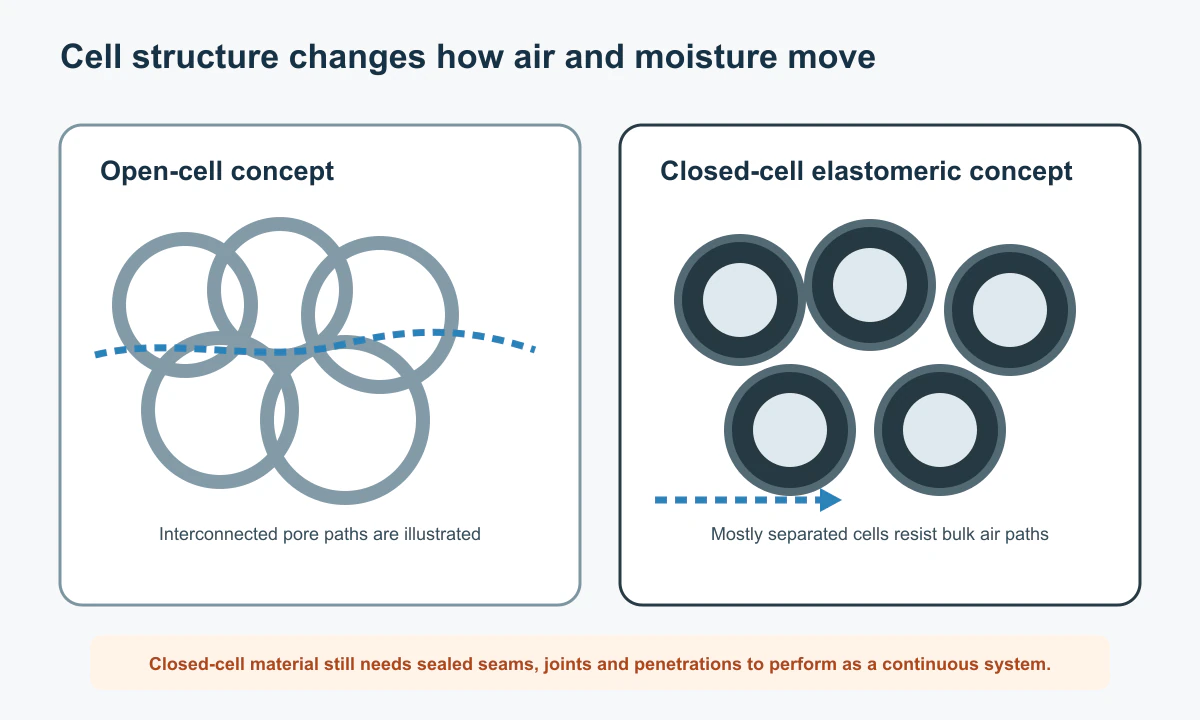
The small, separated cells in elastomeric foam restrict air movement within the material and limit pathways for water vapor diffusion. The flexible foam can also follow pipes, elbows and irregular equipment surfaces.
For systems operating below ambient temperature, insulation must slow heat flow toward the cold surface and restrict vapor movement in the same direction. Closed cell elastomeric insulation provides both functions through its structure, but the relevant properties must be checked for the specified product grade.
Insulvora supplies NBR/PVC closed cell elastomeric insulation in pipe tubes and sheets. The following values apply to the indicated product ranges:
| Property | Product data and practical relevance |
|---|---|
| Thermal conductivity | ≤0.034 W/(m·K) at 0°C; a reference for heat-transfer and insulation-thickness assessment |
| Density | 65–85 kg/m³ for the specified standard pipe tube and B1 sheet ranges |
| Water vapor diffusion resistance factor | ≥1,000 for the B1 rubber foam sheet range; indicates resistance to vapor diffusion through the material |
| Service temperature | −40°C to +105°C for the listed pipe tube and sheet ranges |
| Material and form | NBR/PVC closed-cell elastomeric foam, available in tubes, sheets and other flexible insulation formats |
Thermal conductivity must be interpreted at its stated test temperature. Because conductivity can change with mean temperature, a value measured at 0°C should not be treated as the exact value for every operating condition. The stated service-temperature range must also cover the actual conditions of use.
A higher water vapor diffusion resistance factor generally indicates greater resistance to vapor passing through the foam itself. It does not make the completed system waterproof or compensate for unsealed joints.
Why Condensation Still Matters
Even with closed cell elastomeric insulation, cold pipework presents two related but different condensation risks.
Surface condensation. Moisture can condense on the outside of the insulation when its exposed surface temperature falls below the dew point of the surrounding air. Suitable insulation thickness helps keep that surface warmer by limiting heat flow toward the cold pipe. The thickness required depends on pipe temperature, ambient temperature, relative humidity and pipe size. Humid conditions leave less margin for error.
Moisture beneath the insulation. A vapor-pressure difference can drive water vapor toward the colder pipe even when the insulation surface looks dry. Gaps at longitudinal seams, butt joints and fittings can let humid air bypass the foam. Moisture retained at the pipe surface can reduce insulation effectiveness and increase the risk of dripping or corrosion beneath insulation on metal pipes.
Closed cell elastomeric insulation therefore requires both sufficient thickness to control the exposed surface temperature and a continuous vapor-resistant installation with sealed joints. For more detail on dew point and thickness, see Pipe Condensation Insulation.
Choosing Pipe Tubes or Sheets
Closed cell elastomeric insulation is available in preformed tubes, slit tubes, sheets and rolls. Choose the form according to surface geometry, installation access and the location and number of joints. Where a project specifies fire performance, verify the selected grade against its applicable tests and classification requirements; the material name alone does not establish a fire rating.
Pipework: Preformed Tubes
For straight pipe runs and common HVAC lines, preformed tubes of closed cell elastomeric insulation require fewer field-made longitudinal joints than wrapping flat sheets around the pipe. Slit tubes can be fitted around pipework already in place without dismantling the line.
Insulvora's Slit Rubber Foam Pipe is available in 15, 20, 25, 30, 40 and 50 mm wall thicknesses; available inside diameters vary by thickness. Select the tube by the actual pipe outside diameter, rather than nominal pipe designation alone. A tube that is too tight may compress the insulation, while a loose tube can leave gaps and weaken joint sealing. For additional forms, see Rubber Foam Pipe Insulation.
Ducts and Equipment: Sheets and Rolls
Sheets of closed cell elastomeric insulation can be cut for rectangular ductwork, equipment housings, broad curved surfaces and locations where preformed tubes are unsuitable.
Insulvora's B1 Rubber Foam Insulation Board offers thicknesses of 10, 20, 30 and 50 mm. The 50 mm version has a two-layer laminated construction. Color, surface finish and self-adhesive configurations are available within the range to suit different installation requirements.
Sheets should fit closely against the substrate. Plan joint positions carefully and avoid excessive stretching or compression at corners. On larger equipment surfaces, sheet dimensions, joint sealing and the surrounding construction also affect long-term performance.
Joints, Supports and Outdoor Protection
Closed cell elastomeric insulation resists vapor movement through its foam structure, but the installed vapor-resistant layer must remain continuous across connections.
Longitudinal slits and circumferential butt joints require compatible bonding and sealing methods. Elbows, tees, valves and other fittings should be insulated without leaving cold surfaces exposed. At hangers and support points, compression can reduce local thermal resistance and create colder areas where condensation is more likely.
Wall penetrations, equipment connections and insulation terminations also need to be sealed continuously with the adjacent insulation. Outdoors, additional protection may be required against ultraviolet exposure, rain and mechanical damage. The foam's vapor resistance does not replace appropriate weather or physical protection, and any outer covering must preserve the integrity of sealed joints.
Closed Cell Elastomeric Insulation Products and Quotations
For a project quotation, share the pipe outside diameter or equipment dimensions, operating conditions, required insulation thickness and any finish or grade requirements. Insulvora can discuss available tube or sheet configurations, specifications and pricing for your application.