
Foam vs Rubber Pipe Insulation: Choosing Between PE and NBR/PVC
Foam vs rubber pipe insulation usually means comparing polyethylene (PE) foam pipe sleeves with flexible NBR/PVC elastomeric insulation. These are two foam chemistries, not foam versus a non-foam material: rubber insulation is itself a form of closed-cell foam.
For ordinary indoor water and heating lines, PE sleeves are often the economical starting point. For refrigerant lines, chilled-water systems, and humid or congested installations, NBR/PVC is frequently preferred because it conforms readily around bends and fittings. The best foam vs rubber pipe insulation choice depends on the specific grade, service conditions, and quality of the installed joints.

Compare PE foam and NBR/PVC on the same project basis:
- Same conditionsCompare equivalent operating and reference temperatures, pipe outside diameter (OD), and insulation thickness.
- Installed jointsAccount for longitudinal seams, butt joints, bends, valves, and support penetrations.
- Whole costInclude installation labor, protective covering, waste, and condensation risk—not just price per meter.
Rubber Pipe Insulation vs Foam: Main Differences
| Comparison | NBR/PVC elastomeric pipe insulation | PE foam pipe insulation |
|---|---|---|
| Material | Flexible, closed-cell elastomeric foam that accommodates bends and changes in pipe geometry | Polyethylene-based foam available in cross-linked and non-cross-linked constructions |
| Typical uses | Refrigerant lines, chilled water, HVAC systems, and suitable hot- or cold-water services | Indoor plumbing, heating, general hot- and cold-water lines, and certain cold-pipe applications |
| Flexibility | Generally well suited to bends, corners, and complex fittings requiring continuous coverage | Lightweight and easy to cut, especially on straight runs; flexibility varies by construction and grade |
| Moisture and condensation | Closed-cell structure and carefully sealed joints support a continuous vapor-resistant cold-pipe insulation system | Closed-cell PE can also resist moisture; vapor performance depends on the specific product and joint treatment |
| Thermal performance | Low-conductivity grades are available for hot- and cold-pipe insulation | Can also provide effective insulation; results depend on density, thickness, and test temperature |
| Service temperature | Elastomeric grades are available across a relatively broad temperature range | Many common PE pipe sleeves have upper service limits around 93–100°C, depending on grade |
| Installation | Available as unslit tubes, pre-slit sleeves, and complementary sheets for difficult details | Commonly supplied as preformed tubes, slit sleeves, or self-sealing products |
| Initial material cost | Often higher, with practical advantages for complex pipe routes | Standard PE sleeves are generally less expensive to purchase |
| Outdoor exposure | Protection may be needed against UV, rain, and mechanical damage | Weathering and mechanical protection must likewise be considered |
The table sets out typical differences, not universal limits. In a foam vs rubber pipe insulation comparison, NBR/PVC often simplifies coverage around complicated fittings, while standard PE sleeves can reduce initial material expense. Suitable PE grades can also work on refrigeration and chilled-water lines when the required thermal and vapor performance, including joint detailing, is achieved.
Thermal Conductivity and Condensation Control
Thermal conductivity must be compared at a stated reference temperature. A foam vs rubber pipe insulation assessment should use equivalent mean temperatures and proposed insulation thicknesses rather than simply rank the lowest published numbers.
Insulvora's NBR/PVC slit rubber foam pipe range has the following stated properties:
- Thermal conductivity: ≤0.034 W/(m·K) at 0°C.
- Service temperature: −40°C to +105°C.
- Material: Flexible, closed-cell NBR/PVC elastomeric foam.
For comparison, published technical data for certain PE foam pipe sleeves gives approximate thermal conductivity of 0.038 W/(m·K) at a mean temperature of 10°C and 0.040 W/(m·K) at 38°C. These figures cannot be ranked directly against the NBR/PVC value at 0°C. A pipe insulation foam vs rubber comparison requires equivalent test conditions before making a material-performance judgment.
For foam or rubber pipe insulation on cold services, condensation control is as important as heat-transfer performance. When the pipe is colder than the surrounding air's dew point, moisture can form if the insulated outer surface becomes too cold or vapor reaches the pipe. Appropriate thickness helps keep the outer surface above the dew point; continuous vapor-resistant detailing limits inward moisture movement.
Flexible elastomeric sleeves can follow bends and fittings, but they still require correctly sealed longitudinal slits, butt joints, valves, and support penetrations. Closed-cell PE can also provide moisture resistance if the specific grade and assembled joints meet the project requirements. In cold-service foam vs rubber pipe insulation, gaps or poorly sealed connections can undermine an otherwise suitable design.
Which Material Works Best for Different Pipes?
AC Refrigerant Lines and Chilled-Water Systems
An AC pipe insulation foam vs rubber assessment should start with operating temperature, ambient humidity, insulation thickness, and the details of every joint. Refrigerant and chilled-water lines often operate below ambient temperature, making vapor-resistant, continuous coverage essential to condensation control. For foam vs rubber pipe insulation on these systems, check whether joints can remain continuous around valve groups and pipe supports.
Flexible NBR/PVC sleeves are commonly used around copper-tube bends and fittings. Preformed bore sizes and insulation thicknesses help match the insulation to the pipe. For residential split AC, commercial HVAC, and refrigeration work, the foam vs rubber pipe insulation decision should reflect the actual routing and installation environment, not the material name alone.
For application details, see Air Conditioning Pipe Insulation and Refrigerant Line Insulation.
Indoor Water and Heating Pipes
Standard PE foam sleeves are often economical on straight, accessible indoor plumbing and heating runs, provided the selected grade meets the service-temperature and insulation requirements. In a pipe insulation foam vs rubber comparison for hot-water service, confirm the chosen grade’s sustained temperature limit; cold-water pipes may also encounter seasonal condensation.
NBR/PVC is an alternative where greater flexibility, thicker insulation, or consistency with other elastomeric insulation is needed. For foam or rubber pipe insulation in straightforward indoor service, a suitable PE product may meet the project requirements without the higher initial material cost of NBR/PVC. The foam vs rubber pipe insulation choice therefore depends on the intended pipe service and installed details.
Outdoor AC Lines and Exposed Pipework
Outdoor foam or rubber pipe insulation must be assessed for UV exposure, rain, weathering, and accidental damage as well as heat transfer. Neither dark coloring nor a closed-cell structure on its own establishes long-term weather resistance.
For a foam vs rubber pipe insulation installation that runs to an outdoor AC unit, a suitable protective finish, coating, or separate covering may be needed. Foil-faced sleeves are an option only where the facing and all exposed seams are appropriate for the actual exposure conditions.
High-Temperature and Fire-Sensitive Services
If the pipe temperature exceeds a proposed material's service rating, adding more insulation thickness does not make that material suitable. In a foam vs rubber pipe insulation decision for hotter services, first confirm the grade's allowable operating temperature. Fiberglass or rock wool pipe sections may be more appropriate for higher-temperature industrial and mechanical applications, with the necessary external protection.
Where fire or smoke performance is specified, evaluate the relevant product grade and installed assembly; neither “foam” nor “rubber” alone guarantees a fire classification. See Pipe Insulation Alternatives for other material routes.
Material Price Versus Installed Cost
For foam or rubber pipe insulation on repetitive, accessible indoor pipe runs, standard PE sleeves generally have the lower purchase price. A foam vs rubber pipe insulation cost comparison, however, should consider the completed insulation system rather than the sleeve price per meter alone.
Bends, tees, valves, retrofits, and crowded connections influence cutting, fitting, sealing, labor, and waste. Flexible NBR/PVC sleeves can simplify coverage in such locations; standard PE may offer better value where runs are straight and installation is uncomplicated. When specifying foam or rubber pipe insulation, compare the expected labor and jointing work as well as the material itself.
To compare pipe insulation rubber vs foam on an equivalent basis, use the same pipe OD, insulation thickness, material grade, and project quantity. Include the cost of jointing supplies, required protective covering, and installation labor. For condensation-sensitive work, a foam vs rubber pipe insulation cost assessment should also consider potential wet insulation, joint failure, and replacement costs.
Insulvora Rubber Pipe Insulation Products
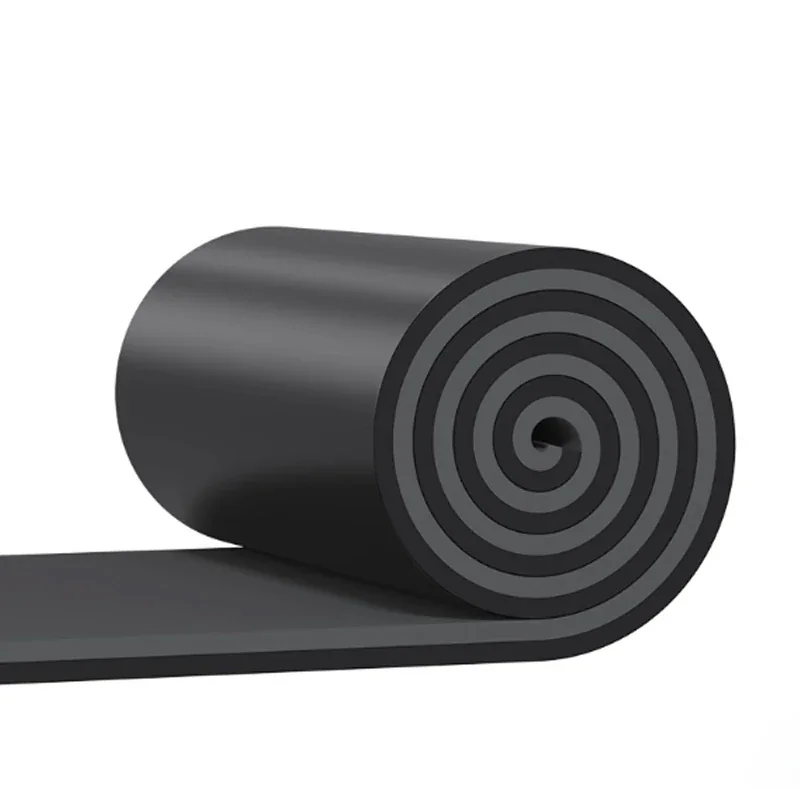
Insulvora supplies closed-cell NBR/PVC elastomeric pipe insulation in different densities, thicknesses, and sleeve constructions for suitable AC, plumbing, heating, and related pipework. For foam vs rubber pipe insulation projects specifying elastomeric material, three available product forms provide different starting points.
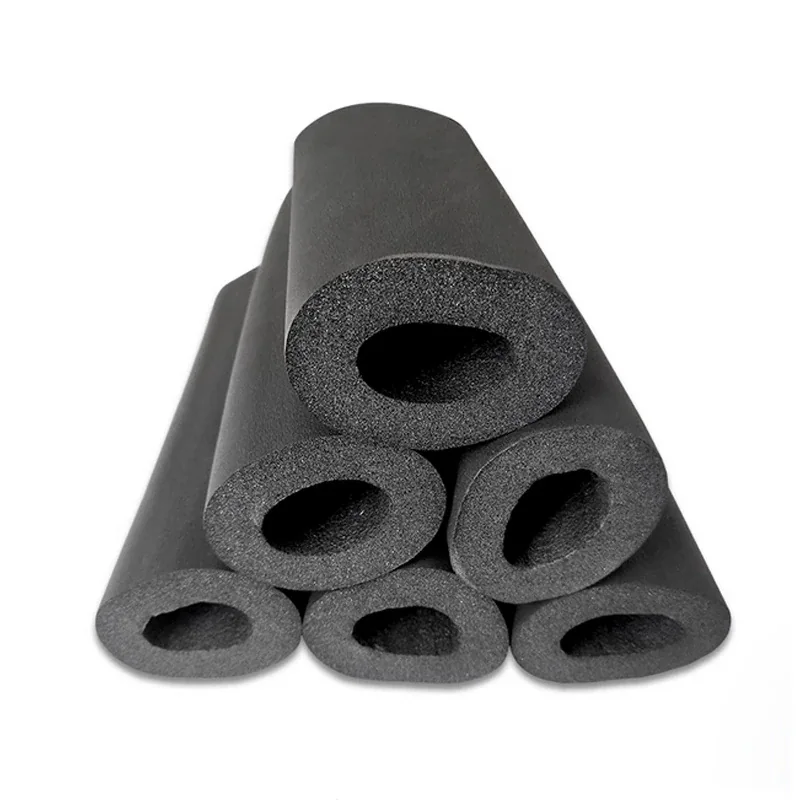
Slit Rubber Foam Pipe
Slit Rubber Foam Pipe is a preformed sleeve with a longitudinal opening for installation around new or existing pipes. Its stated density range is 65–85 kg/m³, with insulation thicknesses of 15, 20, 25, 30, 40, and 50 mm.
Available internal diameters vary with thickness, so sleeve bore and insulation thickness must be selected together for the specified pipe OD. The preformed construction suits AC copper tubing and appropriate hot- or cold-water runs, including retrofits where straight-pipe coverage would otherwise require fabrication from sheet insulation.
High Density Rubber Foam Pipe
High Density Rubber Foam Pipe is available at 80–110 kg/m³ for projects requiring a denser elastomeric sleeve. Density alone does not establish insulation efficiency; selected grade, thickness, pipe size, and performance requirements must all align with the project.
Foil Faced Rubber Foam Pipe
Foil Faced Rubber Foam Pipe combines an elastomeric insulation sleeve with a foil facing for applications requiring a covered surface. Its suitability for protective use depends on the facing, seam details, and actual exposure conditions.
Choose the Right Pipe Insulation for Your Project
For a foam vs rubber pipe insulation specification, share the pipe sizes, operating temperatures, and condensation-control requirements, together with relevant project conditions. Insulvora can discuss suitable NBR/PVC pipe sleeves and related insulation formats and provide pricing based on the confirmed requirements.