
High Temperature Insulation Materials: Limits and Selection
Choosing high temperature insulation materials begins with the temperature at the insulation layer, not simply the temperature inside the equipment. The next decisions are thermal conductivity at working temperature, surface geometry, mechanical conditions, and the construction of the installed system. Fiberglass and rock wool cover many industrial pipes and equipment surfaces, while hotter duties may require refractory-grade materials or layered systems. No single product form suits every temperature and installation.
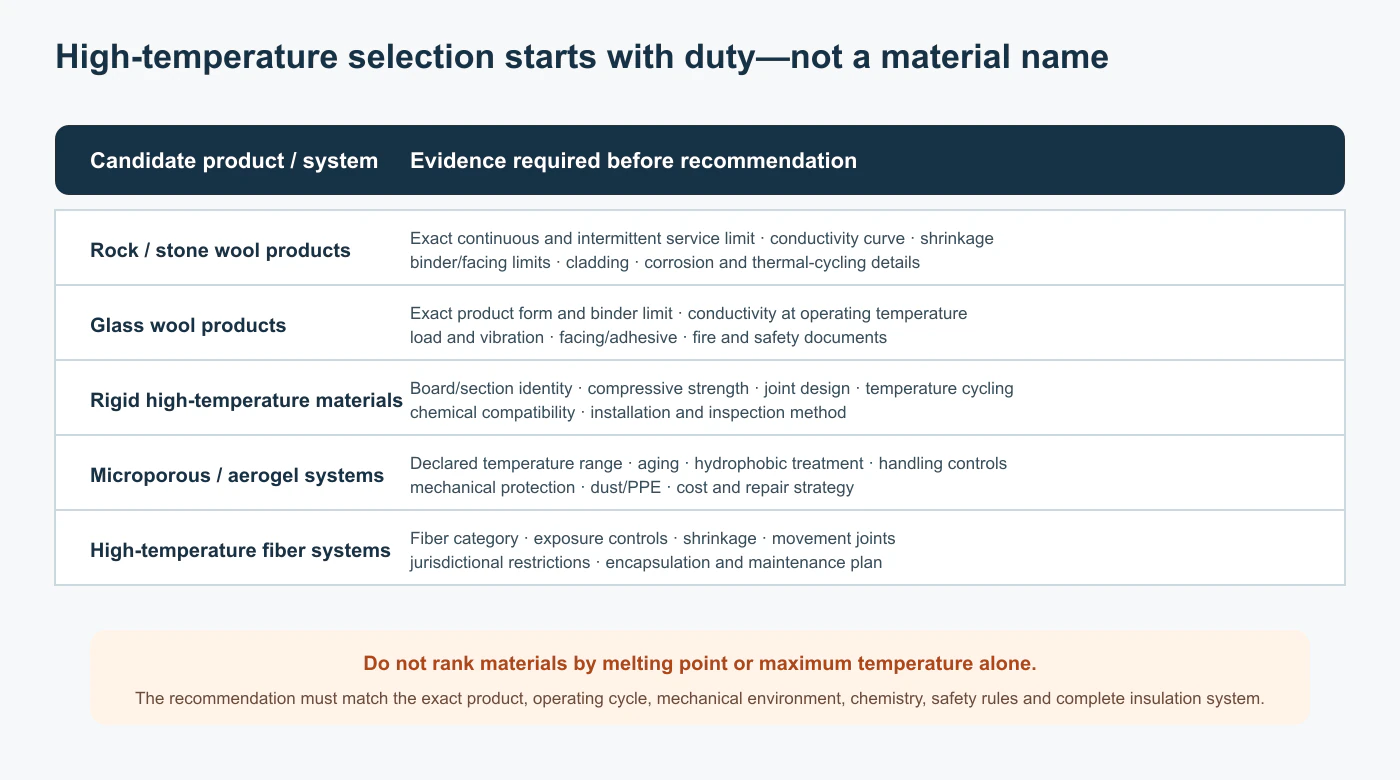
Key selection conditions
- Temperature rangeCheck continuous service and possible short-term peaks, not only a published maximum.
- Material behaviorCompare conductivity at temperature, dimensional stability, and mechanical requirements.
- Installed assemblyConfirm that facings, binders, supports, joints, and cladding suit their actual exposure.
High Temperature Insulation Materials by Operating Range
The following temperature ranges provide an initial shortlist of high temperature insulation materials. They do not replace confirmation of the selected product grade and installed construction.
| Operating temperature | Materials to consider | Typical applications and selection priorities |
|---|---|---|
| Up to 350°C | Suitable grades of fiberglass and rock wool | Heating pipes, machinery, and medium-temperature equipment; choose pipe sections, boards, or blankets to suit the surface. |
| 350–450°C | Higher-temperature fiberglass pipe sections or boards; rock wool | Process piping and equipment; compare product grade, thermal performance, and finished construction. |
| 450–600°C | Rock wool pipe sections, boards, and blankets | Steam and process lines, vessels, and equipment; consider thickness, supports, and cladding. |
| 600–750°C | 750°C-grade rock wool or wire-mesh blankets; other suitable high-temperature systems | Large equipment, curved piping, and hot surfaces; assess sustained exposure, thermal cycling, and dimensional stability. |
| Above 750°C | Suitable grades of refractory ceramic fiber, calcium silicate, or other high-temperature insulation constructions | Furnaces, kilns, heat-treatment equipment, and specialized thermal systems; select by hot-face temperature, product grade, and assembly design. |
These operating bands are selection guides, not universal continuous-service ratings for high temperature insulation materials. Near a grade's upper limit, distinguish sustained operating temperature from brief peaks and classification temperatures. For high temperature thermal insulation, the stated maximum of a material or assembly may not represent its recommended continuous operating limit, particularly above 600°C.
Insulvora High Temperature Insulation Materials
Insulvora supplies fiberglass and rock wool insulation in pipe-section, board, roll, and blanket forms. The temperature references below apply to the specified products or grades, not automatically to every construction made from the same fiber. This table connects the general selection ranges with product forms available for high temperature thermal insulation projects.
| Product form | Listed temperature reference | Application direction |
|---|---|---|
| Fiberglass insulation roll | Maximum working temperature: 350°C | Equipment and larger insulated areas where the grade and construction are suitable. |
| Glass wool board | Standard grade: 350°C; high-temperature grade: 450°C | Flat equipment surfaces and assemblies requiring board form. |
| Glass wool pipe insulation | Maximum working temperature: 450°C | Heating and mechanical piping within the applicable temperature range. |
| Rock wool pipe sections | Standard product maximum working temperature: 600°C | Industrial steam, heating, and process piping. |
| Rock wool board | Maximum working temperature: 600°C | Industrial equipment and flat or regular surfaces. |
| Rock wool blanket | Standard grade: 600°C; high-temperature grade: 750°C | Large equipment, curved surfaces, and irregular shapes. |
| Wire-mesh rock wool blanket | Standard grade: 600°C; high-temperature grade: 750°C | Large pipes and complex equipment where a flexible, reinforced blanket is useful. |
Among these high temperature insulation materials, a standard 600°C rock wool pipe section is not the same product configuration as a 750°C-grade rock wool blanket. Diameter, surface shape, and operating conditions determine whether preformed sections, blankets, or a combined arrangement are suitable. Different high-temperature insulations are not interchangeable merely because their rated temperature ranges overlap.
Finished-product limits also matter. For example, fiberglass insulation may have a maximum working temperature of 350°C, while a conventional bonded foil-faced fiberglass product has a continuous-service reference of 100°C. Facings, adhesives, fasteners, and cladding must be assessed at their installed temperatures rather than assigned the core insulation's rating.
Technical Factors Beyond Maximum Temperature
Thermal Conductivity at Operating Temperature
For high temperature thermal insulation, conductivity must be considered at the relevant mean temperature. A value measured near room temperature cannot be used unchanged to predict performance at 400°C, 600°C, or higher. Two high temperature insulation materials with similar temperature limits can therefore produce different heat losses.
Thickness must be selected for the required result: lower heat loss, a target outer-surface temperature, or safer accessible surfaces. For high temperature thermal insulation on pipes, the inner and outer radii affect cylindrical heat flow, so the resistance calculation for a flat board cannot be applied directly to a pipe. Density alone is not a substitute for temperature-dependent thermal data. For further comparisons, see Low Thermal Conductivity Insulation.
Continuous Exposure and Thermal Cycling
A maximum temperature rating does not establish how a product behaves through sustained heating and repeated shutdowns. Thermal cycling, fiber shrinkage, equipment movement, and compression can create gaps, even when the insulation withstands the peak temperature. Joints and fixings must accommodate the duty and maintain coverage.
For high temperature insulation materials on vibrating or frequently stopped equipment, fasteners, joints, and cladding face additional demands over time. For blankets and other fibrous high temperature thermal insulation, dimensional stability and secure installation are critical to maintaining the intended service performance.
Mechanical Loads and Product Form
Temperature resistance and mechanical strength are separate properties. Rigid boards and preformed pipe sections provide defined shapes where support and local loading are important; flexible blankets can follow large diameters, bends, and irregular equipment. Wire-mesh reinforcement can help retain the blanket form where suitable.
Compare density, compression resistance, flexibility, and temperature capability together. Greater density does not automatically mean lower thermal conductivity or a higher usable temperature. The correct high temperature insulation materials must meet both the thermal and mechanical demands of their installed positions.
Installed System and Environmental Exposure
Outdoors, high temperature insulation materials may require metal cladding, weather-resistant joints, and mechanical protection. Damaged cladding and water entering the insulation can reduce performance; moisture during shutdown may also increase the risk of corrosion beneath insulation. Supports, connections, and joints should avoid large interruptions to the insulation layer.
Fire performance must be evaluated separately from operating temperature. A material's ability to tolerate high heat does not establish its fire-reaction classification or the fire-resistance duration of an assembly. Both requirements may apply to a high temperature thermal insulation system, but they answer different questions.
High Temperature Insulation Materials by Application
Steam and Process Piping
For steam and process piping, high temperature insulation materials commonly take the form of preformed fiberglass or rock wool sections on straight, standard-diameter runs, within the specified product grades. For larger diameters, bends, valves, and irregular connections, flexible rock wool or wire-mesh blankets may be more suitable. The choice also depends on support details, thermal expansion points, joints, and outdoor protection; poor detailing can leave gaps or compress the insulation.
For pipe-specific selection and installation considerations, see High Temperature Pipe Insulation.
Tanks, Large Equipment, and Irregular Surfaces
On tanks and large equipment, high temperature insulation materials must accommodate different surface geometries. Rock wool boards can cover supported flat areas, while blankets follow vessels and curved shells. Wire-mesh blankets provide a reinforced flexible option for large or uneven surfaces. Valves, flanges, and parts requiring maintenance may need removable covers rather than permanent insulation.
For high temperature thermal insulation on large shells, the chosen product must maintain coverage without losing the required thickness or becoming compressed at supports. See Industrial Thermal Insulation for related equipment applications.
Furnaces and Higher-Temperature Equipment
Where hot-face temperatures exceed the limits of standard fiberglass or rock wool, high temperature insulation materials may include suitable refractory ceramic fibers, calcium silicate grades, or engineered multilayer constructions. These are technical material options beyond the fiberglass and rock wool products listed in Insulvora's supply table, not a statement that every material shown is supplied by Insulvora.
Refractory ceramic fibers can be used in furnace linings and other hot-process equipment, subject to grade-specific service temperatures, shrinkage, and thermal-cycle behavior. Calcium silicate can serve as rigid insulation or support where the specified grade is appropriate. In layered high temperature thermal insulation systems, a hot-face layer, primary insulation, and cooler outer layer perform different functions; each must be rated for the temperature it actually experiences.
Cellular glass may serve moisture-control, rigidity, or environmental requirements within its own service range. It is not a direct replacement for a refractory hot-face layer above 750°C. Selection of these higher-temperature systems requires confirmation of the complete assembly rather than a single headline material rating.
Request High-Temperature Insulation Products
Need high temperature insulation materials for steam piping, process equipment, or hot surfaces? Insulvora supplies fiberglass and rock wool pipe sections, boards, rolls, and blankets for applicable temperature ranges. Share the continuous operating temperature, any short-term peaks, equipment dimensions and geometry, preferred product form, thickness, and relevant facing or protection requirements. We can use these details to discuss suitable product configurations and prepare a project quotation.