
How Rockwool Is Made: From Molten Stone to Insulation
Rockwool (stone wool) begins with mineral raw materials such as basalt and diabase, often combined with dolomite and other ingredients. These minerals are melted and spun into fine fibers, which are collected, bonded, formed, cured and finished as insulation products. Understanding how rockwool is made explains why a common mineral-fiber base can become rigid boards, flexible blankets, reinforced coverings or preformed pipe sections.
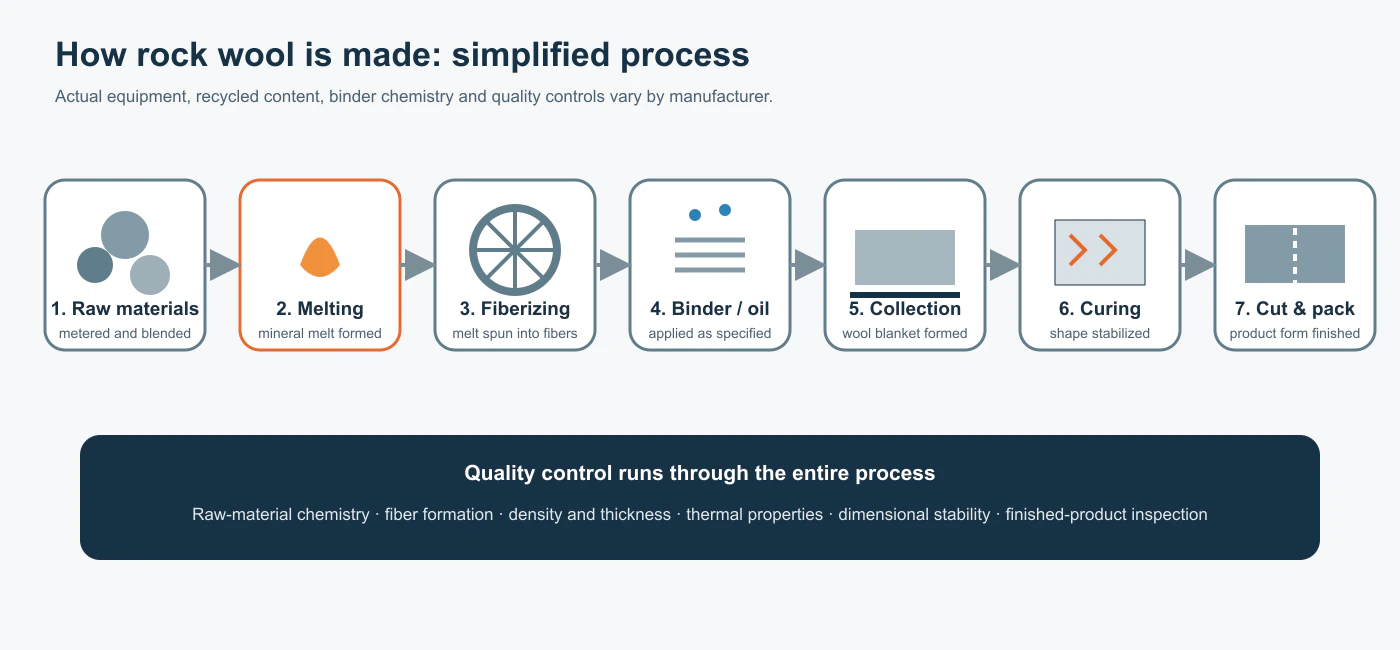
How Is Rockwool Made? Seven Main Production Stages
The manufacturing sequence normally follows seven stages. The table describes the general process; equipment configurations and shaping methods vary with product type.
| Stage | Main operation | Purpose |
|---|---|---|
| 1. Raw-material preparation | Basalt, diabase, dolomite and suitable recycled mineral material are proportioned and fed into the furnace. | Maintains the intended mineral composition. |
| 2. Melting | The mineral charge is heated to around 1,500°C, depending on the process. | Produces a melt suitable for fiberizing. |
| 3. Fiberizing | High-speed spinning wheels turn molten material into fine fibers that cool in the airflow. | Creates the mineral-fiber network. |
| 4. Binder application | Binder is sprayed onto the fibers; water-repellent or dust-control additives may be applied where required. | Supports fiber bonding and finishing. |
| 5. Collection and forming | Fibers are collected, layered and compressed as needed; some products follow separate shaping methods. | Establishes thickness, density and product form. |
| 6. Curing and cooling | The formed wool is heated to cure the binder and then cooled. | Stabilizes the bonded fiber structure. |
| 7. Finishing | Products are cut, rolled, faced, mesh-reinforced or machined, then inspected and packed. | Delivers usable sizes and insulation formats. |
This overview shows how rockwool is made in general, rather than describing one fixed production-line design. The way a particular product is shaped can differ from the sequence used for flat wool.
From Mineral Melt to Insulating Fibers
Fiberizing creates the insulating structure
Rock wool does not insulate as a solid block of stone. Spinning creates fine mineral fibers that form an interwoven, porous network with numerous small air spaces. This structure helps restrict heat transfer.
Melt condition, spinning-wheel speed and airflow are central to how rockwool is made because they influence fiber size and distribution, as well as the amount of unfiberized material. Controlling these variables supports a more consistent internal structure.
Layering and compression determine product structure
Loose fibers are collected into a web, arranged in layers and compressed when required. Fiber quantity, orientation, layering and compression affect thickness, density, flexibility and mechanical behavior.
How is rockwool made into rigid boards versus flexible blankets? The difference starts during forming: boards need a stable, flat structure, while blankets must remain flexible enough to wrap around equipment. Cutting alone does not produce these different properties.
Higher density generally means more fiber per unit volume, but thermal conductivity does not automatically decrease as density increases. Fiber arrangement, pore structure and product grade also influence thermal performance.
Binder and curing stabilize the fibers
Binder applied to the fibers helps hold the structure together. The formed wool then passes through curing, commonly using controlled hot air at temperatures around 200°C, well below the mineral-melting temperature.
Curing is an important part of how rockwool is made because it stabilizes fiber connections for cutting, transport and installation. Binder formulation, curing conditions and fiber orientation can also affect compression resistance, tensile strength, recovery and dimensional stability. Settings vary with the intended product grade and use.
Process control and finished-product checks
How is rockwool made consistently from one production run to another? Manufacturers control raw-material proportions, melt conditions, fiber formation, layering, binder application, curing and finishing. Furnace temperature alone does not determine the result.
Finished products are commonly checked for appearance, dimensions, thickness, density and tolerances. Depending on the application, testing may also cover thermal conductivity, mechanical properties, dimensional stability and reaction to fire. These checks relate manufacturing control to the specifications of the supplied product.
How Is Rockwool Made into Different Insulation Products?
Although the fibers have a common origin, forming and finishing determine the structure and installation format of each product. The distinctions below show how rockwool is made into four common insulation forms.
How Rockwool Is Made into Boards
Fibers are layered, compressed and cured, then cut into boards of specified dimensions. Boards are available in different thicknesses, densities and facing configurations and suit walls, roofs, partitions, equipment enclosures and other flat assemblies. See Insulvora's rock wool boards for relevant product formats and specifications.
Rock wool blankets: flexible coverage
Blankets retain the flexibility needed to wrap around ducts, industrial equipment and curved surfaces. After forming and curing, the wool is cut and supplied as blankets or rolls. This is how rockwool is made into a form that can follow curved surfaces without the rigidity of boards. Explore Insulvora's rock wool blankets.
Wire-mesh blankets: reinforced wrapping
Galvanized steel mesh is attached during finishing to support the wool during wrapping and fastening. In this case, how rockwool is made into a reinforced blanket differs mainly at finishing rather than during the basic fiberizing process. This form suits large pipes and irregular industrial equipment. See Insulvora's wire mesh rock wool blankets.
How Is Rockwool Made into Pipe Sections?
Pipe sections may be formed around a mandrel before curing or cut and machined from previously formed wool. The result is a cylindrical or split-shell section with an inner diameter suited to the pipe and a specified insulation thickness. Preformed sections require less on-site shaping than flat sheets. View Insulvora's rock wool pipe sections for industrial and mechanical piping.
Rock Wool Products and Supply Options
Insulvora supplies rock wool boards, blankets, wire-mesh blankets and pipe sections for building, HVAC and industrial insulation. When requesting a quotation, provide the required product form, density, thickness, dimensions and intended application so the relevant supply specifications can be confirmed.