What Is Mineral Wool Insulation? Types, Properties and Uses
What is mineral wool insulation? It is a family of inorganic fibrous materials made by melting rock, slag or glass and forming the melt into fine fibers. Air trapped between the fibers slows heat transfer, and the porous structure absorbs sound. Common uses include buildings, HVAC systems and industrial equipment.
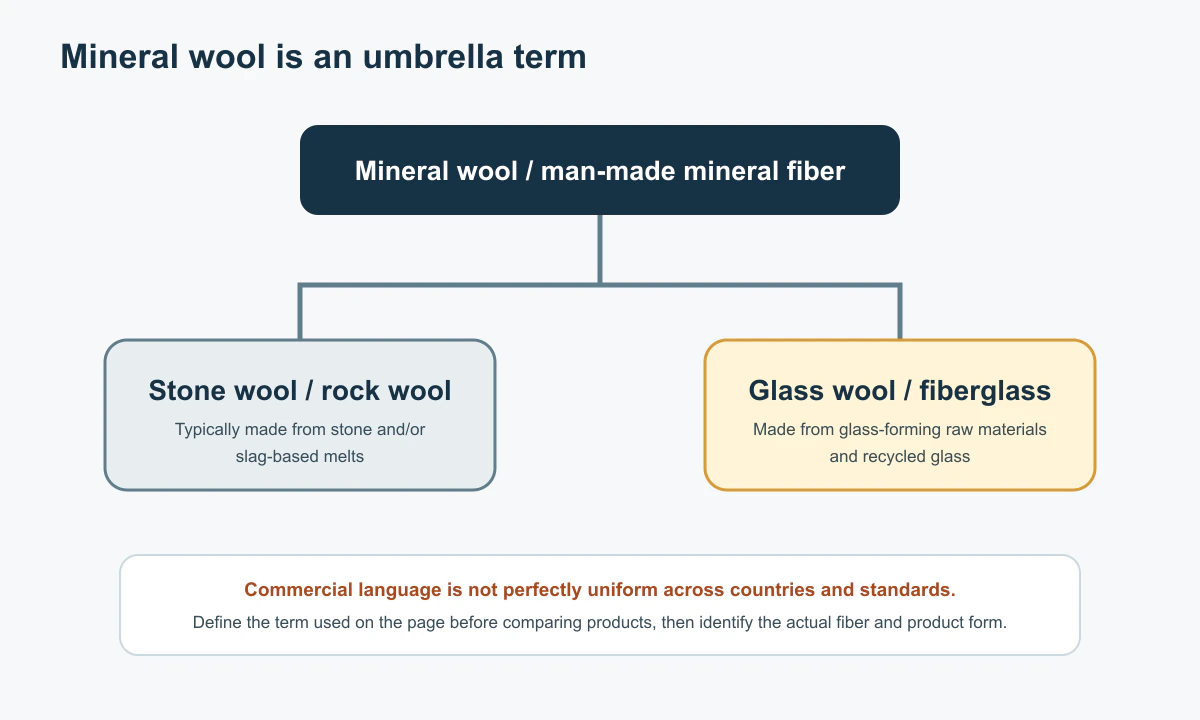
The name does not always mean rock wool. In North America, mineral wool commonly refers to rock wool and slag wool; in European and some international usage, it may also include glass wool. These materials share a fibrous structure but differ in raw materials, product forms and operating limits. So the answer to what is mineral wool insulation? must begin with the actual fiber type.
Three key points
- Know the familyA category, not a universal grade.
- Identify the fiberRock, slag or glass.
- Choose the formBoard, blanket, roll or pipe section.
What Is Mineral Wool Insulation Made Of?
What is mineral wool made of? The answer depends on the fiber family. Manufacturers melt inorganic feedstocks, spin or draw them into fibers, and form insulation products. Some finished products contain binders, facings or reinforcement to provide the required shape, handling characteristics or installation properties.
| Material | Raw materials and characteristics |
|---|---|
| Rock wool / stone wool | Made primarily from mineral rock such as basalt; used where thermal, acoustic and high-temperature performance are required. |
| Slag wool | Produced mainly from suitable metallurgical furnace slag; another mineral-fiber insulation type. |
| Glass wool / fiberglass | Made from glass-forming materials, including silica sand and recycled glass; commonly supplied as resilient thermal and acoustic insulation. |
The question what is mineral wool insulation made of? has no single raw-material answer. The fiber must be identified before comparing products.
Is Rockwool fiberglass? No. Rock wool and fiberglass use different raw materials and are distinct fiber products. Does Rockwool have fiberglass? Fiberglass is not a defining ingredient of rock wool, though both materials may occur in one insulation assembly.
What is mineral insulation? This broader term can include other mineral-based insulation materials. The product name and specification should identify the actual material.
For the manufacturing process, see How Rock Wool Is Made. For the distinction between industry terms, see Rock Wool vs Mineral Wool.
Why Mineral Wool Insulation Works: Thermal, Acoustic and Fire Performance
What is mineral wool insulation expected to achieve? Thermal insulation, sound absorption and fire-related performance are separate considerations. Each must be assessed against the relevant product grade, operating conditions and, where applicable, the tested assembly.
Thermal insulation. Air trapped among the fibers slows heat movement. Thermal conductivity is a key measure: under comparable test conditions, a lower value indicates less heat transfer. Increasing thickness generally increases thermal resistance; increasing density does not necessarily improve thermal performance. For hot equipment and process piping, conductivity at operating temperature is more relevant than a room-temperature value.
Sound absorption. Sound entering the open fiber network loses energy through air movement and friction. Mineral wool can contribute to acoustic performance in partitions, ceilings and equipment enclosures. Absorption is not the same as sound insulation: airborne sound reduction through a complete wall or enclosure also depends on its layers, joints, connections and sealing. Thickness, airflow resistivity, density and installation arrangement influence results.
Fire and temperature performance. Inorganic fibers support heat resistance, and rock wool is used in buildings and industrial applications where fire performance matters. What is mineral wool insulation made of? This matters for reaction-to-fire testing: binders and facings can affect the classification of the finished product. The fire-resistance period of a wall or other assembly applies to the tested construction, not to loose insulation alone. Likewise, fiber temperature tolerance is not necessarily the finished product's continuous service temperature. For handling and health considerations, see Rock Wool Safety.
What is mineral wool insulation suitable for? The answer requires product-grade performance data and the requirements of the complete construction. A material name or density alone is not a finished-system rating.
What Is Mineral Wool Insulation Used For?
Applications depend on surface geometry, operating conditions and required performance. Boards suit flat assemblies; blankets conform to curved surfaces; preformed sections fit cylindrical pipework.
| Application | Typical forms | Function |
|---|---|---|
| Exterior walls, roofs and partitions | Rock wool or glass wool boards | Thermal insulation, with acoustic or fire-related performance as required by the assembly |
| Interior acoustic assemblies | Boards or blankets | Fill wall and ceiling cavities to support sound control |
| HVAC ductwork and equipment | Suitable glass wool or rock wool blankets and boards | Thermal insulation and sound absorption around duct or equipment surfaces |
| Industrial tanks and large equipment | Rock wool blankets and wire-mesh-reinforced blankets | Cover curved or irregular surfaces to reduce heat loss |
| Industrial hot-water and process pipes | Preformed rock wool pipe sections | Form a regular insulation layer to limit heat loss and help control surface temperature |
For building assemblies, thermal conductivity and thickness must be considered together with available cavity depth. Depending on the design, dimensional stability, compressive strength and acoustic requirements may also matter.
For industrial equipment, service temperature, surface geometry, fixing methods and joint details are central to material and form selection.
What is mineral wool insulation used for in a complete system? It provides a fibrous insulating layer, not all protective components. Outdoor equipment may require protective cladding; chilled systems with condensation risk require suitable vapor control and sealed joints. Fibrous insulation alone does not replace a complete vapor barrier or waterproofing system. Fixings, joints and external protection become especially important at elevated temperatures.
Insulvora Mineral Wool Insulation Products
After answering what is mineral wool insulation?, buyers still need to select a suitable product form and grade. Insulvora supplies rock wool and glass wool products for buildings, HVAC systems and industrial equipment, with dedicated product pages below.
Rock Wool Board
Rock wool boards provide a stable panel form, with listed densities of 60–200 kg/m³ and thicknesses of 30–150 mm. Selection depends on insulation depth, assembly design and mechanical requirements.
Rock Wool Blankets and Wire-Mesh Blankets
Rock wool blankets offer flexible insulation for ductwork, equipment and curved surfaces. Wire-mesh rock wool blankets include reinforcement for wrapping and fastening around industrial pipes, tanks and irregular equipment. Product choice depends on service temperature, equipment size and attachment method.
Preformed Rock Wool Pipe Sections
Rock wool pipe sections provide a formed profile for industrial piping. Bore sizes and insulation thicknesses are selected according to the actual pipe outside diameter and thermal requirements. On straight runs, preformed sections help form a regular insulation layer without adapting a flat board or general-purpose blanket.
Glass Wool Board
Glass wool boards are used in partitions, suspended ceilings, roofs and other assemblies requiring thermal or acoustic performance. They differ from rock wool boards in available densities, mechanical properties, temperature ratings and product construction. Selection should reflect the complete assembly's fire and acoustic requirements.
Mineral Wool Insulation for Your Project
Insulvora can discuss rock wool and glass wool product forms, available specifications and project pricing. Share your application, required dimensions and operating conditions to review suitable options.