Mineral Wool vs Fiberglass: Differences, Performance and Selection
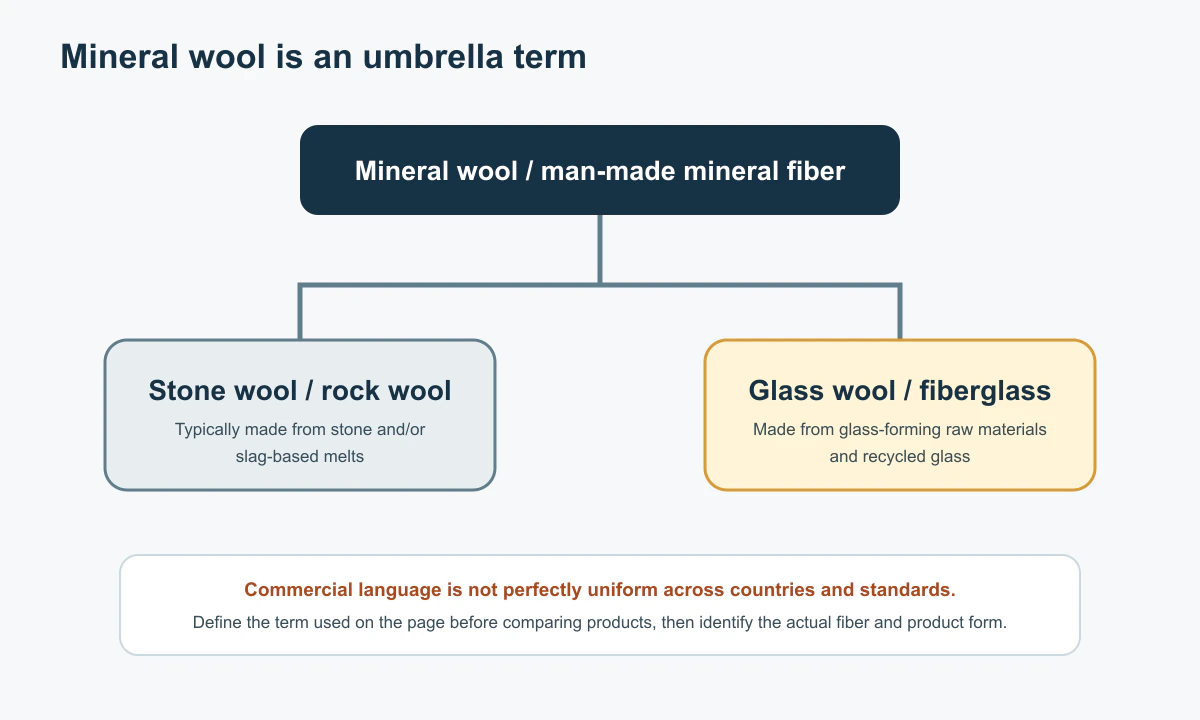
Mineral wool and fiberglass are not always separate insulation categories. In the broad technical sense, mineral wool includes glass wool (fiberglass), stone wool and slag wool. However, some North American catalogs and project specifications use “mineral wool” mainly to describe rock or stone wool, with fiberglass listed separately.
This distinction is the starting point for a mineral wool vs fiberglass comparison. When mineral wool refers to rock wool, the practical differences involve thermal performance, service temperature, rigidity, fire behavior and product form. The correct choice depends on the specified product grade and the requirements of the complete insulation system.
Key points for mineral wool vs fiberglass selection
- Clarify the terminologyConfirm whether mineral wool refers to the broad material family or specifically to rock wool.
- Compare equivalent productsCheck thickness, density, thermal conductivity, service temperature and product form.
- Consider the applicationWalls, roofs, industrial equipment and pipes have different performance requirements.
Quick selection guidance
Rock wool is often preferred where higher service temperatures, firmer boards or specific mechanical properties are required. Fiberglass offers lightweight blankets, rolls and boards suitable for many building and mechanical insulation systems. Both provide thermal insulation and sound absorption, but the selected grade and assembly determine actual performance.
How Mineral Wool and Fiberglass Are Classified
In mineral wool vs fiberglass specifications, the meaning of material names can vary across standards, supplier catalogs and purchasing documents.
| Term | Technical meaning | Common specification wording |
|---|---|---|
| Mineral wool | Broadly includes stone wool, glass wool and slag wool | Sometimes refers mainly to rock/stone wool or slag wool |
| Rock wool / stone wool | Fibers made from molten mineral raw materials, typically rock | Rock Wool Board; Stone Wool Pipe Section |
| Fiberglass / glass wool | Fibers made from molten glass-forming raw materials | Fiberglass Insulation; Glass Wool Board; Glass Wool Roll |
In a mineral wool vs fiberglass procurement review, a specification calling for a 50 mm “mineral wool board” may be interpreted differently by suppliers. One quotation could refer to rock wool and another to glass wool. Although the thickness is identical, the available density, rigidity and temperature ratings may differ.
The term “mineral fiber” also covers a broader material category. A mineral fiber vs fiberglass comparison therefore needs to identify the exact fiber type. If a design explicitly requires stone wool, fiberglass should be treated as a potential alternative requiring evaluation, not simply another name for the same product.

Rock Wool vs Fiberglass: Performance Differences
For projects where “mineral wool” means rock wool, the following properties are central to a mineral wool versus fiberglass assessment.
| Property | Rock wool | Fiberglass |
|---|---|---|
| Thermal performance | Effective thermal insulation; conductivity depends on grade and temperature conditions | Effective insulation; some grades offer lower conductivity |
| Service temperature | Includes a broad selection of higher-temperature industrial grades | Common in building and mechanical systems, with higher-temperature grades available |
| Density and rigidity | Dense rigid and semi-rigid boards and pipe sections available | Lightweight blankets and rolls, as well as denser boards |
| Fire performance | Used in systems requiring noncombustible materials | Unfaced glass wool can also be noncombustible, depending on composition |
| Acoustic performance | Used in partitions, building assemblies and equipment systems | Used in partitions, ceilings, ducts and equipment systems |
| Installation | Rigid grades help maintain shape and dimensional stability | Flexible, lightweight formats suit framing and irregular cavities |
| Moisture protection | Vapor control and external protection depend on the application | The same application-specific protection is required |
Thermal performance and service temperature
Neither material is universally superior in a mineral wool vs fiberglass thermal comparison. At equal thickness, the product with lower thermal conductivity generally provides greater material-layer thermal resistance.
A reliable mineral wool vs fiberglass insulation comparison therefore uses the conductivity of the actual product grade at relevant temperature conditions. Material names or density values alone cannot establish which product provides better thermal resistance.
Service temperature also matters in a mineral wool versus fiberglass assessment. Rock wool includes grades suitable for demanding industrial conditions, while glass wool products have their own specified operating limits. Higher-temperature glass wool grades are also available, so the actual product rating must be checked before making a selection.
Acoustic and fire performance
In a mineral wool vs fiberglass acoustic comparison, both materials can provide sound absorption. Their performance depends on fiber structure, airflow resistivity, thickness, cavity depth and surrounding construction.
A fiberglass insulation vs mineral wool acoustic comparison should consider the complete wall, ceiling or equipment assembly rather than density alone.
Fire performance also requires careful distinction. An insulation material classified as noncombustible does not automatically establish the fire-resistance rating of an entire wall, roof or partition. The relevant material classification and any required assembly rating must be evaluated separately.
Rock Wool and Glass Wool Board Specifications
For mineral wool vs fiberglass board evaluations, Insulvora supplies both rock wool and glass wool boards for suitable building and industrial insulation applications. The following ranges illustrate the available specifications and their differences.
| Specification | Rock Wool Board | Glass Wool Board |
|---|---|---|
| Density | 60–200 kg/m³ | 24–100 kg/m³ |
| Thickness | 30–150 mm | 20–130 mm |
| Thermal conductivity | 0.038–0.042 W/(m·K) | 0.035–0.042 W/(m·K) |
| Service temperature | Up to 600°C | Standard board: 350°C; high-temperature grade: 450°C |
| Product form | Rigid or semi-rigid board | Rigid or semi-rigid board |
| Typical applications | Walls, roofs, partitions, industrial insulation | Walls, partitions, roofs, curtain walls and related assemblies |
The conductivity ranges overlap substantially. In a fiberglass vs mineral wool insulation board comparison, the lowest conductivity figure from one material range should not be compared with an unrelated grade from the other.
Thermal resistance calculation
For a 50 mm board with a thermal conductivity of 0.040 W/(m·K), the calculated material-layer thermal resistance is:
R = 0.050 ÷ 0.040 = 1.25 m²·K/W
Under the same thickness and conductivity assumptions, rock wool and glass wool provide the same calculated material-layer thermal resistance.
In a mineral fiber vs fiberglass insulation comparison, higher density alone does not guarantee better thermal insulation. Density may influence other properties, such as rigidity and mechanical performance, but it is not a substitute for the specified thermal conductivity.
For a meaningful mineral wool vs fiberglass board comparison, conductivity values should be assessed at relevant mean temperatures. Board specifications must also be distinguished from the performance data of blankets, rolls and preformed pipe sections.
Available board products
- Rock Wool Board — density, thickness and rigidity options for building and industrial insulation.
- Glass Wool Board — board grades and thicknesses for walls, partitions, roofs and related systems.
Mineral Wool vs Fiberglass in Different Applications
The appropriate insulation depends on where it is installed and what the assembly must achieve. A mineral wool vs fiberglass selection should consider the product form, service conditions and required performance rather than relying on the material name alone.
Walls, Partitions and Ceilings
In a mineral wool vs fiberglass wall comparison, glass wool rolls, blankets and boards are commonly used in framed cavities, lightweight partitions and ceiling systems. Flexible products can fit around framing members and accommodate irregular spaces.
Rock wool boards can serve many of the same applications, especially where firmer insulation or particular mechanical and fire-performance characteristics are required.
For acoustic partitions, the selected insulation is only one component of the system. Cavity depth, framing connections, wall layers and finishes also affect sound performance. A fiberglass vs mineral wool insulation decision should therefore account for the complete assembly.
Roofs and Load-Bearing Assemblies
Roofs may impose mechanical requirements that are less important in ordinary wall cavities. Where insulation must withstand installation or service loads, compressive strength, dimensional stability and fixing arrangements become essential.
Certain high-density rock wool boards are suitable for these requirements. However, density alone does not establish compressive strength; the selected board must meet the mechanical requirements of the roof system.
A fiberglass insulation vs mineral wool comparison should also consider suitable glass wool products for roofing and metal-building assemblies, particularly in blanket, roll and purpose-designed board formats.
A mineral wool vs fiberglass roof comparison should follow the specified thermal, mechanical and fire requirements rather than assuming all insulation boards are interchangeable.
Industrial Equipment and Hot Pipes
For a mineral wool vs fiberglass comparison involving hot equipment and piping, continuous service temperature is a primary selection factor.
Rock wool pipe sections and blankets are commonly used for industrial equipment and higher-temperature lines. Glass wool pipe insulation can also be suitable where the operating temperature remains within the product's rated limits.
Insulvora offers preformed glass wool pipe insulation grades rated up to 450°C, with different pipe sizes and insulation thicknesses.
When conducting a mineral fiber insulation vs fiberglass evaluation for piping, compare the specifications of the actual pipe insulation products. Board data should not be used in place of pipe-section performance information.
A correctly rated glass wool section may serve a conventional heating line without requiring a higher-temperature rock wool grade.
Related pipe insulation products
- Rock Wool Pipe Section — preformed insulation for pipework requiring an appropriate higher-temperature grade.
- Glass Wool Pipe Insulation — preformed glass wool sections in different sizes and thicknesses.
For chilled-water and other below-ambient piping, both fibrous materials require effective vapor control, sealed joints and suitable external protection to prevent moisture ingress. Thermal properties alone are not sufficient to determine the complete insulation system.
Can Fiberglass Replace Mineral Wool?
In a mineral wool vs fiberglass substitution review, fiberglass can be considered as an alternative when a specification uses “mineral wool” to mean rock wool, provided the selected product meets the required performance conditions.
In general thermal insulation, acoustic assemblies and cavity-fill applications, suitable grades of either material may satisfy the design requirements.
However, substitution should not be assumed where the specification requires particular high-temperature performance, compressive properties, reaction-to-fire classifications or an approved assembly.
A mineral wool insulation vs fiberglass substitution must be assessed against the actual design and specified product characteristics. Equivalent thickness does not necessarily mean equivalent mechanical properties, temperature limits or system performance.
If stone wool is explicitly specified, an alternative fiberglass product must be evaluated against the stated requirements before it can be treated as an acceptable substitute.
For a mineral fiber vs fiberglass procurement review, clear material identification, product form, performance requirements and installation conditions are more reliable than a generic material label.
Insulvora Rock Wool and Glass Wool Products
Insulvora supplies rock wool boards, blankets and preformed pipe sections, alongside glass wool boards, rolls and pipe insulation.
For mineral wool versus fiberglass supply comparisons, the product ranges cover different densities, thicknesses, dimensions and grades for suitable building, mechanical and industrial applications.
For a mineral wool vs fiberglass purchasing decision, the product pages provide the next level of material and specification information.
Product categories
Related technical comparisons
Discuss Mineral Wool vs Fiberglass With Insulvora
Insulvora supplies rock wool and glass wool insulation in board, blanket, roll and preformed pipe formats for suitable building and industrial projects.
Share the application, required product form, thickness, operating temperature and performance requirements. Insulvora can discuss the applicable material grades, available specifications, supply options and pricing based on those details.