
Duct Insulation R-Value: Requirements, Thickness & Material Selection
The duct insulation R-value describes the resistance of an insulation layer to heat flow. For supply, return and outdoor HVAC ducts, the required resistance depends on the duct location, the applicable project requirements and the temperature difference between the duct air and its surroundings. Material conductivity, effective installed thickness and moisture conditions also affect the final selection.
US R-6, R-8 and R-12 are commonly referenced targets in particular duct-insulation code frameworks; they are not universal requirements. Once the applicable duct insulation R-value target is known, it can be translated into an effective thickness and then matched to a suitable glass wool roll, glass wool board or closed-cell rubber foam product.

Key checks before specifying a system
- Code and locationConfirm whether R-6, R-8, R-12 or another requirement applies to the duct's actual location.
- Effective thicknessUse thermal conductivity at the relevant mean temperature and allow for any compression of flexible wrap.
- System continuityAccount for joints, fasteners, framing bridges, vapor control and exposure to outdoor conditions.
What R-Value Is Needed for Different Duct Locations?
Duct location is the starting point for selecting a duct insulation R-value. Some US energy codes distinguish ducts in unconditioned spaces from those outside the building, while other installations require assessment against their particular thermal and moisture conditions. The following table is a selection reference, not a set of worldwide minimums.
| Duct location or condition | R-value reference | Main considerations |
|---|---|---|
| Supply or return ducts in unconditioned spaces | R-6 is specified in certain codes | Heat exchange with the surrounding space |
| Ducts outside the building | R-8 or R-12 is specified in certain codes | Climate zone, outdoor temperature difference, heat loss and weather protection |
| Ducts above ceilings, in cavities or in roof spaces | Depends on space classification and project requirements | Building envelope, duct location, temperature difference and installation space |
| Cold supply ducts in humid environments | Determine thermal resistance together with condensation control | Insulation surface temperature, dew point and vapor-barrier continuity |
| Ducts in conditioned areas with small temperature differences | Based on actual thermal and project requirements | Heat exchange, condensation risk and acoustic needs |
The applicable code, building use and climate zone determine whether a stated rating is required. Cold supply ducts in warm, humid surroundings also need a condensation assessment: meeting a specified duct insulation R-value alone does not establish that the outer surface and vapor-control assembly will remain dry. For material selection by supply- and return-air conditions, see Air Duct Insulation.
Duct Insulation R-Value Calculations and Thickness Chart
Calculate R-Value from Thickness and Conductivity
For a uniform, flat layer of insulation, the duct insulation R-value follows the relationship:
Rₛᵢ = t / λ
- Rₛᵢ: Thermal resistance in m²·K/W.
- t: Effective insulation thickness in meters.
- λ: Thermal conductivity in W/(m·K).
To express the result in US units:
US R-value ≈ 5.678 × Rₛᵢ
US R-6 corresponds to approximately 1.06 m²·K/W; R-8 to 1.41 m²·K/W; and R-12 to 2.11 m²·K/W. At the same thickness, lower conductivity gives greater thermal resistance. At a fixed conductivity, greater effective thickness increases the calculated resistance.
For example, with λ = 0.040 W/(m·K), the approximate effective thickness required is 42 mm for US R-6, 56 mm for US R-8, and 85 mm for US R-12. These figures describe a calculated insulation layer, not necessarily the nominal thickness of a purchased roll or the performance of a complete duct assembly.
Thickness Reference Chart
The chart compares four effective thicknesses at three conductivity values. It is useful for estimating a duct insulation R-value before selecting a product with relevant, documented conductivity data.
| Effective insulation thickness | λ = 0.035 W/(m·K) | λ = 0.040 W/(m·K) | λ = 0.045 W/(m·K) |
|---|---|---|---|
| 25 mm | US R-4.1 | US R-3.5 | US R-3.2 |
| 50 mm | US R-8.1 | US R-7.1 | US R-6.3 |
| 75 mm | US R-12.2 | US R-10.6 | US R-9.5 |
| 100 mm | US R-16.2 | US R-14.2 | US R-12.6 |
Calculation basis: Each value uses the flat-layer thickness-to-conductivity relationship. The results exclude compression, joints, fasteners and other thermal bridges. They are comparison calculations, not measured ratings for complete duct assemblies.
For example, at 50 mm effective thickness, λ = 0.035 W/(m·K) gives approximately US R-8.1, while λ = 0.040 W/(m·K) gives approximately US R-7.1. That difference shows why equal thickness does not necessarily deliver equal thermal resistance. Conductivity must be taken at an appropriate mean temperature; figures quoted at different temperatures should not be treated as directly comparable when matching a duct insulation R-value to a specified thickness.
Installed Duct Insulation R-Value: Compression and System Conditions
How Compression Changes Effective R-Value
Flexible glass wool duct wrap can be compressed around corners, bends, flanges and fastening points. An R-value calculated from uncompressed thickness therefore may not represent the layer after installation. Some duct-wrap rating or installation methods use 75% of nominal thickness as an installed-thickness basis, but this is not a universal rule for every insulation material or product.
Consider glass wool wrap with a nominal thickness of 75 mm. At 75% of nominal thickness, the effective thickness is about 56 mm. If λ is assumed to remain 0.040 W/(m·K), a thickness-only calculation gives:
- 75 mm nominal thickness: Approximately US R-10.6 before the assumed reduction.
- 56 mm effective thickness: Approximately US R-8.0 after the assumed reduction.
The example illustrates the effect of thickness reduction, not a tested installed R-value for a particular roll. Actual conductivity after compression, product rating methods and installation conditions may produce different results. The duct insulation R-value used for specification should therefore be checked against the applicable product rating and installation method.
Supported glass wool boards can retain a more consistent thickness than flexible wraps in appropriate external insulation systems. However, neither product form eliminates thermal bridges at metal hangers, flanges, connections or gaps in insulation coverage. A specified duct insulation R-value needs to be considered alongside how the complete insulation layer is installed.
Condensation, Weather Protection and Installation Clearance
Condensation control. On cold supply ducts, the outer insulation surface may collect moisture if its temperature falls below the dew point of the surrounding air. Thermal resistance can help raise that surface temperature, but condensation risk also depends on ambient temperature, relative humidity, supply-air temperature and surface heat transfer. Fibrous insulation systems need suitable vapor-resistant facings and sealed seams and penetrations to restrict moisture entry. Wet insulation can lose thermal effectiveness and allow concealed condensation problems.
Outdoor protection. The duct insulation R-value measures resistance to heat flow; it does not indicate resistance to rain, ultraviolet exposure or impact. Exterior insulation therefore needs suitable cladding for the actual exposure conditions, with attention to joints and penetrations.
Installation clearance. The design must leave room for the specified effective insulation thickness around ceilings, hangers, equipment and adjacent services without obstructing flanges, access doors or maintenance areas. Details at corners, fasteners and transitions should preserve the intended insulation and vapor-control continuity. For installation details, see Duct Insulation Installation.
Matching Glass Wool and Rubber Foam to Duct Requirements
Insulvora supplies three relevant product forms for appropriate external duct insulation. Product selection starts with the specified duct insulation R-value, then considers duct geometry, humidity, available space, facing requirements and the applicable operating and fire conditions. The ranges below are supply information; an installed system still needs to be checked against project conditions.
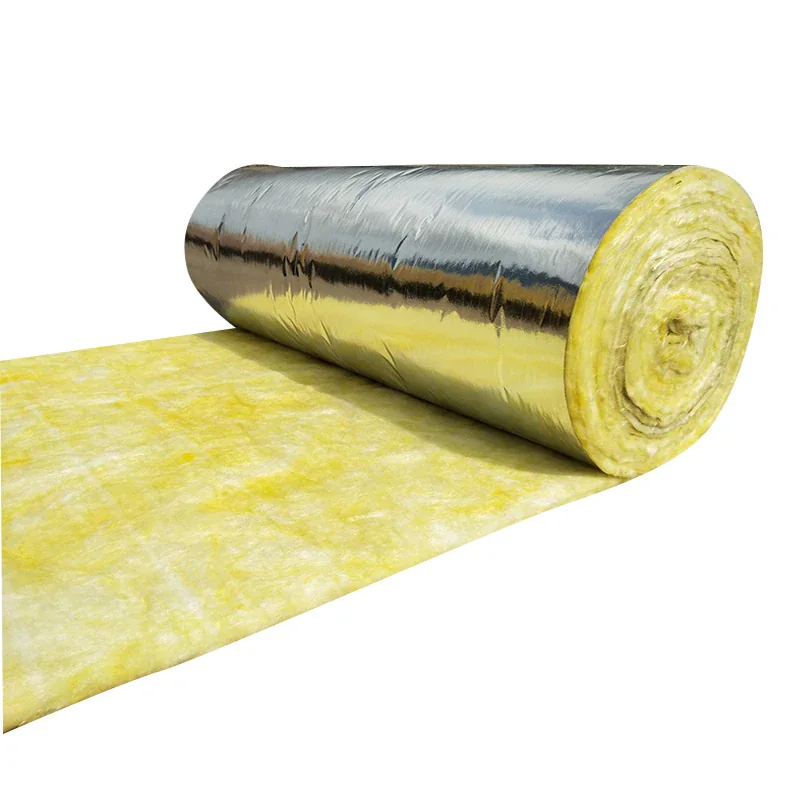
Foil Faced Glass Wool Roll for External Duct Wrap
Foil Faced Glass Wool Roll is suited to flexible external wrapping on rectangular metal ducts and certain round ducts. Insulvora supplies 25–100 mm thicknesses, with glass wool thermal conductivity of 0.035–0.042 W/(m·K). Plain aluminum foil, reinforced foil and other facing options are available.
To meet a duct insulation R-value target of R-6 or R-8, select the grade and thickness by the required effective installed resistance rather than nominal thickness alone. Higher targets may call for greater thickness or a suitable multilayer arrangement, with compression considered. The foil facing may form part of the vapor-control system, subject to the facing construction and sealing of seams and penetrations.
Glass Wool Board for Stable Panel Insulation
Glass Wool Board is available in 20–130 mm thicknesses, with thermal conductivity of 0.035–0.042 W/(m·K). The board form is appropriate for flat external duct surfaces and related equipment where a supported panel insulation system is suitable. Correct support and protection help maintain the intended thickness; joints, corners and fasteners still require attention.
External glass wool board is not the same product as purpose-made internal duct liner. If insulation is exposed to the airstream, the product and assembly must be suitable for that service.
Closed-Cell Rubber Foam for Moisture-Sensitive Ductwork
Foil Faced Rubber Foam Board uses closed-cell NBR/PVC foam for suitable external duct applications, subject to service temperature, installation and fire requirements. Insulvora offers thicknesses of 5, 10, 20, 30 and 50 mm, with base-material thermal conductivity no greater than 0.034 W/(m·K) at 0°C. Foil finishes and self-adhesive configurations are available.
Its closed-cell structure provides water-vapor resistance characteristics different from fibrous insulation, which can be useful on cold ducts in humid environments. Seams, edges and penetrations still need a continuous sealed assembly. When comparing this product's duct insulation R-value with glass wool options, remember that a conductivity value stated at 0°C cannot automatically be compared with a value determined at a different mean temperature.
Match the Required R-Value to Available Duct Insulation
Insulvora supplies foil-faced glass wool rolls, glass wool boards and closed-cell rubber foam sheets for external duct insulation. Share your required R-value, duct dimensions, service conditions and facing requirements. We can then discuss suitable thicknesses, product configurations and pricing for your project.