
Mineral Wool Insulation Thickness: Choosing Rock Wool Boards, Blankets and Pipe Sections
Choosing mineral wool insulation thickness starts with the required thermal performance, application and installation. For rock wool in walls and roofs, the main considerations are R-value or overall heat-transfer targets. Industrial equipment may require heat-loss and surface-temperature limits, while pipes also call for pipe diameter and operating temperature to be considered.
As an example, rock wool with a thermal conductivity of 0.040 W/(m·K) provides a material R-value of approximately 1.25 m²·K/W at 50 mm thickness and 2.50 m²·K/W at 100 mm. A thicker layer offers greater resistance, but actual requirements depend on the design and installation.
Three points to keep the technical answer tied to the real project:
- Start with the targetTranslate the required R-value, heat-loss or surface-temperature objective into thickness.
- Match the applicationBoards, blankets and pipe sections have different available thickness ranges.
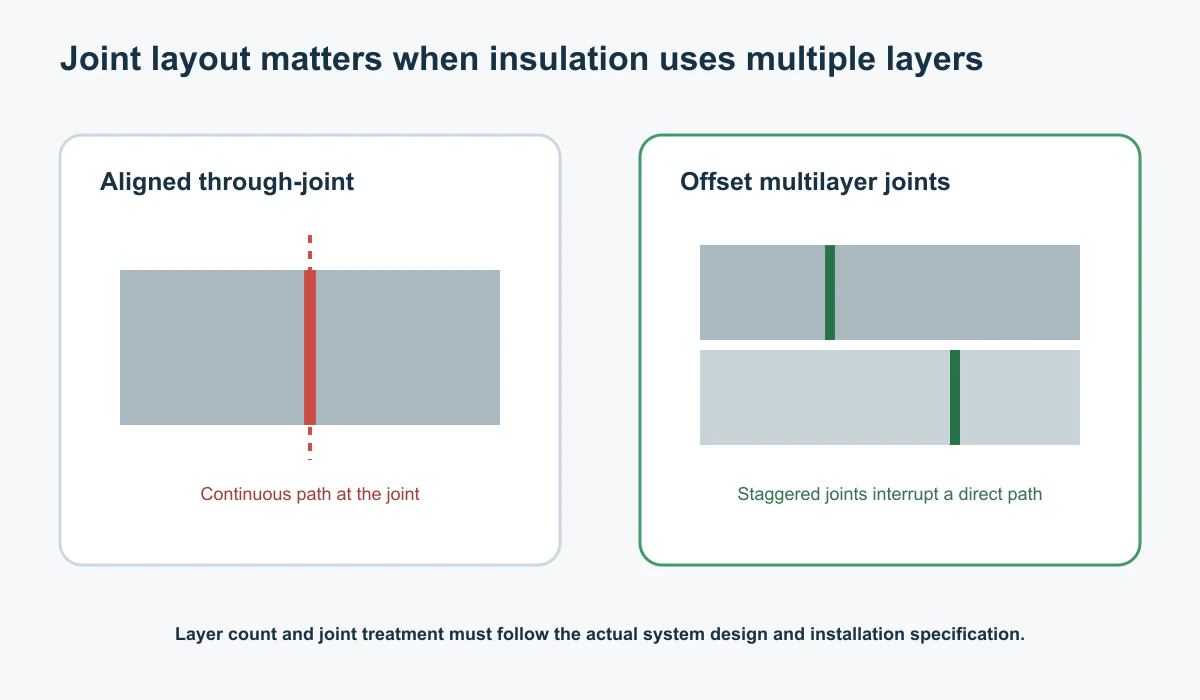
- Detail multiple layersStagger longitudinal and transverse joints to avoid continuous gaps.
Insulvora supplies rock wool boards, blankets, wire mesh blankets and preformed pipe sections in various thicknesses and densities for building, acoustic and industrial projects.
How Rock Wool Thickness Affects Thermal Resistance
For flat insulation layers, mineral wool insulation thickness and thermal conductivity determine the material's thermal resistance:
R = d / λ
Here, R is material thermal resistance (m²·K/W), d is insulation thickness (m), and λ is thermal conductivity (W/(m·K)).
The following values assume 0.040 W/(m·K) throughout.
| Rock wool thickness | Reference R-value | Relative to 50 mm |
|---|---|---|
| 30 mm | 0.75 m²·K/W | 0.6× |
| 50 mm | 1.25 m²·K/W | 1.0× |
| 75 mm | 1.88 m²·K/W | 1.5× |
| 100 mm | 2.50 m²·K/W | 2.0× |
| 120 mm | 3.00 m²·K/W | 2.4× |
| 150 mm | 3.75 m²·K/W | 3.0× |
These are calculated values for a uniform, flat insulation layer, not the total thermal resistance of a complete wall or roof assembly.
For a target material R-value of 2.50 m²·K/W, the calculated thickness is 100 mm at 0.040 W/(m·K), or approximately 105 mm at 0.042 W/(m·K).
This is why mineral wool insulation thickness should not be evaluated separately from the material's conductivity. Two products of equal thickness may not deliver the same R-value. For imperial units and further thickness comparisons, see Rock Wool R-Value per Inch.
Choosing Thickness for Different Applications
The right mineral wool insulation thickness depends on the job. Building envelopes, acoustic partitions, equipment and pipework have different requirements.
| Application | Main factors affecting thickness | Relevant product forms |
|---|---|---|
| Exterior walls and roofs | Target R-value or U-value, available space, thermal bridges and installation details | Rock wool boards, exterior wall boards, roof boards |
| Partitions and acoustic assemblies | Cavity depth, fill arrangement and required sound absorption or sound insulation | Rock wool boards and blankets |
| Industrial equipment and hot surfaces | Operating temperature, allowable heat loss, surface temperature and protective construction | Rock wool boards and wire mesh blankets |
| Industrial and mechanical pipes | Actual pipe outside diameter, fluid temperature, heat loss per unit length and clearance | Preformed rock wool pipe sections and blankets |
Building Walls and Roofs
For building envelopes, mineral wool insulation thickness follows the thermal target and material conductivity, subject to the available construction depth.
Studs, fasteners, joints and other thermal bridges affect finished-wall performance. A rock wool layer may meet its own R-value target without the whole assembly doing so. Continuous exterior insulation and cavity infill can therefore perform differently at equal thickness.
Roofs also require suitable compressive performance, substrate support, waterproofing and fixings. Increasing the thickness of an ordinary board does not make it suitable for specified roof loads.
Insulvora offers Exterior Wall Rock Wool Board and Roof Rock Wool Board in thicknesses from 30 to 150 mm for their respective building applications.
Partitions and Acoustic Infill
For partitions and ceilings, mineral wool insulation thickness must suit the cavity depth, fill properties and assembly design.
A 75 mm partition cavity can accommodate suitable rock wool infill, but sound insulation also depends on facing boards, framing, air leakage and sound bridges.
Thicker infill may improve absorption at some frequencies, but twice the thickness does not mean twice the sound reduction. Specified acoustic ratings must be considered at assembly level.
Industrial Equipment and Hot Surfaces
For industrial service, mineral wool insulation thickness is commonly selected to reduce heat loss, keep exposed surface temperatures within the required limits, or meet both objectives.
Unlike a wall at ordinary temperatures, high-temperature equipment requires conductivity data appropriate to its operating conditions. Thickness calculated from a room-temperature conductivity value should not be carried over unchanged to high-temperature service.
Rock wool boards may suit flat equipment surfaces, while flexible blankets or Wire Mesh Rock Wool Blankets can be easier to wrap and secure around large vessels, curved equipment and irregular shapes.
Thicker systems also need suitable layers, pins, supports and metal cladding, with allowance for their effect on space and heat loss.
Industrial and Mechanical Pipes
For pipework, mineral wool insulation thickness depends on the actual pipe outside diameter, operating and ambient temperatures, and the required heat-loss performance. Heat flow through cylindrical insulation differs from that through a flat layer, so the flat-layer R-value table above is not a direct pipe thickness chart.
Preformed pipe sections must fit the actual pipe outside diameter. A 114 mm pipe with 50 mm insulation has a theoretical insulated diameter of 214 mm, excluding cladding and other outer components. This matters for pipe spacing, supports and maintenance access.
Rock Wool Pipe Sections offer a consistent cylindrical form for straight runs. Suitable blankets may be used for large diameters or more complex shapes, depending on the installation.
Insulvora Mineral Wool Insulation Thickness Ranges
Available mineral wool insulation thickness ranges vary by product form. The appropriate choice also depends on density, dimensions and the installation method.
| Product form | Available thickness | Typical applications |
|---|---|---|
| Rock Wool Board | 30–150 mm | Walls, roofs, partitions and flat equipment surfaces |
| Rock Wool Blanket | 25–200 mm | Large or curved surfaces, equipment wrapping and acoustic infill |
| Wire Mesh Rock Wool Blanket | 30–100 mm | Large-diameter pipes, industrial equipment and irregular surfaces |
| Rock Wool Pipe | 20–150 mm | Industrial and mechanical pipe insulation |
Equal nominal thickness does not make different product forms interchangeable.
A 100 mm board and a 100 mm blanket may differ in density, rigidity, fixing and temperature rating. Roofs carrying specified loads need boards with suitable mechanical properties.
Thickness defines the insulation layer's dimensions; density and product construction must be selected for the application. Higher density does not automatically mean higher thermal resistance. For further guidance, see the Rock Wool Density Guide.
Single-Layer vs. Multi-Layer Rock Wool Insulation
As mineral wool insulation thickness increases, a project may use one layer or multiple layers, depending on the available product sizes and installation details.
For example, 100 mm may be installed as one layer or, where suitable, two 50 mm layers. With comparable materials and close-fitting installation, nominal R-values are similar, but joints and fixings affect installed performance.
In multi-layer construction, joints can be staggered between layers to reduce continuous gaps through the insulation. On pipes, both longitudinal and circumferential joints deserve attention.
Boards and blankets should also retain their intended installed thickness. Large gaps, local compression and interruptions around supports can reduce the effectiveness of the insulation layer.
For equipment and pipes, additional layers affect cladding size, supports and access. Where an assembly must meet a specified fire-resistance requirement, its layers, density, fasteners and joints must follow the applicable system design.
Confirm Rock Wool Thickness and Product Specifications
Once the required mineral wool insulation thickness is established, Insulvora can match it to available rock wool boards, blankets, or pipe sections. Share the application, thickness, density, and dimensions to discuss suitable specifications and pricing.