
Pipe Insulation Vapor Barrier: Continuous Moisture Protection for Cold Piping
For chilled-water lines, air-conditioning refrigerant pipes, and other piping operating below ambient temperature, a pipe insulation vapor barrier limits moisture movement into the insulation and toward the cold pipe. Its performance depends on a continuous low-permeance system—not just the vapor resistance of the insulation or facing material.
The vapor-control layer normally belongs on the warm, humid side of the insulation. Closed-cell elastomeric foam can provide vapor resistance within the insulation itself when its seams, butt joints, and fittings are sealed. Fiberglass and rock wool pipe sections generally require a separate external vapor retarder with sealed laps, penetrations, and terminations.
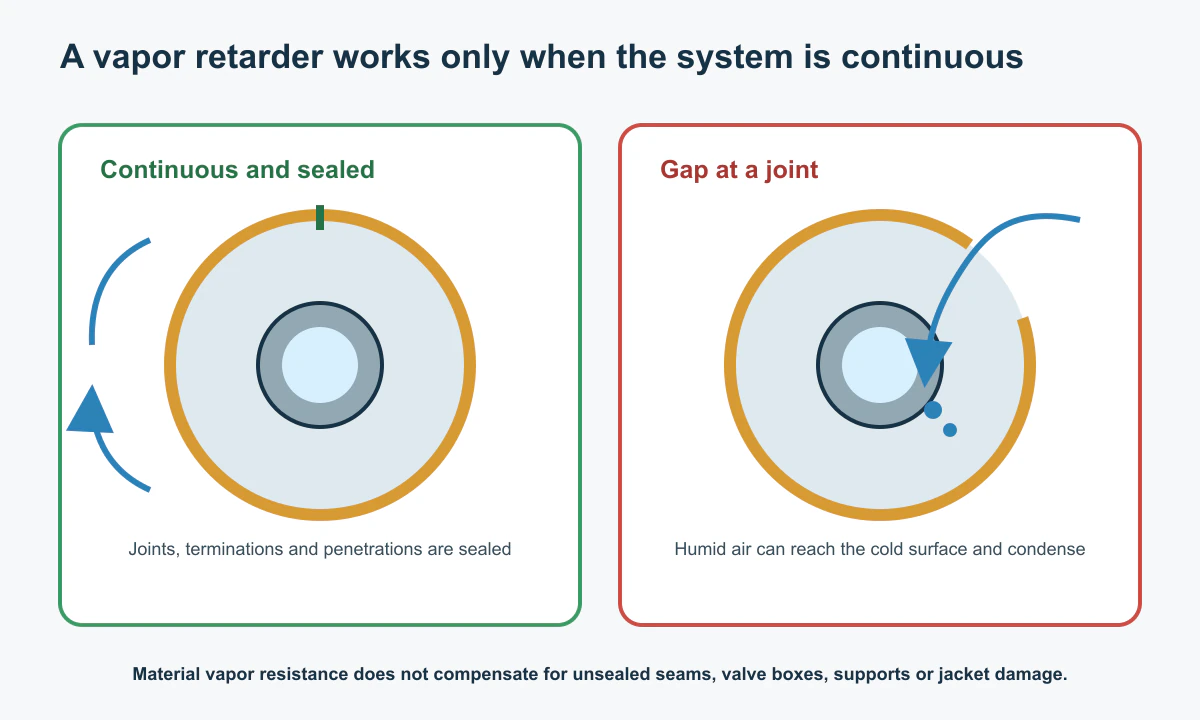
Where Should the Vapor Barrier Be Located on Cold Pipes?
On cold piping, the pipe insulation vapor barrier is normally placed at the outside of the insulation, facing the warmer and more humid surroundings. Water vapor tends to move from higher to lower vapor pressure. Open seams and unsealed penetrations can also allow humid air to reach colder surfaces, where moisture may condense.
Once moisture enters the insulation, it can reduce thermal performance, cause staining or dripping, and increase the risk of corrosion under insulation on susceptible pipes. A complete cold-pipe assembly therefore needs three related—but distinct—functions:
| Component | Main function | Typical construction |
|---|---|---|
| Thermal insulation | Reduces heat gain and, at sufficient thickness, helps keep the outer surface above the dew point. | Closed-cell elastomeric tubes or preformed fiberglass and rock wool sections. |
| Vapor-control layer | Restricts vapor diffusion and air leakage through joints and penetrations. | Sealed closed-cell insulation, or a separate facing, membrane, or coating with sealed connections. |
| Protective jacket | Protects against rain, mechanical damage, and outdoor exposure. | Metal cladding, suitable composite jacketing, or other protective finishes. |
A metal jacket or foil facing may resist vapor movement, but it does not complete a pipe insulation vapor barrier unless its relevant laps, ends, and penetrations are sealed. Weather protection and vapor control may be incorporated into the same assembly, but their functions should not be confused.
For demanding refrigeration service, a vapor-retarder permeance of 0.02 US perm or less may be used as a reference specification. This material-level criterion does not replace the need to assess the installed system, particularly its joints and terminations.
How Vapor Control Changes with Insulation Material
The construction of a pipe insulation vapor barrier depends on the insulation material, its resistance to moisture vapor, and the service conditions. Closed-cell foam and fibrous pipe sections require different approaches to continuous vapor control.
Closed-Cell Rubber Foam for Chilled Water and AC Lines
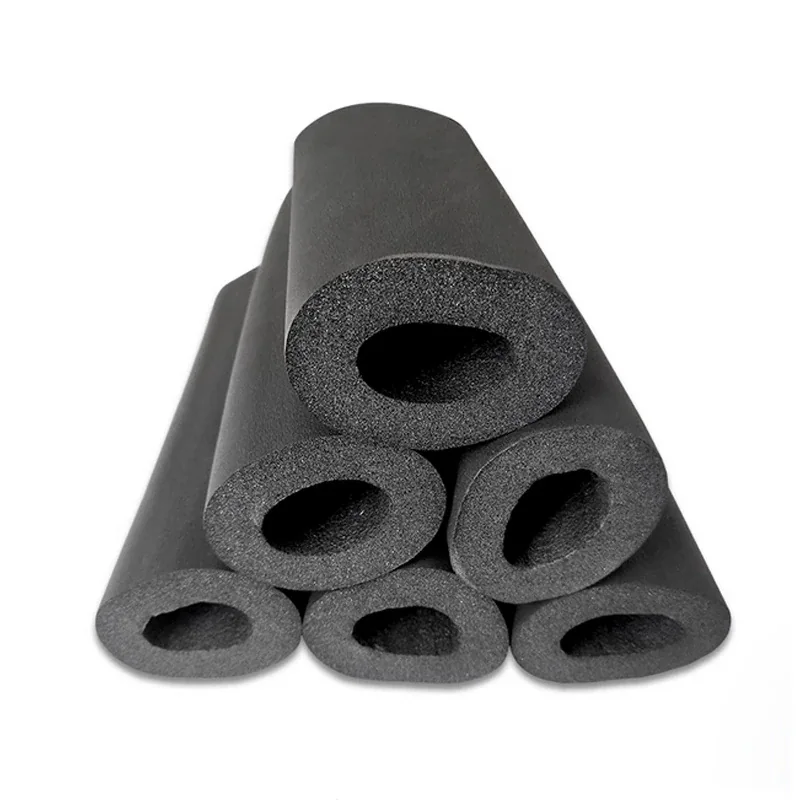
NBR/PVC closed-cell elastomeric foam has relatively low water-vapor permeability. In suitable chilled-water and air-conditioning applications, the foam and its sealed connections can provide both thermal insulation and vapor resistance without a separate external vapor-retarder membrane. Preformed tubing is also practical around bends, changes in pipe size, and restricted installation spaces.
Insulvora's Slit Rubber Foam Pipe is preformed tubing with a longitudinal slit for fitting around new or existing pipework. Available wall thicknesses include 15, 20, 25, 30, 40, and 50 mm; inside-diameter availability varies with thickness.
For this arrangement, the pipe insulation vapor barrier remains effective only when slits, butt joints, and fabricated fittings are sealed with a compatible adhesive or joint-sealing system. The practical first choice for many chilled-water and AC lines is therefore closed-cell tubing with a properly sealed joint system, not unsealed foam alone.
Fiberglass and Rock Wool with a Separate Vapor Retarder
Fiberglass and rock wool pipe sections provide thermal insulation but do not themselves form a continuous pipe insulation vapor barrier. For cold-pipe service, a suitable low-permeance facing, membrane, or coating is generally required outside the fibrous insulation. The separate layer must remain continuous across straight sections, fittings, valves, and terminations.
Insulvora's Glass Wool Pipe Insulation is available with 22–720 mm inside diameters and 25–100 mm insulation thicknesses. Rock Wool Pipe is available with 22–910 mm inside diameters and 20–150 mm thicknesses. Where either product is used on cold piping, the specified vapor-retarder assembly and any required protective jacket must be considered separately from the fibrous insulation.
Service temperature, ambient humidity, and the consequences of condensation all influence this selection. Similar thermal-conductivity values do not establish equivalent resistance to moisture entry. Where project specifications require fibrous sections, the vapor-control system must be selected and detailed as part of the complete assembly. For available pipe sizes and related technical requirements, see Pipe Insulation Specification.
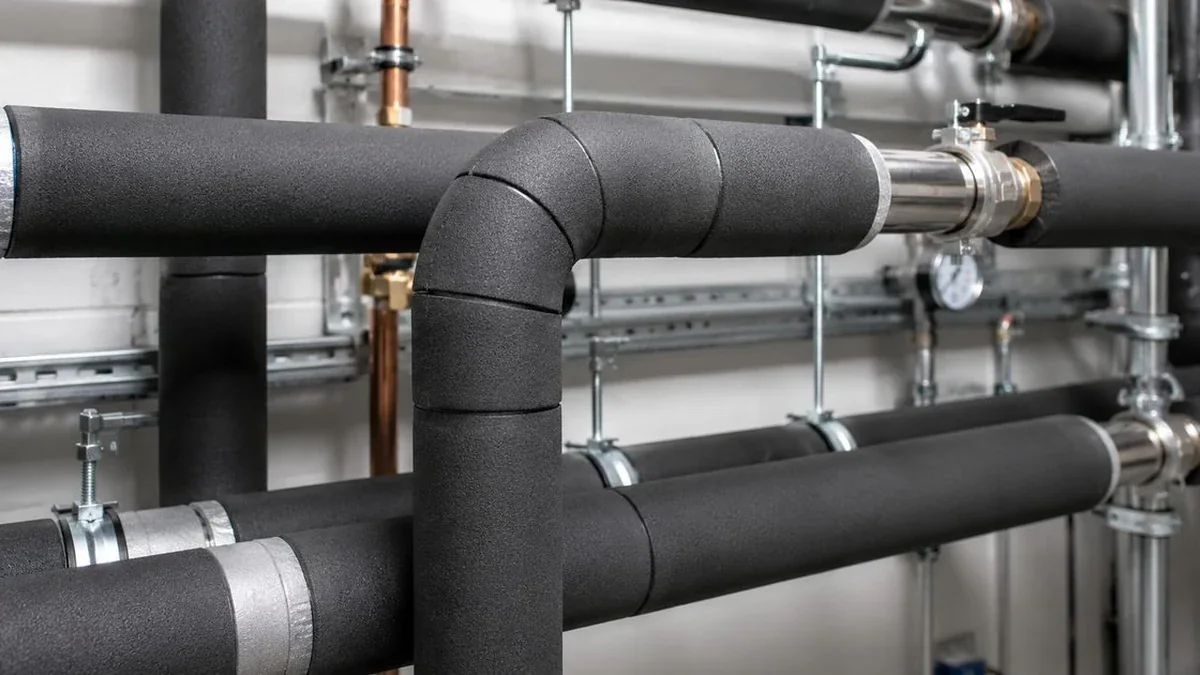
Seams, Supports, and Valves: Keeping the Barrier Continuous
Straight pipe runs are generally easier to insulate. A pipe insulation vapor barrier is more vulnerable wherever insulation is cut, joined, supported, penetrated, or made removable. These details need attention before an external jacket conceals the sealing work.
Longitudinal and butt joints. Adjacent sections and slit tubes should fit closely and be continuously sealed. Elastomeric systems typically use compatible adhesives; external vapor retarders use the specified laps, tapes, sealants, or coatings. For multilayer insulation, staggered joints help avoid a direct path through the full thickness. Do not install metal cladding over unfinished joints.
Elbows, tees, and reducers. Use suitable preformed fittings or carefully fabricated sections to follow changes in pipe geometry. Cut faces should fit closely, with no open edges in the vapor-control layer. External systems may require compatible vapor-retarder mastic, reinforcing fabric, or formed coverings to connect fittings to straight runs.
Valves, flanges, and removable covers. Removable insulation needs a suitable seal against the adjoining fixed insulation while preserving maintenance access. Where specified, vapor stops at valves, flanges, or other section boundaries seal the annular space between pipe and insulation, helping limit the spread of moisture intrusion along the line.
Supports and penetrations. Hangers can compress soft insulation or interrupt a pipe insulation vapor barrier. Load-bearing insulation supports, support blocks, or protective saddles help distribute loads and reduce compression. Seal any penetration through the vapor-control layer, including at supports, wall and floor openings, and insulation terminations.
Insulation Thickness, Vapor Control, and Outdoor Protection
A pipe insulation vapor barrier restricts moisture entry; insulation thickness controls heat gain and external surface temperature. More thickness can reduce the risk of surface condensation but cannot compensate for an open vapor seal. Similarly, a well-sealed vapor retarder cannot prevent surface condensation if the insulation is too thin to maintain the outer surface above the ambient dew point.
Choose thickness using the pipe operating temperature, surrounding temperature and humidity, insulation thermal conductivity, and pipe size. The Pipe Insulation Thickness Chart provides guidance under defined conditions; it should not be treated as a substitute for checking the actual operating environment.
Outdoor cold piping needs weather-resistant protection in addition to vapor control. Cladding and its laps and terminations should shed rainwater without puncturing or damaging the underlying pipe insulation vapor barrier. The vapor retarder limits inward moisture movement, while the outer jacket protects against rain, ultraviolet exposure, and mechanical damage.
For systems already showing sweating or localized dripping, Pipe Condensation Insulation explains dew-point conditions, insulation thickness, and common weak points.
Checking the Completed Vapor Barrier
Before installing opaque cladding or other outer coverings, inspect the pipe insulation vapor barrier while joints and details remain visible. Confirm that the insulation is dry and that longitudinal and butt joints, fittings, valves, supports, and penetrations are fully sealed.
For a pipe insulation vapor barrier using an external facing or membrane, check lap continuity and adhesion. Look for lifted edges, damage, and gaps where tapes or sealants meet the substrate. Outdoors, confirm that the finished jacket sheds water and that fasteners and sharp metal edges do not puncture the vapor-control layer.
If condensation, staining, or wet insulation develops after installation, examine the affected area's insulation thickness, joints, supports, and vapor-control details before concluding that the insulation material has failed. This separates possible surface-temperature problems from failures of vapor continuity.
Cold-Pipe Insulation Products and Project Quotes
Insulvora supplies closed-cell elastomeric tubing, fiberglass pipe sections, and rock wool pipe sections for chilled-water, air-conditioning, and related piping projects. Share your pipe sizes, required insulation thicknesses, service conditions, and proposed vapor-control construction so the available product dimensions can be checked against your project requirements and a quotation prepared.