
Thermal Conductivity of Fiberglass: Values, Temperature Effects, and Material Selection
The thermal conductivity of fiberglass insulation is typically around 0.033–0.045 W/(m·K) at commonly referenced temperatures. The actual value depends on product grade, density, fiber structure, mean temperature, and test conditions. At the same thickness and temperature, a lower conductivity value provides greater thermal resistance.
For Insulvora's fiberglass rolls, standard boards, and preformed pipe sections, the listed product ranges are 0.035–0.042 W/(m·K) . High-density fiberglass boards have a listed range of 0.038–0.045 W/(m·K) . These ranges are starting points for comparison, not universal values for every temperature or installation.
Three conditions for a meaningful comparison:
- Mean temperature: Compare the thermal conductivity of fiberglass at the same or equivalent mean temperature.
- Product grade: Check the stated grade, density, fiber structure, facing, and applicable test basis rather than comparing material names alone.
- Insulation thickness: Use conductivity together with the installed thickness when assessing thermal resistance or heat flow.
Thermal Conductivity of Fiberglass by Product Form
Fiberglass is supplied in flexible rolls, insulation boards, high-density boards, and preformed pipe sections. Their conductivity ranges may overlap even when density, rigidity, available thickness, and installation characteristics differ. The table below reflects Insulvora's existing product lines.
| Product form | Thermal conductivity, W/(m·K) | Density, kg/m³ | Available thickness |
|---|---|---|---|
| Fiberglass insulation roll | 0.035–0.042 | 10–72 | 25–100 mm |
| Fiberglass insulation board | 0.035–0.042 | 24–100 | 20–130 mm |
| High-density fiberglass insulation board | 0.038–0.045 | 64–120 | 20–100 mm |
| Glass wool pipe insulation | 0.035–0.042 | 40–80 | 25–100 mm |
The thermal conductivity of fiberglass varies by product grade; the ranges above should not be treated as interchangeable performance ratings for every size or test temperature. Fiber arrangement, pore structure, and density influence heat transfer, but higher density does not automatically mean lower conductivity. High-density boards are primarily worth considering when added rigidity and dimensional stability are needed. Use the conductivity data for the selected grade and its intended service conditions rather than choosing by density alone.
How Mean Temperature Changes Thermal Conductivity
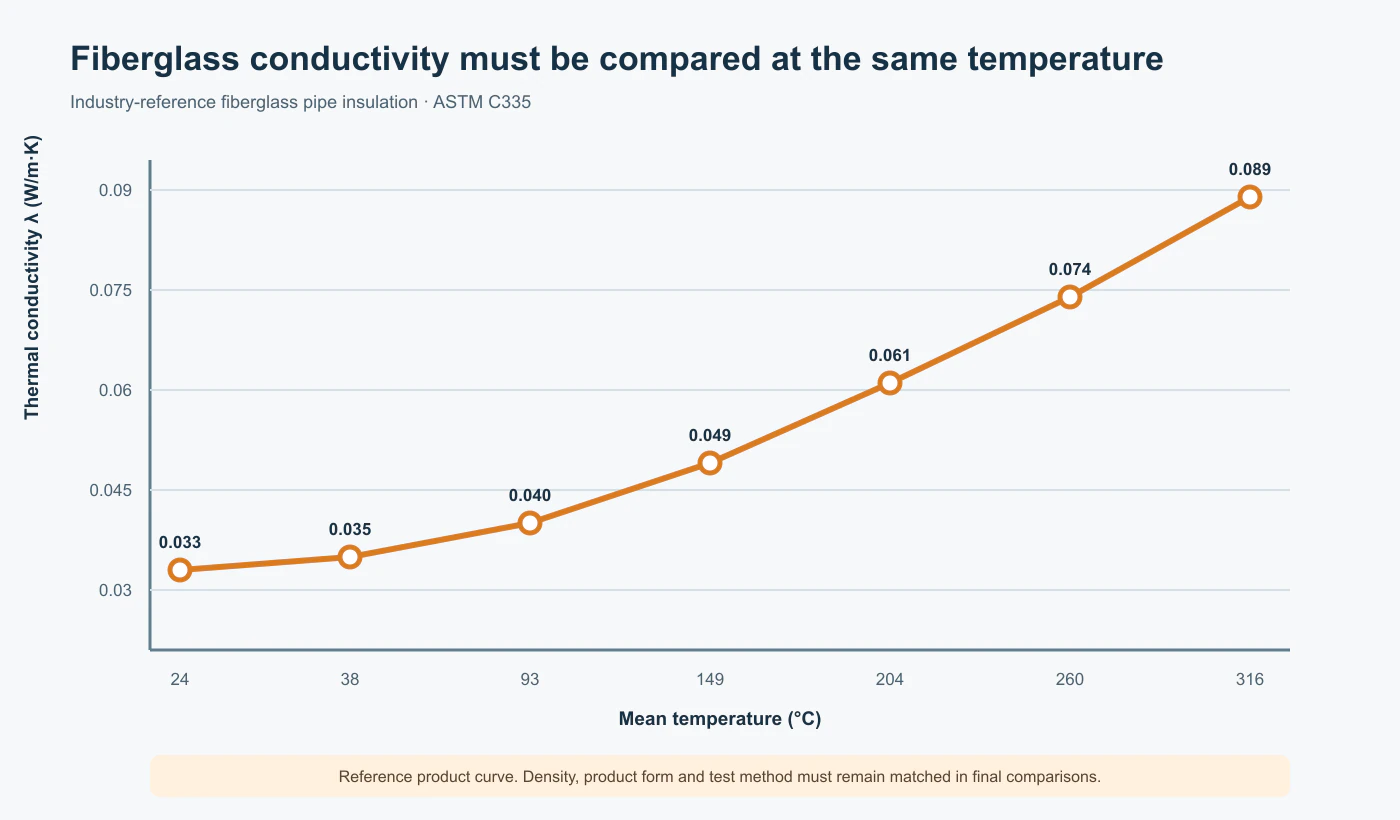
The thermal conductivity of fiberglass generally rises as the insulation's mean temperature increases. Heat transfer through the air spaces and radiation within the fibrous structure change with temperature, so a layer that performs well near room temperature may provide less thermal resistance in hotter service.
The following reference measurements concern one grade of preformed fiberglass pipe insulation tested at different mean temperatures using ASTM C335 . They illustrate the temperature trend; they are not presented as the specified conductivity curve for every Insulvora product.
| Insulation mean temperature | Thermal conductivity, W/(m·K) |
|---|---|
| 24°C | 0.033 |
| 38°C | 0.035 |
| 93°C | 0.040 |
| 149°C | 0.049 |
| 204°C | 0.061 |
| 260°C | 0.074 |
| 316°C | 0.089 |
In this example, the thermal conductivity of fiberglass increases from 0.040 W/(m·K) at 93°C to 0.061 W/(m·K) at 204°C , a rise of approximately 53% . At the same thickness, this higher conductivity means lower thermal resistance and greater conductive heat transfer, all else being equal.
Mean temperature describes the temperature condition through the insulation layer; it is not simply the fluid temperature inside a pipe. It relates to the temperature distribution between the insulation's inner and outer surfaces. Using a room-temperature conductivity value such as 0.035 W/(m·K) in a substantially hotter heat-loss calculation can therefore underestimate heat loss.
For hot-water piping and industrial equipment, use the thermal conductivity of fiberglass for the selected product grade at the relevant mean temperature, together with the actual thickness and operating conditions. The material's continuous service-temperature suitability is a separate question; see Fiberglass Insulation Temperature Rating .
What Does Conductivity Mean for Insulation Thickness?
The thermal conductivity of fiberglass alone does not determine the thermal resistance of an insulation layer. Installed thickness also matters. For two uniform flat layers , each 50 mm thick, evaluated at the same mean temperature and under otherwise identical conditions:
| Thermal conductivity | Insulation thickness | Calculated thermal resistance |
|---|---|---|
| 0.035 W/(m·K) | 50 mm | 1.43 m²·K/W |
| 0.042 W/(m·K) | 50 mm | 1.19 m²·K/W |
For a uniform flat layer, the thermal conductivity of fiberglass and the installed thickness are related by:
Here, R is thermal resistance in m²·K/W , d is thickness in metres , and λ is thermal conductivity in W/(m·K) .
At a thickness of 50 mm, the layer rated at 0.035 W/(m·K) provides approximately 20% more thermal resistance than the layer rated at 0.042 W/(m·K). Conversely, to achieve approximately 1.43 m²·K/W , a flat material rated at 0.042 W/(m·K) would need about 60 mm of thickness, compared with 50 mm at 0.035 W/(m·K) . This illustrates the trade-off between conductivity and thickness in walls, roofs, and other flat assemblies.
Round pipes require a cylindrical heat-flow calculation. Pipe diameter and the insulation's inner and outer radii affect thermal resistance, so the flat-layer equation must not be used directly to size pipe insulation. See Fiberglass Insulation R-Value for related guidance.
Factors That Affect Installed Thermal Performance
A laboratory conductivity value describes a material under stated test conditions. The thermal performance of an installed assembly also depends on whether its thickness is maintained, its joints remain continuous, and moisture is controlled.
Moisture exposure. Persistent moisture or water accumulation can impair fiberglass insulation performance. On pipes operating below ambient temperature, a continuous vapor barrier and properly sealed joints are especially important to limit moisture entry into the insulation.
Installed thickness and compression. Compressing a fiberglass roll reduces the actual installed thickness and therefore its thermal resistance, even if the material's stated conductivity remains the basis of the design calculation. The specified and installed dimensions should not be assumed to be identical where compression occurs.
Joints, supports, and penetrations. Gaps between boards, joints in pipe sections, supports, and structural penetrations can create localized heat-transfer paths. The thermal conductivity of fiberglass is one input to performance assessment, but it cannot account by itself for discontinuities in the installed system.
Choosing Fiberglass Insulation for Different Applications
For practical material selection, compare the thermal conductivity of fiberglass at the required service temperature while also considering insulation form, thickness, and installation method. Similar conductivity values do not mean that rolls, boards, and pipe sections can be substituted without considering how each is installed.
Large Roof, Ceiling, and Building Envelope Areas
Fiberglass insulation rolls are practical for roofs, ceilings, and other broad building areas that need coverage over longer runs. Their flexible format can reduce the need to fit numerous separate boards. For building insulation, the required thermal resistance and available installation space are often the main sizing considerations.
Walls, Partitions, and Assemblies Requiring Shaped Boards
Fiberglass insulation boards provide a defined shape for walls, partitions, curtain-wall cavities, and framed or supported assemblies. They can be positioned, cut, and secured where a stable board form is needed.
When greater rigidity or dimensional stability is required, high-density fiberglass insulation boards may be appropriate. Evaluate the chosen grade's conductivity, thickness, density, and fixing method together, rather than assuming that higher density necessarily gives higher thermal resistance.
Hot-Water, Mechanical, and Industrial Piping
For regular round pipes, preformed glass wool pipe insulation provides a consistent shape around the pipe and reduces the cutting and fitting required when wrapping flat insulation.
On high-temperature piping, assess insulation thickness using the pipe diameter, the thermal conductivity of fiberglass at the relevant mean temperature, and the project's heat-loss target. Protective cladding, joints, and supports also affect the finished system. For cold-service piping, account for the vapor-barrier and joint-sealing requirements described above.
Unlike many flat building assemblies, industrial piping may call for a temperature-dependent heat-loss assessment as well as attention to the pipe geometry. Product form and dimensions should therefore be confirmed against the actual project conditions before a specification is finalized.
Need Fiberglass Insulation for Your Project?
Insulvora supplies fiberglass rolls, standard and high-density boards, and preformed pipe sections. Share your application, operating temperature, target thermal performance, and required dimensions. We can review suitable product forms and available specifications against those requirements and provide a quotation.