
Pipe Insulation R Value: Calculations and Reference Data
A pipe insulation R value describes resistance to heat conduction through an insulation layer. At the same thermal conductivity and temperature, thicker insulation generally provides greater resistance. On a pipe, however, heat flows through a cylinder rather than a flat sheet, so pipe diameter and the basis used to report resistance also matter.
This pipe insulation R value reference explains the calculations, compares pipe sizes and thicknesses, and provides a calculator for applying the same equations to a chosen pipe diameter and insulation material. The values are calculation examples, not certified ratings for individual products.
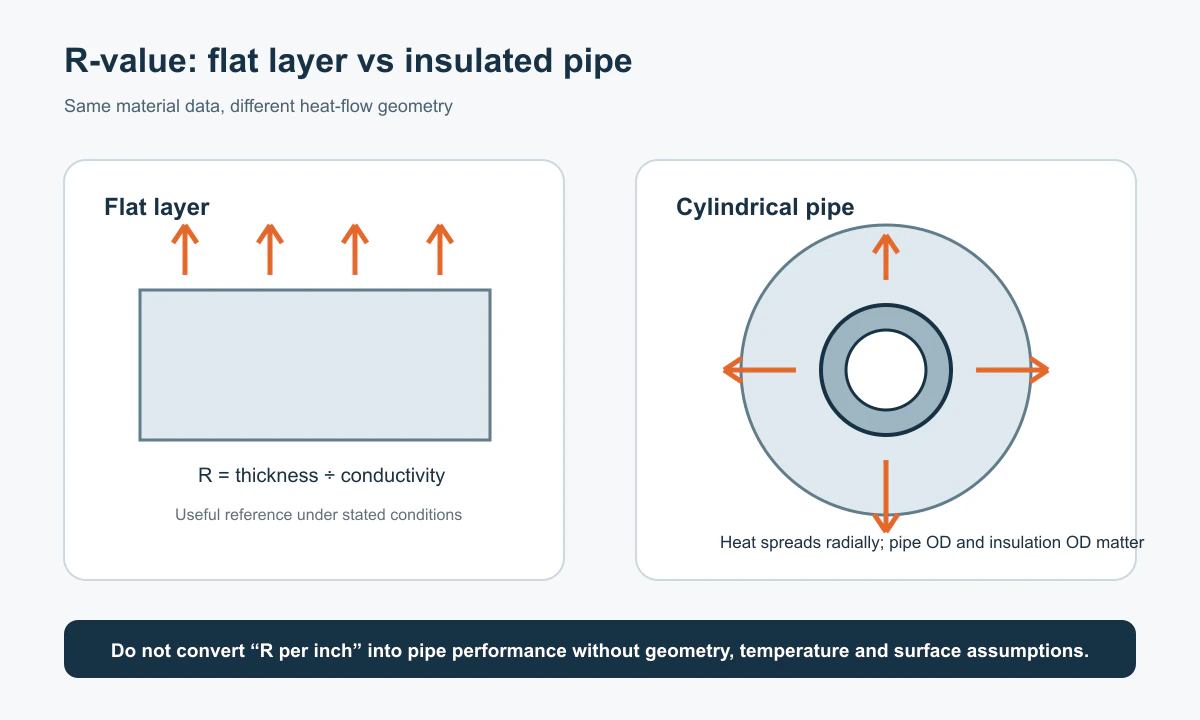
Quick flat-layer reference — assuming λ = 0.040 W/(m·K):
- 25 mm insulation: 0.625 m²·K/W, or approximately US R-3.55.
- 1 inch (25.4 mm) insulation: approximately US R-3.61.
- 50 mm insulation: approximately US R-7.10.
How Is Pipe Insulation R Value Calculated?
Thermal conductivity (λ) measures how readily heat passes through a material. At the same thickness and mean temperature, a lower conductivity produces higher resistance.
For a uniform flat layer, area-based thermal resistance is:
R = t / λ
Here R is measured in m²·K/W, t is insulation thickness in metres, and λ is thermal conductivity in W/(m·K).
For a 25 mm layer with λ = 0.040 W/(m·K):
R = 0.025 / 0.040 = 0.625 m²·K/W ≈ US R-3.55
This flat-layer pipe insulation R value is useful for comparing thicknesses and materials on a consistent area basis. It is not the cylindrical conduction resistance per metre of insulated pipe.
Why Does Pipe Diameter Change Thermal Resistance?
A cylindrical insulation layer has a greater outer surface area than inner surface area. As heat moves radially through the layer, the area available for conduction changes with radius. For steady, one-dimensional radial conduction through a uniform layer, resistance per unit length is:
Rₗ = ln[(D + 2t) / D] / (2πλ)
- D: actual outside diameter of the uninsulated pipe.
- t: insulation thickness.
- λ: insulation thermal conductivity.
- Rₗ: cylindrical conduction resistance per metre, in K·m/W.
Use the same length units for D and t. For a given conductivity and thickness, larger pipe diameters give different resistance values. A pipe insulation R value expressed per metre therefore cannot be selected from thickness alone.
Why Can R-Values in Pipe Datasheets Look Different?
Flat-layer R-values are area-based, using m²·K/W or h·ft²·°F/Btu (commonly written as US R-3, R-5 and so on). Cylindrical resistance per unit length uses K·m/W. Some datasheets instead report an area-based cylindrical value using a specified inner or outer surface area.
Before comparing a published pipe insulation R value with a project requirement, check its units, whether it is area-based or per unit length, and which surface defines the area. Values calculated on different bases cannot be compared directly.
Pipe Insulation R Value Reference: Diameter and Thickness
The examples below use a constant λ = 0.040 W/(m·K). They demonstrate the separate effects of actual pipe outside diameter and insulation thickness without assigning a verified performance rating to any particular product.
| Pipe outside diameter | Insulation thickness | Flat-layer US R-value | Cylindrical resistance per metre |
|---|---|---|---|
| 30 mm | 25 mm | R-3.55 | 3.90 K·m/W |
| 60 mm | 25 mm | R-3.55 | 2.41 K·m/W |
| 100 mm | 25 mm | R-3.55 | 1.61 K·m/W |
| 60 mm | 50 mm | R-7.10 | 3.90 K·m/W |
| 60 mm | 75 mm | R-10.65 | 4.98 K·m/W |
Assumptions: uniform insulation, constant conductivity, and steady one-dimensional radial conduction. Cylindrical figures describe the insulation layer only; they exclude pipe-wall and contact resistance, external convection, and radiation. The flat-layer and cylindrical columns use different units and must not be compared numerically.
At 60 mm pipe OD, increasing thickness from 25 to 50 mm raises cylindrical resistance from 2.41 to 3.90 K·m/W. At a constant 25 mm thickness, increasing pipe OD from 30 to 100 mm reduces the calculated resistance from 3.90 to 1.61 K·m/W.
What If the Specification Calls for R-5?
First establish what R-5 means in the specification. If it is a flat-layer US area R-value, then at λ = 0.040 W/(m·K) the theoretical thickness is approximately 35.2 mm. This is a calculated flat-layer thickness, not a universal pipe insulation thickness or necessarily a stocked size.
If R-5 is defined on a cylindrical surface-area basis, the required calculation also depends on the stated area reference and actual pipe diameter. The specified pipe insulation R value must be interpreted before it can be translated into a thickness selection. Available product sizes and operating conditions remain separate checks.
Use the pipe insulation R value calculator with thermal conductivity for the selected material at the relevant mean temperature, insulation thickness, and actual pipe OD. Select Calculate to display flat-layer SI and US R-values, cylindrical resistance per metre, and finished insulation outside diameter.
R-Value Calculator
Reference calculations only; results do not determine code-required insulation thickness or verify condensation protection.
Understanding the outputs
The flat-layer values use an area basis; cylindrical resistance is per metre of insulated pipe. Calculations assume a uniform layer, constant conductivity, and steady radial heat conduction.
When an R-Value Is Not Enough
A pipe insulation R value represents conduction resistance within the insulation. By itself, it does not establish total heat loss, outer surface temperature, or condensation performance.
Operating temperature. Thermal conductivity can vary with mean temperature. Use data relevant to the intended operating condition rather than automatically applying a value measured at another temperature.
System heat loss. For hot-water and industrial lines, fluid temperature, ambient conditions, surface characteristics, and air movement influence overall heat transfer. Insulation resistance is one input to a heat-loss assessment, not the entire assessment.
Moisture control on cold lines. For chilled-water and refrigeration piping, compare the expected outer surface temperature with the ambient dew point. Closed-cell structure, sealed joints, and continuous insulation are important alongside thermal resistance.
Calculation and test methods. ASTM C680 describes methods for calculating heat loss, heat gain, and surface temperatures under specified conditions. ASTM C335/C335M addresses steady-state heat-transfer properties of pipe insulation. These methods have different purposes.
Matching R-Value Requirements to Pipe Insulation Products
Once the required resistance basis, pipe diameter, and service conditions are known, select a suitable insulation form and check its available dimensions. Insulvora offers the following preformed pipe insulation options:
| Main application | Relevant Insulvora product | Available range and selection focus |
|---|---|---|
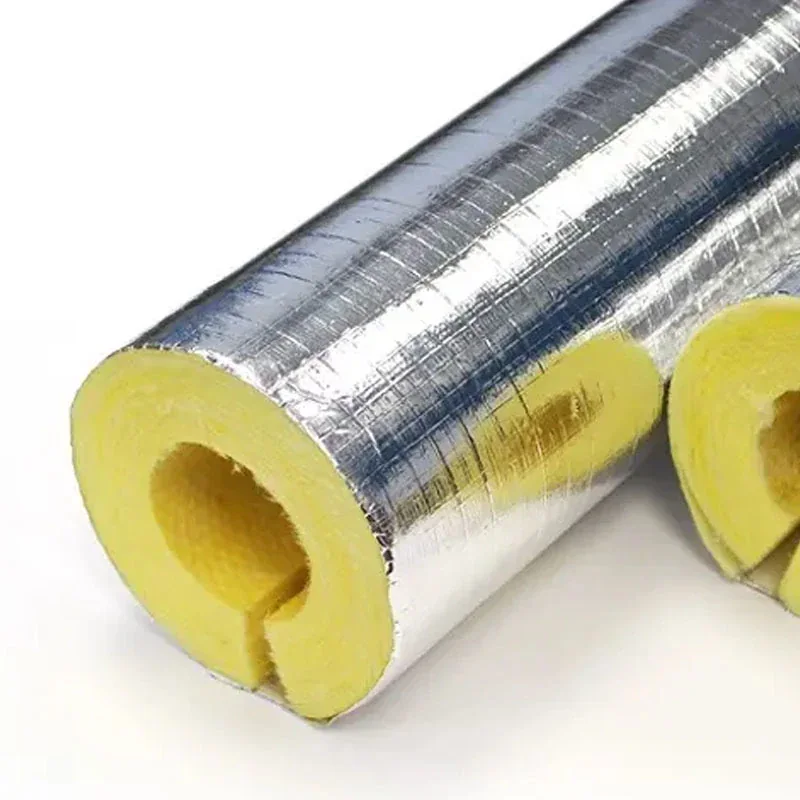
| Hot-water and suitable mechanical piping | Glass Wool Pipe Insulation | 22–720 mm internal diameter; 25–100 mm thickness. Check pipe fit and conductivity at the relevant service temperature. |
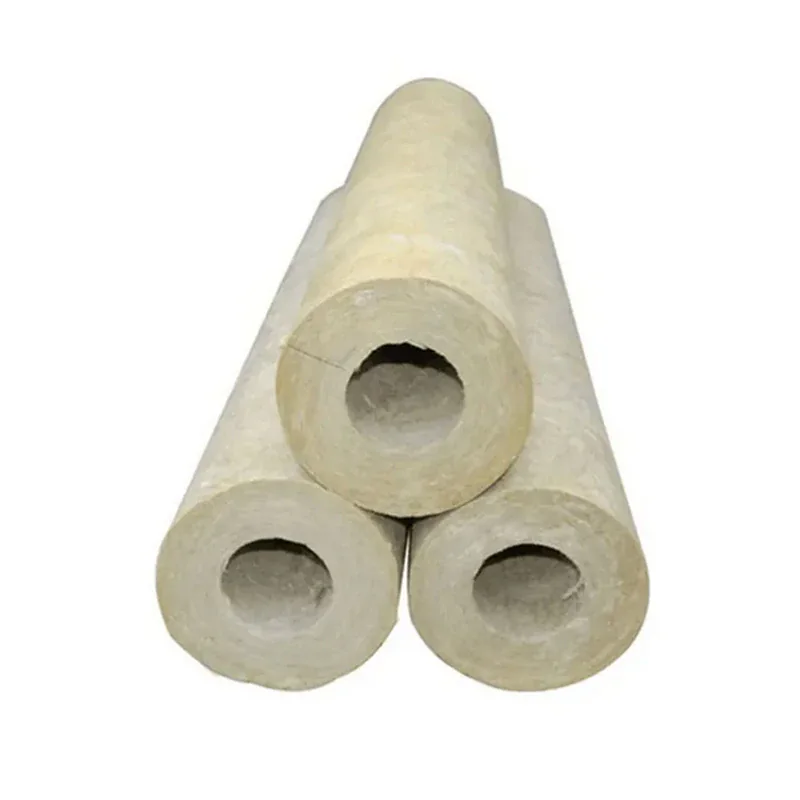
| Higher-temperature industrial and mechanical piping | Rock Wool Pipe | 22–910 mm internal diameter; 20–150 mm thickness. Confirm temperature suitability, required thickness, and protective covering where applicable. |
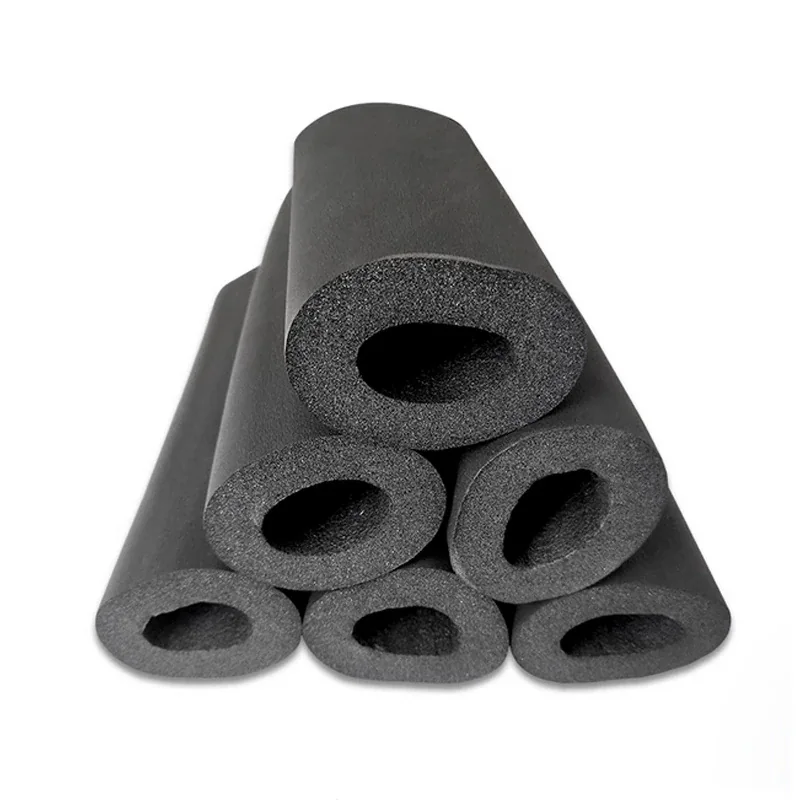
| Air-conditioning, cold-water, and suitable service lines | Slit Rubber Foam Pipe | 15, 20, 25, 30, 40, and 50 mm thickness options; internal diameters vary by option. Evaluate moisture resistance, joint sealing, and thermal performance together. |
A material category does not have one universal pipe insulation R value. Use conductivity data for the actual product and relevant temperature when checking the required resistance.
Related Technical Resources
- Pipe Insulation Thickness Chart — thickness references and selection conditions.
- Pipe Insulation Sizing Chart — pipe outside diameters and insulation size relationships.
- Pipe Insulation Specification — material properties, product dimensions, and project specification requirements.
Discuss Pipe Insulation for Your Project
Share your pipe outside diameter, operating temperature, application, preferred insulation form, and required thickness or pipe insulation R value. Insulvora can review relevant product forms, available size and thickness options, and quotation requirements for the project.