
Air Conditioning Pipe Insulation
For refrigerant copper lines, mini-split line sets, and compatible chilled-water piping, air conditioning pipe insulation typically starts with closed-cell elastomeric rubber foam tubes. Select first by pipework duty, then match the product to actual pipe outside diameter (OD), operating temperature, ambient humidity, thickness requirements, and installation exposure.
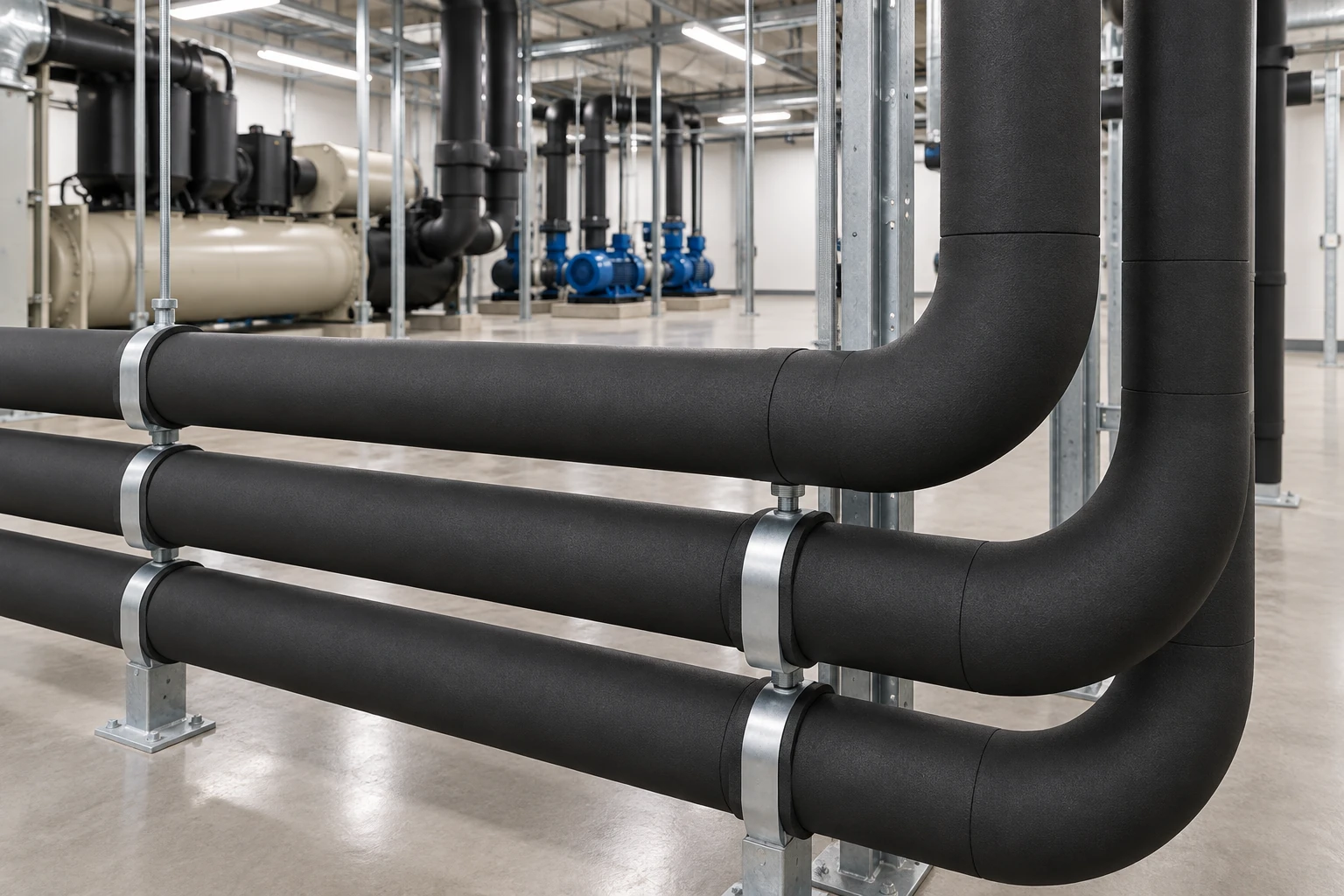
Different AC Pipework Requires Different Product Routes
Refrigerant Piping
Refrigerant circuits commonly use copper tubing, but line temperatures vary. Cold suction lines need particular attention to condensation, while other lines must be assessed against their own operating conditions. For these applications, air conditioning pipe insulation generally begins with a flexible, closed-cell elastomeric sleeve sized to the actual copper tube OD.
See Refrigerant Line Insulation for circuit conditions and condensation requirements. Confirm tube OD and insulation thickness before choosing a sleeve from the ranges below.
Mini-Split Line Sets
Mini-split and other split systems use paired refrigerant lines between indoor and outdoor units. Their routes often cross rooms, wall penetrations, and outdoor sections. Insulation must remain continuous, with appropriate protection for exposed sections. Where the paired lines use different copper diameters, specify the actual OD of each line instead of assuming both take the same sleeve size.
Flexible closed-cell tubing is a direct AC pipe insulation option for suitable copper sizes. Match sleeve ID to actual copper tube OD and confirm thickness against the project and condensation conditions. See Mini Split Line Insulation for the line-set-specific requirements.
Chilled-Water Piping
Chilled-water networks usually involve larger diameters, longer runs, and more valves, flanges, supports, and equipment connections than small refrigerant lines. Closed-cell elastomeric tubes are an initial air conditioning pipe insulation option where the available diameters and thicknesses meet the specification and continuous vapor control is needed.
Thickness, joints, supports, fittings, and service conditions must be considered together. If fibrous pipe insulation is specified instead, the assembly requires a complete vapor-control layer. Continue to Chilled Water Pipe Insulation for the larger mechanical-system route.
Conditions That Change the Final Specification
Operating temperature and ambient humidity. In air conditioning pipe insulation, condensation risk depends on the cold pipe and surrounding air. Review thickness and vapor continuity against the ambient dew-point conditions, including the exposed surface of the insulated pipe. A thickness suitable for one combination of pipe temperature and humidity should not automatically be applied to a different service condition. Where condensation is the main concern, see Pipe Condensation Insulation.
Actual pipe outside diameter. Sleeve ID must match actual pipe OD rather than an assumed nominal dimension. For air conditioning pipe insulation inquiries, provide each actual OD and the quantity required for that size.
Pipe geometry and connections. Straight runs generally suit tubular sections. Elbows, tees, valves, flanges, and equipment connections require attention to fitting arrangements and joint continuity.
Indoor and outdoor exposure. Indoor cold pipes require heat-gain and moisture control. Outdoor runs also face UV, rain, and physical damage; confirm external protection for the project. For AC pipe insulation passing from indoors to outdoors, both insulation continuity and environmental protection matter.
Insulvora Rubber Foam Tube Ranges
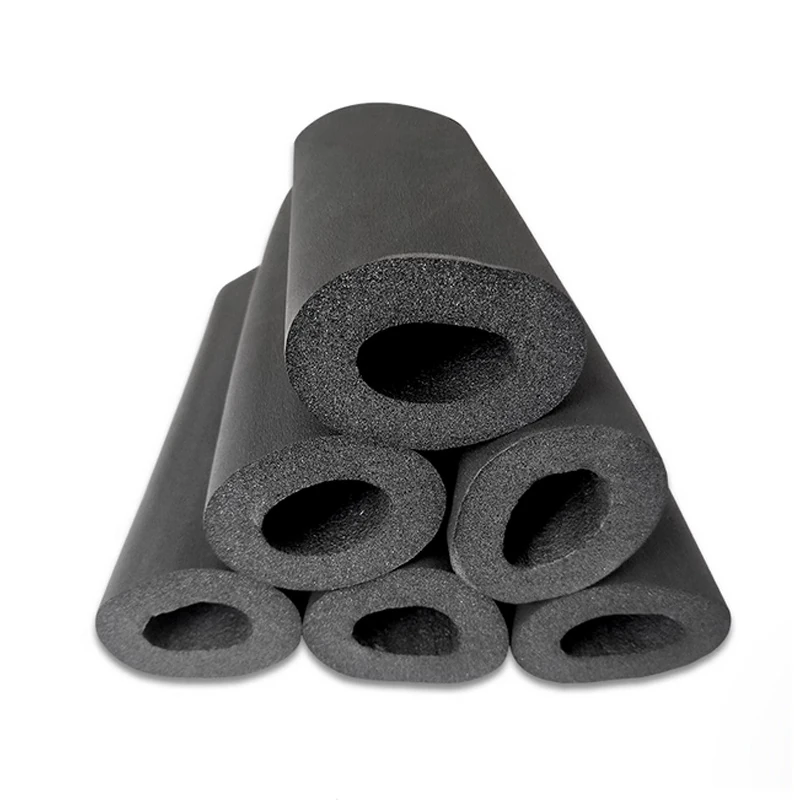
Insulvora supplies closed-cell NBR/PVC rubber foam tubes for relevant cold-service applications. For smaller copper lines, AC Copper Pipe Insulation Sleeve covers approximately 6–32 mm internal diameter (ID), with 8 mm and 15 mm insulation thicknesses. For air conditioner pipe insulation orders, match these sleeves to the actual copper tube OD and confirm that the required thickness falls within this range.
For larger copper and mechanical pipes, Rubber Foam Pipe Insulation extends to approximately 110 mm ID, with multiple insulation thicknesses from 15–50 mm. Match each OD and thickness to the available range, listing quantities separately for mixed-size projects. Available internal diameter alone does not establish suitability; specified thickness and service conditions also need confirmation. These are distinct air conditioning pipe insulation routes for small copper lines and larger mechanical pipes.
Confirm density, thermal conductivity, service temperature, fire performance, and facing options against product information and project requirements, including broader HVAC pipe insulation specifications.
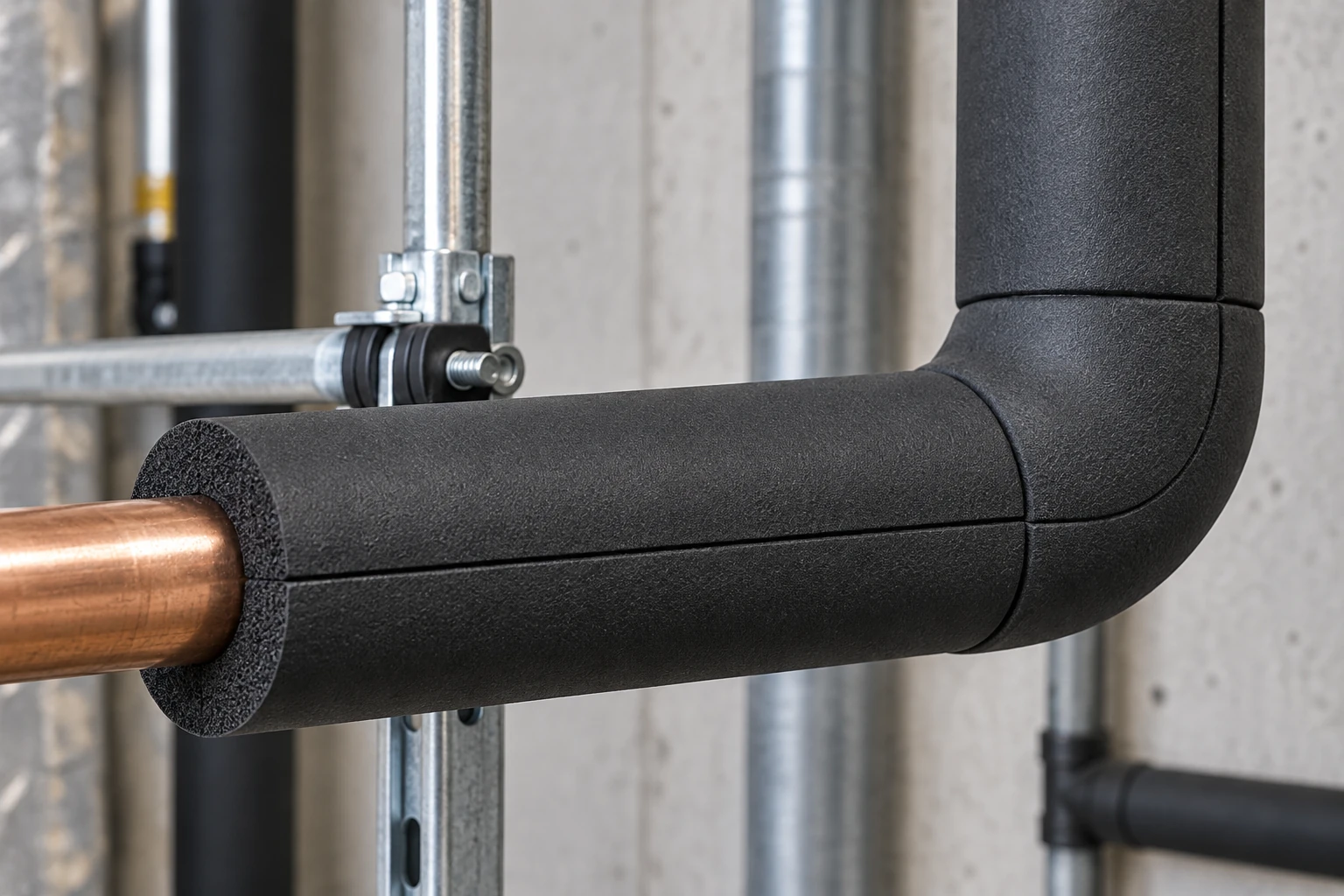
System Weak Points Are Usually at Joints and Transitions
Selecting the correct tube size is only part of a complete air conditioning pipe insulation system. Longitudinal seams, butt joints, elbows, valves, supports, penetrations, and equipment interfaces are vulnerable when insulation or vapor-control continuity is interrupted.
Open seams can admit humid air to cold surfaces and cause local condensation. Supports involve structural loads, while exposed metal or interrupted coverage may create thermal bridges. Address these details as part of the assembled system.
At indoor-to-outdoor transitions, maintain insulation and vapor continuity while adapting exterior protection to the exposure. For more detailed guidance, consult Pipe Insulation Vapor Barrier, Pipe Insulation Installation, or Pipe Condensation Insulation, according to the issue being resolved.
Send Pipe Conditions for Specification Confirmation
For air conditioning pipe insulation matching, send pipe duty, actual OD by size, operating temperature, location, specified thickness (if any), and quantities. Include known humidity or condensation concerns. Insulvora can confirm suitable tube options, dimensions, and supply requirements for a project or bulk quotation.