
Pipe Insulation for Condensation | Cold-Pipe Control & Selection
Pipe insulation for condensation has to address two issues: keeping the outer insulation surface above the design dew point and limiting humid air from reaching colder areas through joints, fittings, supports, and penetrations. For cold water, chilled water, refrigerant, air-conditioning, condensate, and other below-ambient piping, operating temperature, ambient temperature, relative humidity, and actual pipe outside diameter affect the final insulation configuration.
For common round cold pipes and HVAC piping, closed-cell NBR/PVC elastomeric pipe insulation is often one of the first product forms to evaluate for pipe insulation for condensation. Final insulation ID, thickness, facing, and additional protection are then confirmed against the service condition and installation environment rather than pipe size alone.
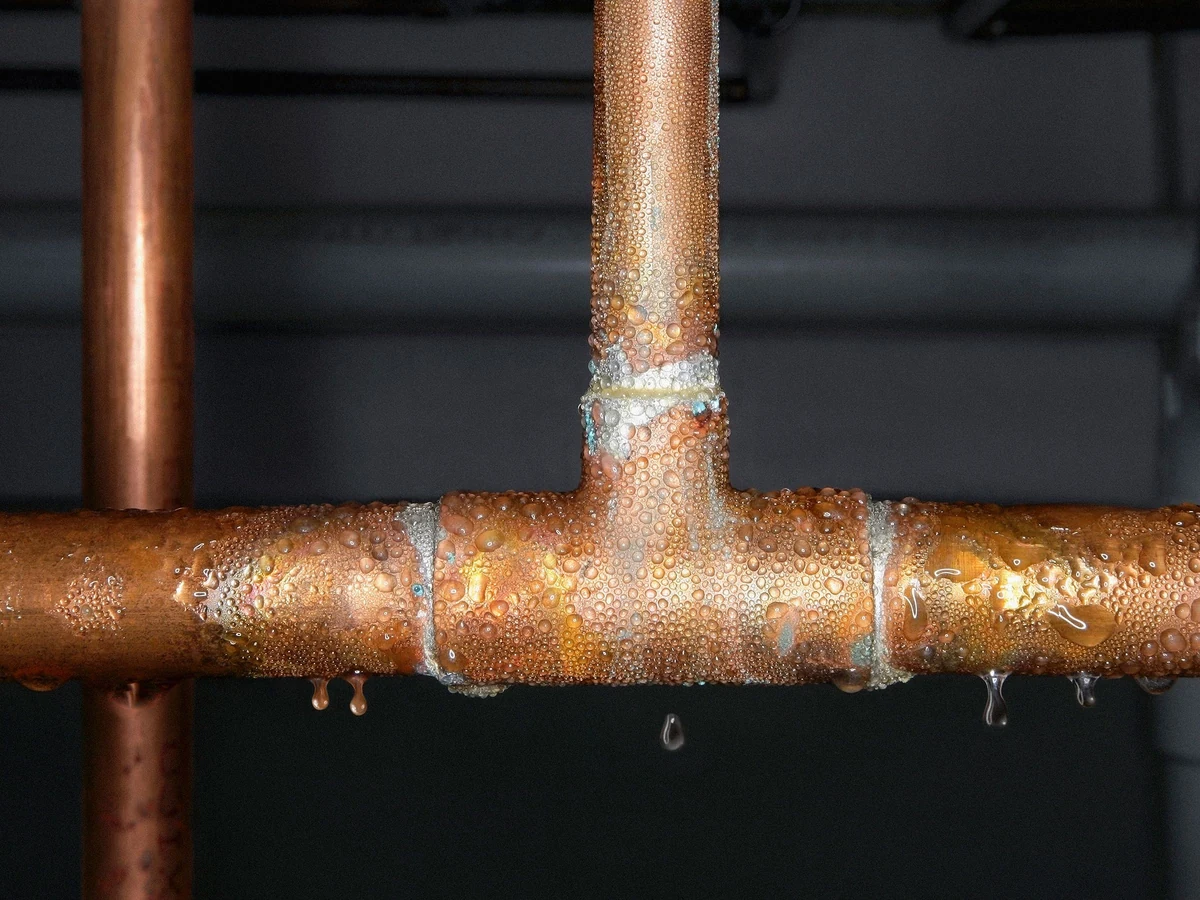
Start With the Actual Operating Condition
Pipe insulation for condensation starts with the relationship between pipe or fluid temperature and the ambient dew point. As operating temperature falls, or as ambient temperature and relative humidity rise, more thermal resistance is required to maintain a safe surface-temperature margin above the dew point.
Actual pipe OD and insulation thickness should be confirmed separately. For pipe insulation for condensation, a nominal pipe size alone is not enough. The insulation ID determines whether the pipe section fits correctly, while insulation thickness affects outer-surface temperature. Mechanical rooms, ceiling spaces, high-humidity areas, and outdoor locations may also require different design assumptions because the surrounding conditions are not the same.
This distinction matters at the purchasing stage. A pipe section can match the nominal pipe size but still be unsuitable if the required thickness or service condition is different. The pipe dimensions and the condensation-control requirement therefore need to be checked together.
Surface Condensation and Moisture Ingress Are Different Problems
With pipe insulation for condensation, surface condensation normally indicates that the insulation surface has fallen below the ambient dew point because the thermal resistance is insufficient for the design condition.
Moisture ingress is different. Even when the nominal thickness is adequate, humid air can still reach colder areas if longitudinal seams, butt joints, terminations, supports, or penetrations lose continuity.
Moisture can then develop within the insulation system or near the pipe surface without appearing as uniform sweating along the full straight run. For that reason, pipe insulation for condensation cannot be solved by adding thickness alone. Thickness controls surface temperature, while continuous sealing and vapor control limit moisture movement into colder parts of the system. Both need to remain effective, and a failure in one cannot simply be compensated for by the other.
Conditions That Change the Final Configuration
| Project condition | Effect on product or system selection |
|---|---|
| Lower operating temperature | Recheck the applicable product range and required insulation thickness |
| Higher ambient temperature or relative humidity | Higher dew point and greater demand on surface-temperature margin and joint continuity |
| Different pipe outside diameter | Match the correct insulation ID first, then confirm thickness |
| More elbows, valves, flanges, and reducers | Continuity at fittings becomes more critical than on simple straight runs |
| More supports and hangers | Avoid local compression, exposed cold surfaces, and breaks in vapor control |
| Outdoor installation | Condensation control must be combined with separate weather, UV, and mechanical protection |
| Condensate drain piping | Condensate pipe insulation should be selected from actual temperature and ambient conditions, not from the pipe service name alone |
For pipe insulation for condensation, these conditions often occur together. A low-temperature line in a humid environment with multiple fittings places greater demands on the insulation system than a simple indoor straight run. In practice, the product form, thickness, and treatment of local details have to reflect the combined condition rather than any one input considered on its own.
For outdoor service, condensation control and external protection should also be treated as separate requirements. Keeping the insulation system dry does not remove the need for suitable weather and mechanical protection around the finished assembly.
Primary Product Route and Available Forms
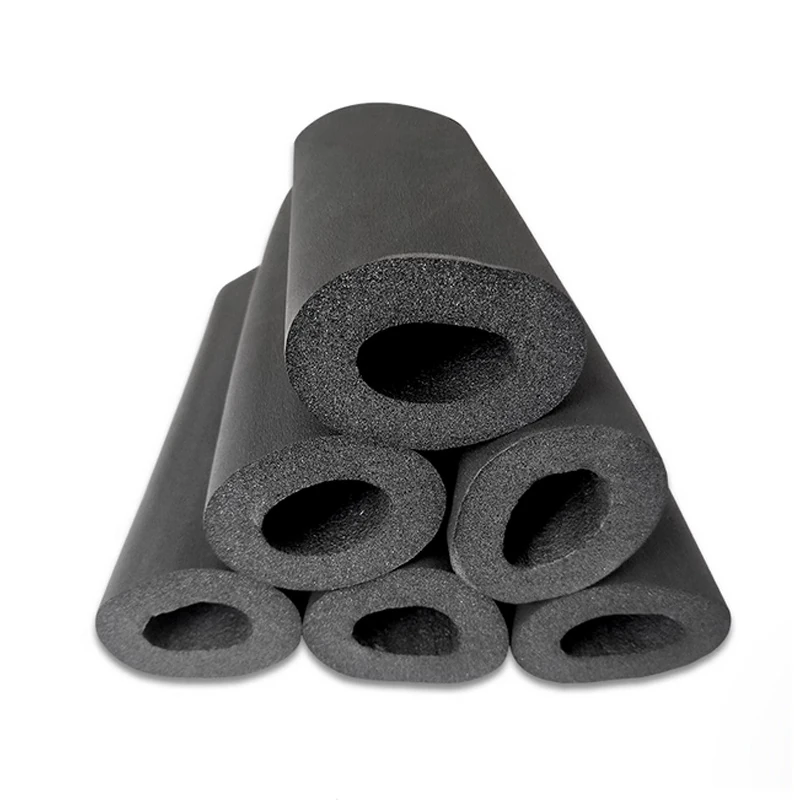
For common cold-pipe systems, pipe insulation for condensation is normally evaluated first with closed-cell NBR/PVC elastomeric pipe insulation. Insulvora supplies preformed rubber foam pipe sections in multiple ID and thickness combinations. Current product series include thicknesses of 15, 20, 25, 30, 40, and 50 mm, with selected series covering approximately 10–110 mm ID. Exact combinations depend on the product series.
Slit pipe sections are available where an open longitudinal seam is needed for installation. Foil-faced versions are also available when an additional surface layer is specified. The foil facing is part of the product configuration, but it should not be treated by itself as a complete vapor-control or outdoor-protection system.
Some projects use fibrous insulation instead. In those cases, pipe insulation for condensation has to be evaluated together with a continuous vapor-retarder, jacket, and sealed joint system. Fibrous insulation and closed-cell elastomeric insulation are not interchangeable simply because both provide thermal resistance. The selected route has to suit the operating temperature, ambient moisture condition, pipe size, geometry, and required protection.
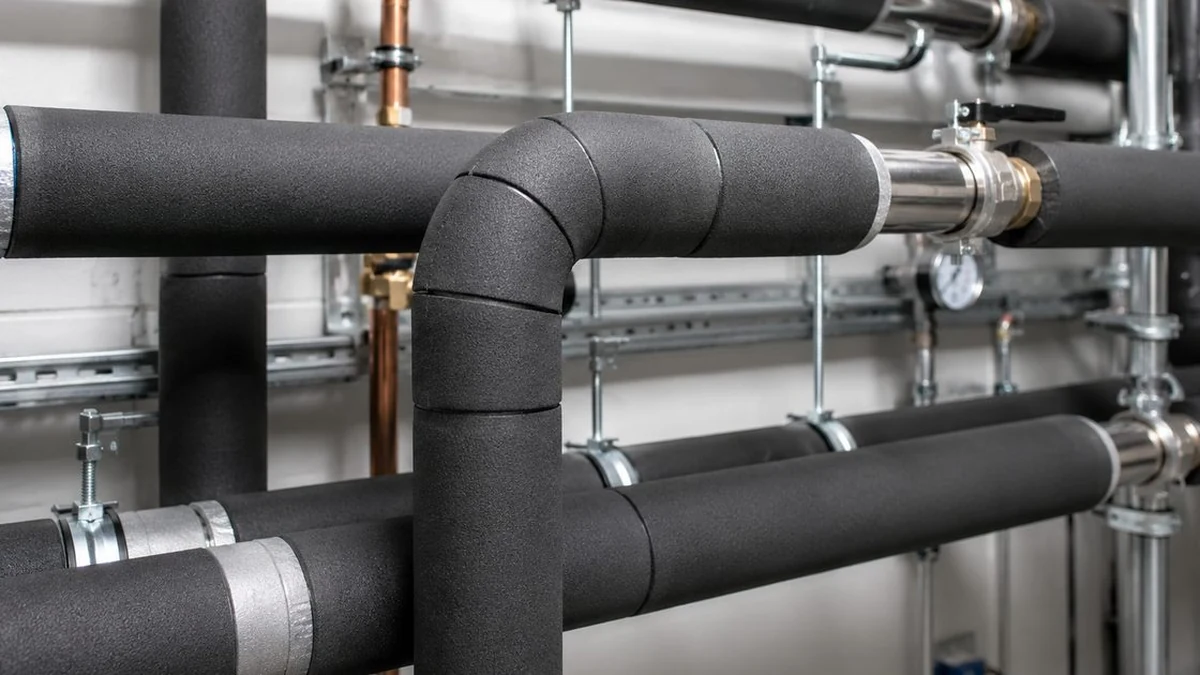
Where Condensation Problems Commonly Appear
Local failures in pipe insulation for condensation often appear away from straight pipe runs. Longitudinal seams, butt joints, elbows, valves, flanges, reducers, supports, hangers, and wall penetrations can create thermal bridges, vapor paths, or areas of compressed insulation.
Terminations, maintenance access points, damaged outer protection, and indoor-to-outdoor transitions also deserve attention. If condensation is concentrated around one joint, support, or valve, the first step is to check for a local seam failure, compression, thermal bridge, or damaged protection before concluding that the entire line has insufficient insulation thickness.
This is an important distinction in pipe insulation for condensation: the system has to remain continuous across both straight runs and local details, not simply meet a nominal thickness on the pipe body.
Continue With the Relevant System
For air-conditioning piping, continue to Air Conditioning Pipe Insulation. Refrigerant lines should be checked under Refrigerant Line Insulation, where low operating temperature, copper tube size, ambient humidity, and joint conditions become more specific. Chilled-water systems can continue to Chilled Water Pipe Insulation for operating temperature, pipe size, and system configuration, while general cold-water service can be reviewed under Cold Water Pipe Insulation.
Condensate pipe insulation should still be confirmed from actual water temperature, ambient humidity, and condensation risk. Where the main question is insulation thickness, vapor control, or installation detailing, continue to Pipe Insulation Thickness, Pipe Insulation Vapor Barrier, or Pipe Insulation Installation.
The Elastomeric & Rubber Foam and Rubber Foam Pipe Insulation product pages provide the specific pipe-section forms, IDs, thicknesses, and facing options needed to complete pipe insulation for condensation selection. Once the application route is clear, these product pages are the appropriate place to confirm the available specification before quotation.
Confirm the Cold-Pipe Insulation Requirement
Explore closed-cell pipe insulation for condensation-sensitive cold piping. Contact Insulvora to discuss suitable product options and request a project or bulk-supply quotation.