
Low Thermal Conductivity Insulation: Material Performance and Selection
Low thermal conductivity insulation reduces heat flow through a given thickness. When temperature and test conditions are comparable, a lower thermal conductivity (λ) means higher material-layer thermal resistance. For an installed system, service temperature, space, moisture exposure and product form also affect the result.
This guide compares exceptionally low-conductivity materials with conventional insulation products, then examines temperature-dependent values, thickness calculations and practical selection for pipes, HVAC systems and building assemblies. The objective is to select low thermal conductivity insulation that performs under the project's conditions—not simply the product with the smallest quoted number.
Three checks before comparing products:
- Match the dataCompare mean temperature, units and test method.
- Match the serviceConfirm temperature limits, moisture exposure, fire requirements and mechanical protection.
- Calculate the layerUse conductivity and required thermal resistance to estimate thickness; check installed-system effects separately.
Which Insulation Materials Have the Lowest Thermal Conductivity?
Some vacuum insulation panels (VIPs) report initial center-of-panel thermal conductivity values of approximately 0.003–0.007 W/(m·K). Certain aerogel composite blankets achieve around 0.014–0.021 W/(m·K) near room temperature. These products can provide substantial thermal resistance where thickness is restricted, making them important reference points when evaluating the lowest thermal conductivity insulation.
Their installed performance requires qualification. A VIP relies on an intact sealed envelope; cutting or puncturing it compromises the vacuum. Panel edges, aging and available dimensions also matter. Aerogel blanket performance and protection requirements vary with product construction and service temperature. Consequently, the lowest thermal conductivity insulation material is not automatically the best practical or economic choice.
For common building, HVAC and industrial work, low thermal conductivity insulation is also available as closed-cell elastomeric foam, fiberglass and rock wool. Their conductivity ranges can overlap, so a material-family label alone does not establish which specific product performs better. The next table identifies Insulvora's supplied forms; application-specific choices follow later.
Low Thermal Conductivity Insulation: Product Reference Values
Insulvora supplies low thermal conductivity insulation in seven product forms. The values below are reference figures for initial shortlisting, not a ranking of products tested under identical conditions.
| Product and form | Thermal conductivity, W/(m·K) | Typical application direction |
|---|---|---|
| NBR/PVC closed-cell slit rubber foam pipe | ≤0.034 at 0°C | Air-conditioning, water and compatible cold-service piping |
| Fiberglass pipe insulation | 0.035–0.042 | Mechanical, hot-water and industrial piping |
| Rock wool pipe sections | 0.035–0.042 | Industrial, heating and mechanical pipe systems |
| Fiberglass insulation roll | 0.035–0.042 | Roofs, walls and large-area building insulation |
| Fiberglass insulation board | 0.035–0.042 | Walls, roofs, partitions and fixed-board assemblies |
| Rock wool board | 0.038–0.042 | Building envelopes and industrial equipment |
| Rock wool blanket | 0.035–0.045 | Industrial equipment, curved surfaces and large-area coverage |
Comparison note: The rubber foam figure is specified at 0°C, while the other figures are product-family ranges. They must not be interpreted as directly comparable values at a common mean temperature. Fiberglass and rock wool have no fixed conductivity ranking across all grades: density, fiber structure and test temperature influence the results. For product-specific context, see Fiberglass Thermal Conductivity.
The table helps identify low thermal conductivity insulation by supplied form; the required grade and reference temperature should be checked before specifying thickness.
How Temperature Affects Low Thermal Conductivity Insulation
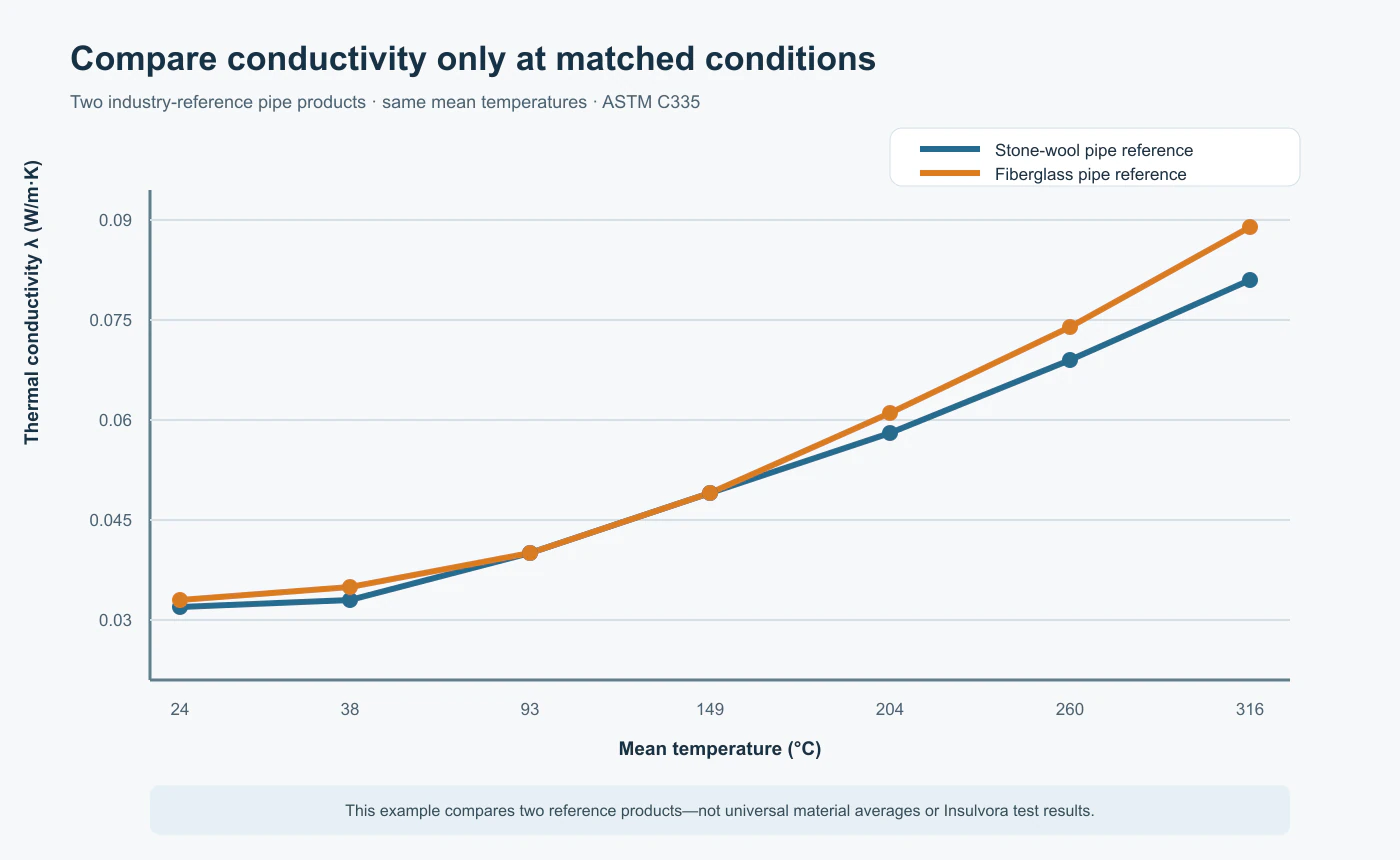
Low thermal conductivity insulation does not have one fixed conductivity value at every operating temperature. For most conventional fibrous insulation, it increases as mean temperature rises, so room-temperature figures can understate heat transfer in hot industrial service. Comparing low thermal conductivity insulation for those systems requires data at relevant temperatures.
The following published reference values describe two specific pipe-insulation products tested to ASTM C335 at the same mean temperatures. They show temperature dependence; they do not establish a universal ranking of fiberglass and rock wool.
| Mean temperature | Rock wool pipe reference, W/(m·K) | Fiberglass pipe reference, W/(m·K) |
|---|---|---|
| 24°C | 0.032 | 0.033 |
| 93°C | 0.040 | 0.040 |
| 204°C | 0.058 | 0.061 |
| 316°C | 0.081 | 0.089 |
These values describe the two reference products, not every grade in either material family. The selected insulation product and complete system must be suitable for the intended service temperature.
At 93°C, both reference products have the same conductivity. At 316°C, both values are substantially higher, with a wider difference between them. This is why the lowest thermal conductivity insulation value measured at one temperature does not guarantee the same relative performance at another.
For hot pipes, use the selected grade's conductivity data over its operating range. Mean temperature through the insulation depends on the pipe or equipment surface, outer-surface temperature and heat-transfer conditions. Where that temperature range is large, evaluating conductivity across the layer is more appropriate than relying on a single ambient-temperature figure.
How Much Thickness Can Low Thermal Conductivity Insulation Save?
Low thermal conductivity insulation may reduce the thickness needed for a specified material-layer thermal resistance. Consider two uniform, flat insulation layers, each 25 mm thick, with conductivity values of 0.034 and 0.040 W/(m·K) at the same temperature. The relationship is:
R = d / λ
Here, R is material-layer thermal resistance in m²·K/W, d is thickness in metres and λ is thermal conductivity in W/(m·K).
- At λ = 0.034 W/(m·K), R = 0.025 / 0.034 ≈ 0.735 m²·K/W.
- At λ = 0.040 W/(m·K), R = 0.025 / 0.040 = 0.625 m²·K/W.
For equal thickness and temperature difference, the lower-conductivity layer transmits approximately 15% less heat through the material itself. To match the resistance of 25 mm at λ = 0.034 W/(m·K), the material with λ = 0.040 W/(m·K) would require approximately 29.4 mm thickness.
This calculation is for a uniform flat layer—not a complete wall, roof or pipe assembly. Pipe insulation has a cylindrical resistance relationship involving inner and outer radii, so the same thickness ratio is not a complete pipe heat-loss calculation. See Pipe Insulation R-Value for the pipe-specific method.
Thermal bridges and discontinuities mean installed performance can differ from material-layer calculations. The following application guidance addresses those conditions in more detail when selecting low thermal conductivity insulation.
Choosing Low Thermal Conductivity Insulation for Different Applications
Cold Pipes and HVAC: Insulation with Vapor Control
On chilled-water lines, air-conditioning pipework and compatible refrigeration services, low thermal conductivity insulation must reduce heat gain while helping control moisture migration toward cold surfaces. Closed-cell elastomeric foam is often a practical option where both functions are required.
Insulvora's NBR/PVC slit rubber foam pipe is a preformed sleeve offered in multiple inside diameters and 15–50 mm insulation thicknesses, for compatible pipe sizes and service temperatures. These dimensions allow the selected sleeve to be matched to pipework and the project's insulation target.
Low thermal conductivity insulation on cold-service pipes must remain continuous at seams and fittings, particularly when pipe temperatures are below the surrounding air's dew point. Low thermal conductivity insulation alone cannot prevent condensation if moisture enters through discontinuities or the external surface remains below the dew point. Thickness, surface-temperature control and vapor detailing must be considered together.
Hot-Water and Industrial Pipes: Conductivity at Service Temperature
For hot-water and industrial lines, low thermal conductivity insulation should be selected by product grade, form and actual working temperature. Insulvora supplies preformed fiberglass pipe insulation with 22–720 mm inside diameters and 25–100 mm thicknesses, and rock wool pipe sections with 22–910 mm inside diameters and 20–150 mm thicknesses. Both forms provide a defined bore and thickness for straight pipe runs.
Rock wool is commonly considered for higher-temperature industrial duties, while fiberglass pipe sections are used in mechanical services within the specified grade's temperature rating. As shown by the temperature comparison above, product-specific conductivity data is more useful than a nominal room-temperature figure when evaluating low thermal conductivity insulation for hot service.
External jackets, fixings, weather exposure and mechanical protection must be considered within the installed system. For larger equipment, tanks and curved surfaces, a flexible rock wool blanket or another compatible format may be more suitable. See Industrial Thermal Insulation for related application details.
Roofs and Walls: Match Conductivity to the Assembly
For roofs and walls, low thermal conductivity insulation must fit the cavity, framing and installation depth while meeting the thermal target. Fiberglass insulation roll provides flexible coverage for roof areas, ceilings and framed cavities. Fiberglass insulation board suits assemblies requiring defined panel dimensions. Rock wool board is an option for compatible building and industrial-building assemblies where thermal, acoustic and specified fire-performance needs are considered together.
Insulvora's fiberglass rolls are available in 25–100 mm thicknesses, and rock wool boards in 30–150 mm. The selected low thermal conductivity insulation product should fit the available depth without compromising the intended installed thickness.
A material's conductivity does not, by itself, determine the overall U-value of a roof or wall. Metal framing, purlins and other thermal bridges affect heat flow, while compressing flexible insulation reduces thickness and thermal resistance. For related assemblies, see Roof & Thermal Insulation and Roof Insulation.
For continuously operating systems, a low thermal conductivity insulation comparison should account for more than material price per unit. Required thickness, installation work, joints and supports, protective cladding, maintenance and operating energy use can all affect the practical result and total project cost. The lowest thermal conductivity insulation option is not necessarily the lowest-cost installed solution over its service life.
Discuss Your Insulation Requirements with Insulvora
Insulvora supplies low thermal conductivity insulation in elastomeric foam, fiberglass and rock wool forms for HVAC, building and industrial applications. Share your operating temperature range, installation environment, pipe or assembly dimensions, thermal target and preferred product form. We can review suitable available specifications and thickness options and confirm applicable pricing in a quotation.